every image has been made by me, with equipment i own and have configured, and with data i have painstakingly collected and carefully analysed and processed.
no commercial datasets or rented instruments are used.
every print is professionally made to archival standards on your choice of metal, acrylic, or fine art paper in formats that do justice to the detail and scale of the image.
prints are available from 12" to 40" on the long edge. made to order, and shipped worldwide.
every print has all watermarks removed, and is signed and numbered for authenticity.
for pricing and shipping quotes, use the contact page. i'll aim to respond within two working days, unless i’m out imaging!
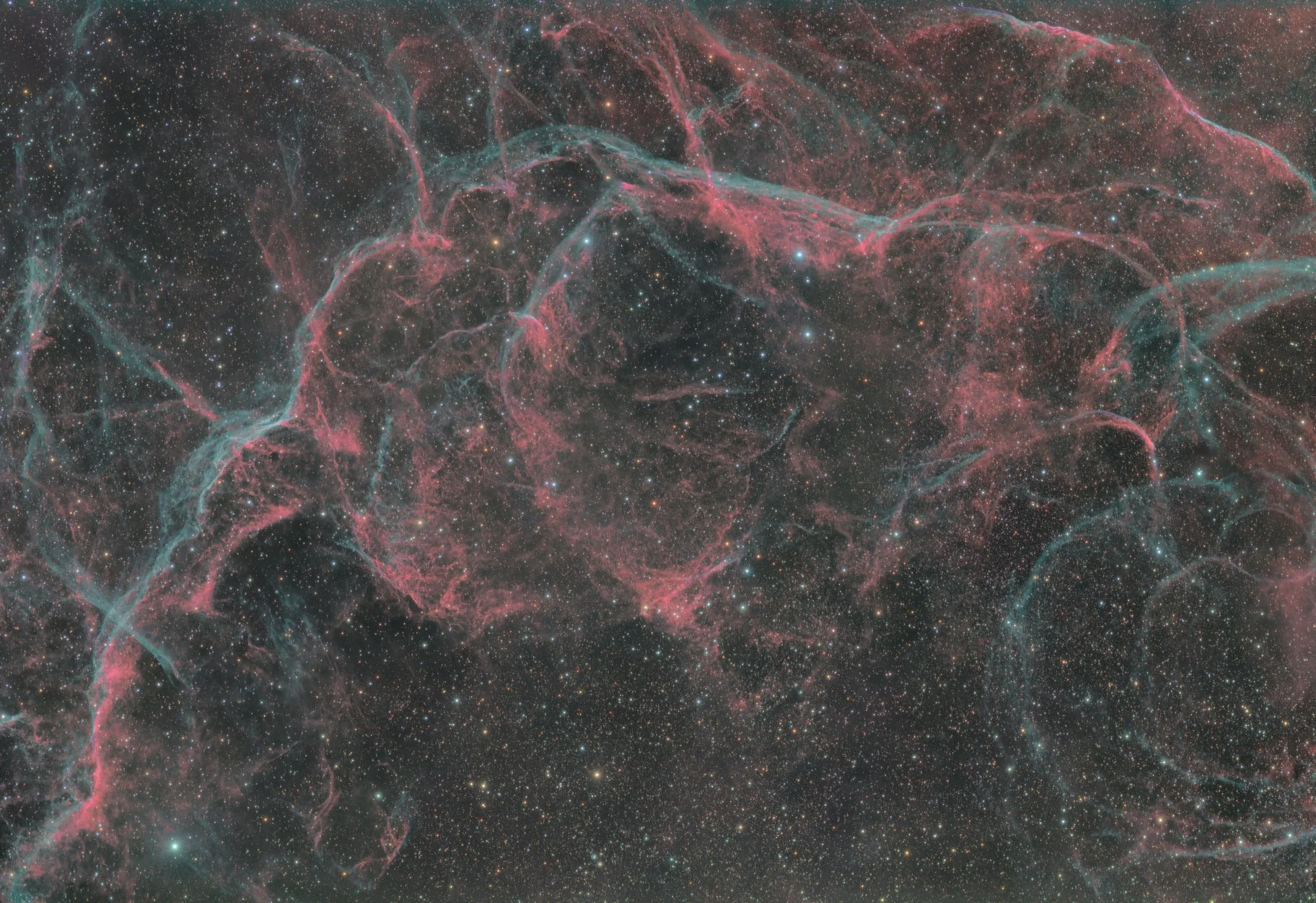
Vela Supernova Remnant I — The Bones of a Dead Star
Constellation Vela — The Sail of the Argo | HOO Palette | ~815 light years
This is what a star looks like, eleven thousand years after it died.
The Vela Supernova Remnant is the optical remains of a star that exploded roughly 11,000 years ago, about 815 light years from our Sun — one of the closest supernova remnants to our Solar System. The star that created this wreckage may have been among the most extreme objects the universe produces: recent research suggests the Vela SNR's progenitor may have been a Wolf-Rayet star — a stellar monster so luminous and so hot that it sheds its own outer layers in a ferocious stellar wind before finally destroying itself completely. What remained after that destruction is what you see here: the bones.
This panel captures one of the most rewarding and complex regions of the remnant — a dense, turbulent knot of overlapping shock fronts where the filaments pile upon each other in extraordinary detail. In this HOO narrowband palette, hydrogen glows deep rose and red marking the densest, most energetically compressed regions of the shock, while oxygen traces the broader expanding shell in teal — the cooler outer wavefront of a star's final, still-travelling exhale. The filaments are not gas in the conventional sense. They are shockwaves — the physical leading edge of the explosion itself, still ploughing through the interstellar medium millennia after the event that created them, compressing and heating everything they encounter into glowing plasma threads that stretch across light years of space.
The constellation Vela represents the sail of the Argo — the mythical ship of Jason and the Argonauts. It is a fitting home for this object. These filaments are themselves a kind of sail, catching the interstellar wind, driven forward by an energy released before human civilisation existed.
21 hours 56 minutes integration | Kagga Kamma Remote Observatory, Cederberg Mountains, South Africa | Bortle 1 | Tele Vue 76mm at f/5 | HOO narrowband
Available as:— Metal print — the recommended format for this image. the rose and teal palette has exceptional luminosity on a reflective surface.— Acrylic print — exceptional depth and colour saturation— Fine art paper — archival giclée, satin or matte finish
Sizes from 12" to 40" on the long edge. Made to order.
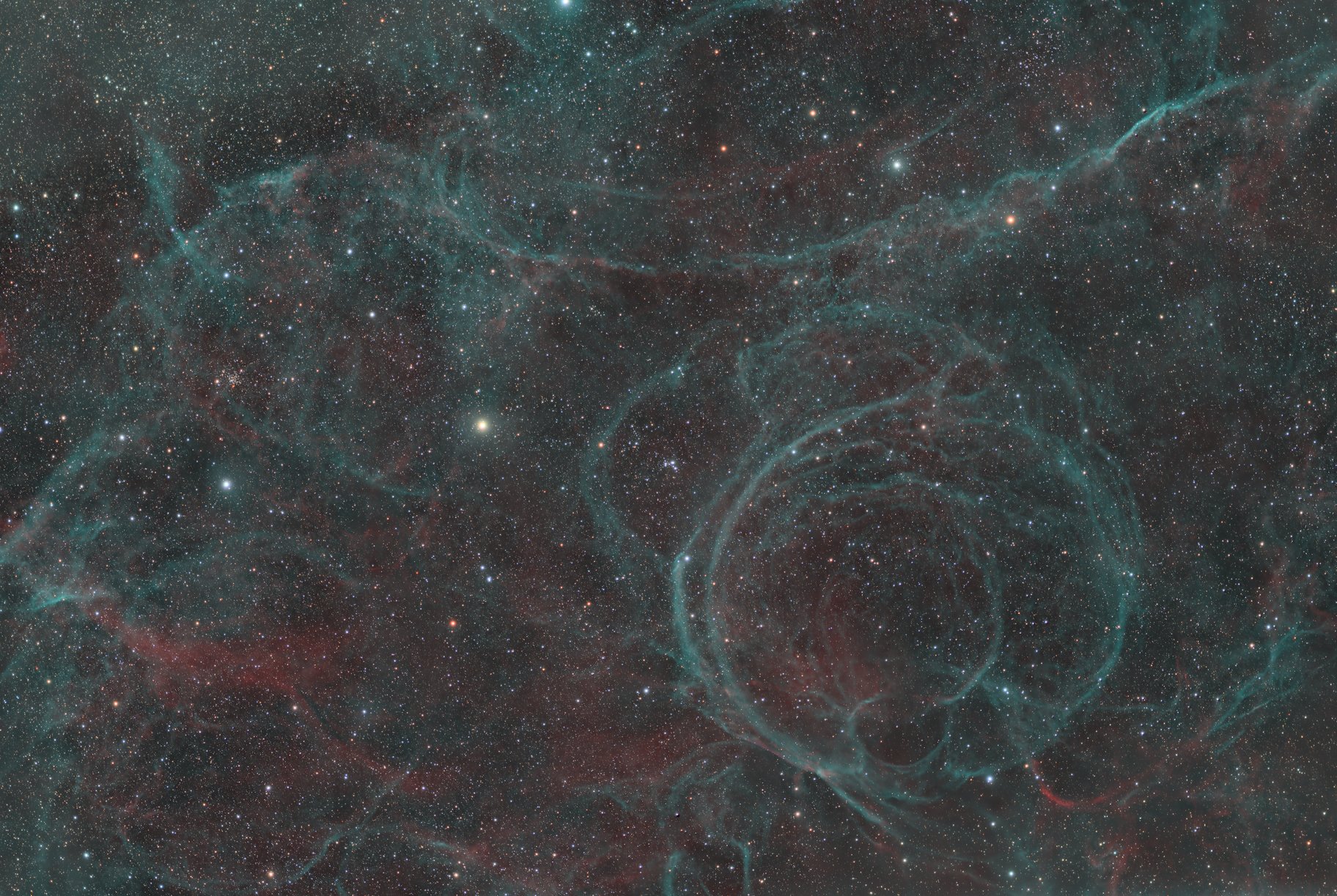
Vela Supernova Remnant II — The Wave
Constellation Vela — The Sail of the Argo | SOO Palette | ~815 light years
The same star. The same explosion. An entirely different face.
Where the first panel of this remnant shows turbulence and density, this one offers something rarer and more unsettling — geometry. The defining feature of this image is the extraordinary circular loop structure dominating the lower right of the frame: a near-perfect coiling ring of shock front whose curvature is so precise it looks almost constructed, almost intentional. It is neither. It is pure physics — a shockwave encountering a region of interstellar medium with particular density characteristics, causing the expanding shell to curl back on itself in a structure that has persisted for thousands of years as the explosion propagates around it.
In this SOO narrowband palette, sulphur traces the hottest compressed shock regions in deep red, while oxygen — mapped to both green and blue channels — dominates the frame in luminous teal, giving this image a cooler, more ethereal character than its companion panel. The filaments are highly polarised structures with magnetic fields directed along them — meaning what you see here is not just the shape of an explosion, but the signature of magnetic fields threading through the interstellar medium, sculpted by the passage of a shockwave over eleven millennia.
The filaments in this panel are more ordered than in the densest regions of the remnant — more legible, with a sense of sweeping motion rather than violent turbulence. Threads of plasma stretch across light years of space, frozen by nineteen hours of exposure time into something that looks like brushwork, or the grain of ancient wood, or the surface of water disturbed by a stone dropped into it eleven thousand years ago.
The Vela Pulsar — a neutron star spinning dozens of times per second — is the crushed remnant of the star that created all of this. That object lies elsewhere in the remnant. What you see here is purely aftermath: the light of destruction, still travelling outward, still reshaping the galaxy around it, still beautiful.
19 hours 4 minutes integration | Kagga Kamma Remote Observatory, Cederberg Mountains, South Africa | Bortle 1 | Tele Vue 76mm at f/5 | SOO narrowband
Available as:— Metal print — the recommended format for this image. the teal luminosity of the oxygen filaments responds beautifully to the reflective surface.— Acrylic print — exceptional depth and colour saturation— Fine art paper — archival giclée, satin or matte finish
Sizes from 12" to 40" on the long edge. Made to order.
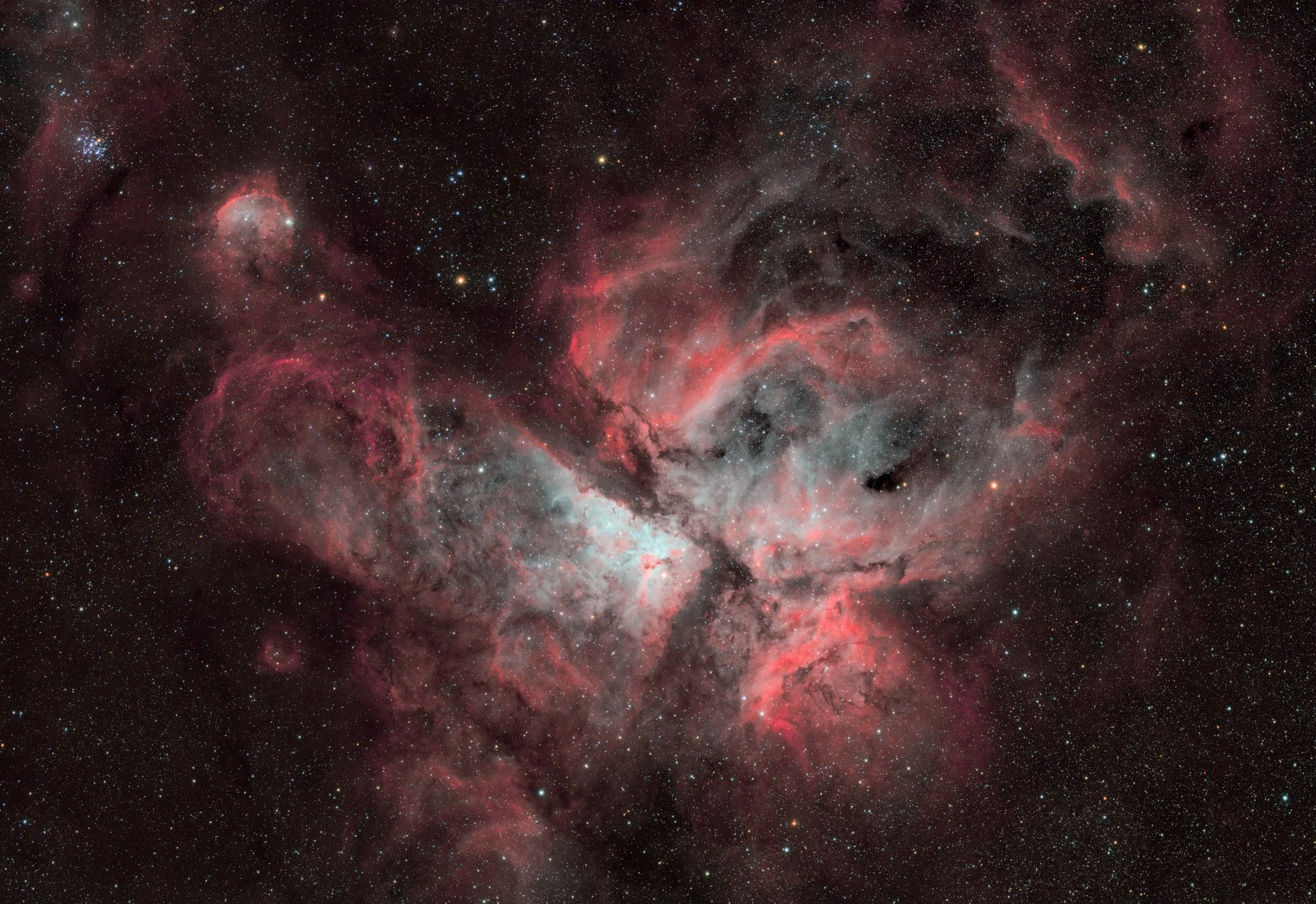
Eta Carinae Nebula — NGC 3372
Constellation Carina | HOO+RGB | ~7,500 light years
One of the most violent and luminous stellar nurseries in the Milky Way, caught in a moment of extraordinary drama.
At its heart lies Eta Carinae itself — a stellar monster perhaps 150 times the mass of our Sun, burning so intensely it sits permanently on the edge of self-destruction. The surrounding nebula spans over 300 light years of space, sculpted by the ferocious stellar winds and radiation of the young, massive stars embedded within it. What you see here is not tranquil beauty — it is a cosmic forge, active and dangerous, where new suns are being born in the shadows of dust clouds that have existed since before our own Solar System formed.
The image rewards close inspection. Scattered across the hydrogen and sulphur-rich regions, dark nebulae weave through the frame like fault lines — cold molecular clouds silhouetted against the glowing gas behind them. The overall effect is of dramatic stage lighting on a particularly intense cosmic production: deep shadows, fierce highlights, and a sense that something momentous is either just beginning or just ending.
This is a target invisible from most of the northern hemisphere, made under skies that most will never experience.
19 hours 14 minutes integration across 11 nights in January 2026 | Kagga Kamma Remote Observatory, Cederberg Mountains, South Africa | Bortle 1 | Tele Vue 76mm running at f/5 with 0.79x reducer | Astronomik CLS-CCD, DeepSky RGB & 12nm HSO filters
Available as: — Metal print — the recommended format for this image. the deep reds and dramatic contrast have exceptional presence on a reflective surface. — Acrylic print — exceptional depth and colour saturation — Fine art paper — archival giclée, satin or matte finish
Sizes from 12" to 40" on the long edge. Made to order.
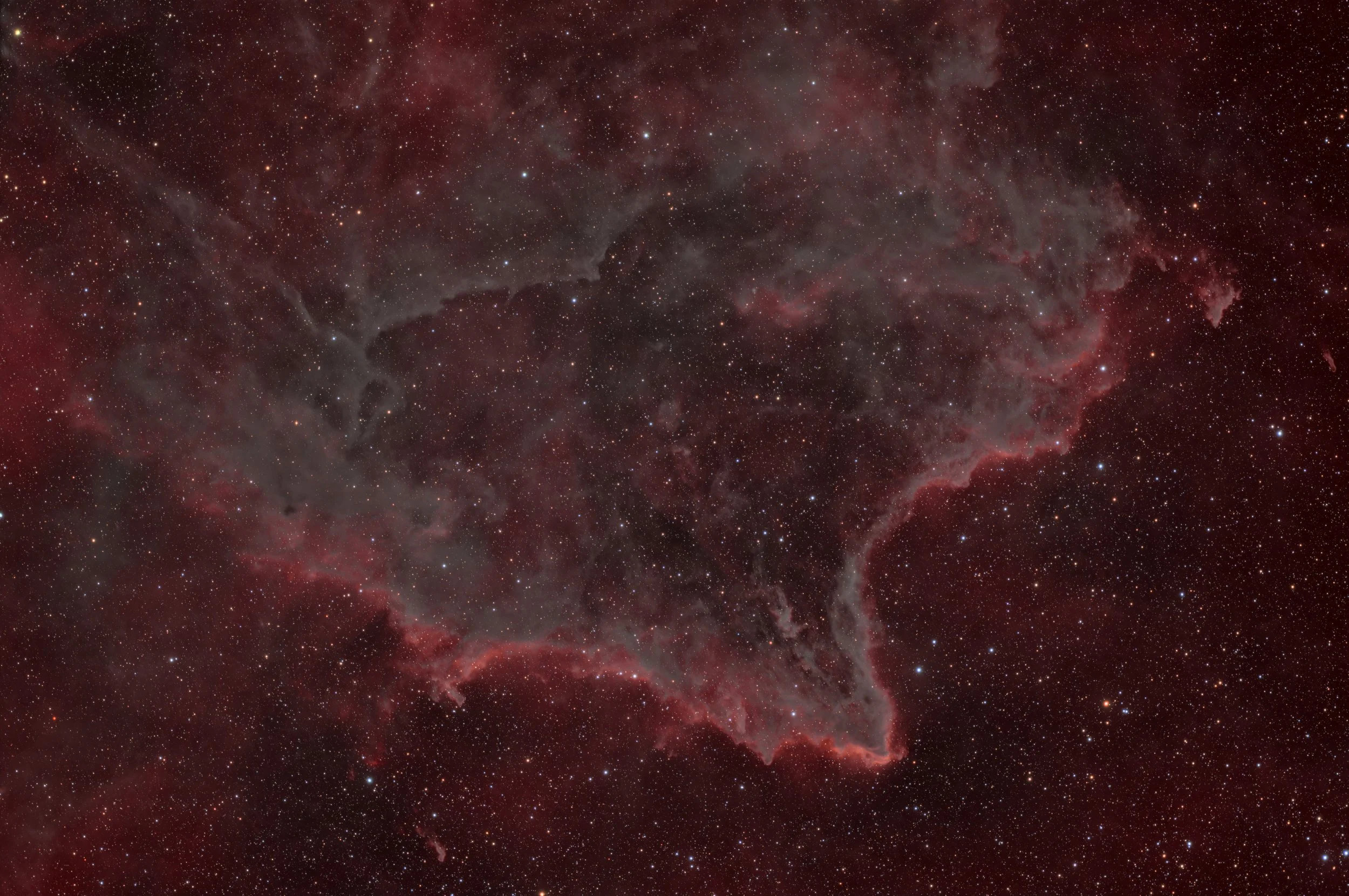
A Valkyrie in Puppis BBW 56 — CG 8, 9 & 10 | Constellation Puppis | HaRGB | ~1,300 light years
Some objects name themselves.
This vast dark molecular cloud in the constellation Puppis has no common name — it sits in catalogues as BBW 56, its cometary globules listed drily as CG 8, 9 and 10. But look at it. The great sweeping mass of the cloud forms wings and a body, banking from upper left to lower right across the frame. The glowing hydrogen filaments along the lower edge trail like the hem of a cloak, lit from beneath by the ferocious stellar winds of an ancient region of our galaxy. She is a Valkyrie, standing in the wreckage of a battlefield older than our world.
The battlefield is the Gum Nebula — the vastly expanded remnant of a supernova explosion that occurred roughly a million years ago, whose shockwaves are still propagating outward through the interstellar medium today. BBW 56 sits in the middle of that ancient wreckage, and its cometary globules — the dark teardrop structures visible along its edges — all point away from the Vela Supernova Remnant, their tails streaming in the same direction, blasted into shape by stellar winds of almost unimaginable violence. Zeta Puppis, one of the most luminous stars in the sky, loses mass in its stellar wind at ten million times the rate of our own Sun. These globules are the survivors — molecular clouds dense enough to resist the blast, standing firm while the gas around them was stripped away.
What you see here are cold molecular clouds with temperatures as low as -256 degrees Celsius, dense enough to block the light of everything behind them, sites of future star formation where gravity is slowly winning against the outward pressure of the gas. In a few million years, some of these dark knots will collapse into new stars. The Valkyrie is not just standing in a field of ancient destruction. She is pregnant with the future.
After initially imaging in just natural RGB, a later addition of hydrogen-alpha data — blended into the red channel of the original — deepened the contrast between the dark molecular structure and the surrounding emission field, and brought out the faint Ha nebulosity threading through the edges of the cloud complex that broadband alone could not fully render. The Valkyrie became herself.
This image was made in natural colour, with the Ha enhancing rather than replacing the broadband truth of the object. What you see is the true colour of these clouds as they exist in space, captured over 16 hours 52 minutes across multiple nights from a Bortle 1 dark sky site in the Cederberg Mountains of South Africa.
This object has no common name. Very few have the chance to image it. It is visible only from the southern hemisphere, and only from truly dark skies. You are looking at something that most people — including most astronomers — will never see.
16 hours 52 minutes integration | Kagga Kamma Remote Observatory, Cederberg Mountains, South Africa | Bortle 1 | Tele Vue 76mm f/5 with 0.79x reducer | HaRGB
Available as: — Metal print — the recommended format for this image. the dark molecular structure against the hydrogen-lit field has exceptional tonal depth on a reflective surface. — Acrylic print — exceptional depth and colour saturation — Fine art paper — archival giclée, satin or matte finish
Sizes from 12" to 40" on the long edge. Made to order.
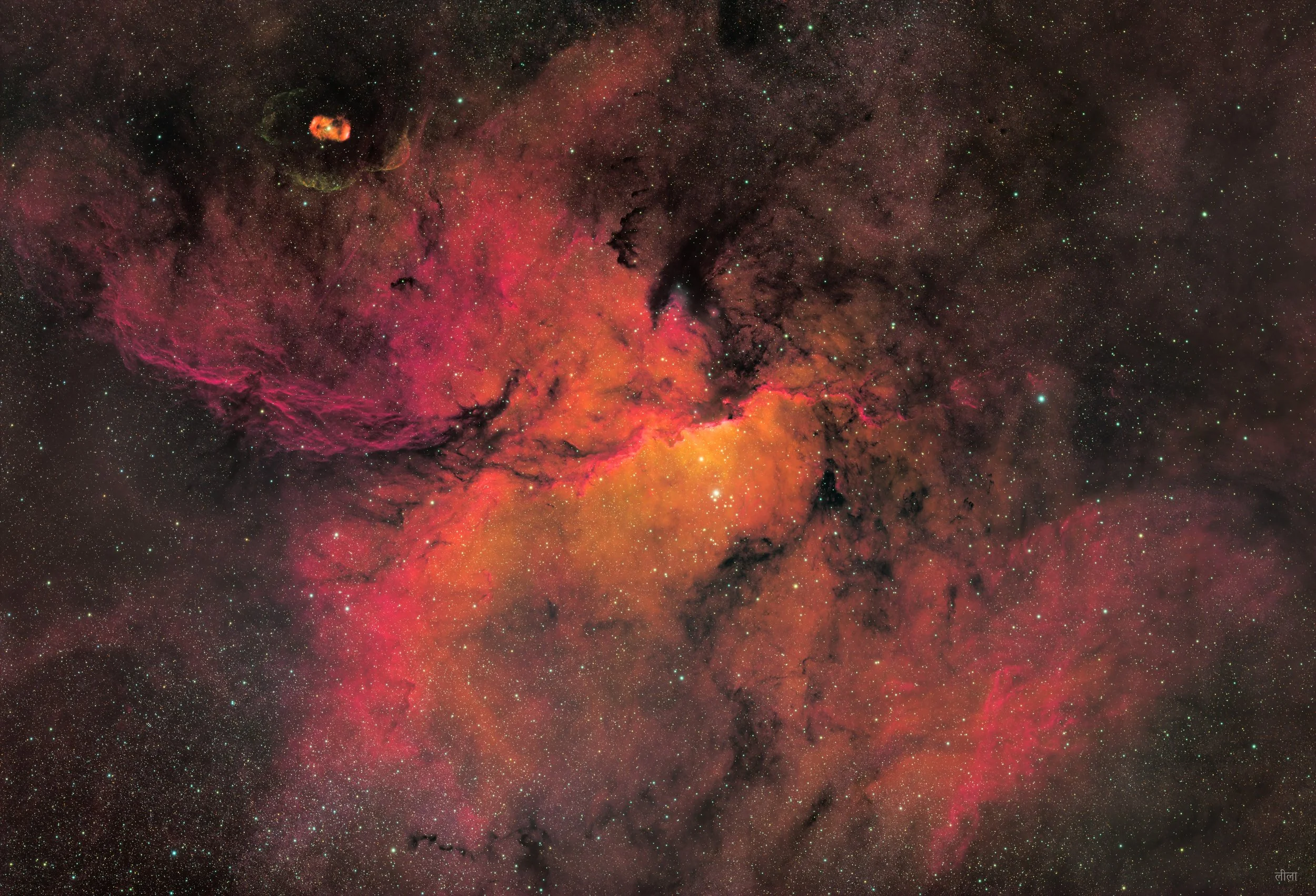
Nel Mezzo
NGC6188 The Dragons of Ara | Constellation Art | HOSRGB | ~4,000 light years
Nel mezzo del cammin di nostra vita — in the middle of the journey of our life — Dante found himself in a dark wood, lost, the straight path gone. The wayfarer in this image finds something rather more elemental: creatures writhing in fire and darkness, not in conflict with each other, but in the grip of something vast and circular that they did not choose and cannot name.
NGC 6188 lies four thousand light years away in the southern constellation Ara — the Altar. An earlier generation of massive stars died in supernova explosions, their shockwaves compressing the surrounding molecular cloud, triggering the birth of the Ara OB1 association — the young stars whose radiation now illuminates this scene. Those stars, mere infants at one to three million years old, are blasting the cloud that made them with stellar winds and ultraviolet light, sculpting the dark pillars, and compressing the next generation of star-forming regions into existence. The dragons are not caught in this cycle. They are the cycle, made briefly and violently visible — death and birth expressed as fire and darkness, writhing together in the same body, indistinguishable from one another.
At the heart of the conflagration, two O-type giants stand almost in contact, their colliding winds generating X-rays. Around them the dark molecular pillars glow at their edges where radiation eats inward — and deep within those same pillars, hidden, new protostars are already forming. Birth inside the body of destruction. The cycle unaware of the distinction.
The wayfarer stands in the middle of something that has no beginning they can find, and no end they will live to see. And perhaps that is the point. The dragons writhe not for themselves — they have no self apart from the process. They writhe so that someone passing through might stop, and wonder whether the cycle they are witnessing is not entirely foreign to themselves too.
This image combines hydrogen-alpha, sulphur II and oxygen III data with RGB stars, the ionised gas rendered in the ambers and crimsons of a fire that has been burning for millions of years, and will burn for millions more.
20 hours 16 minutes integration | Kagga Kamma Remote Observatory, Cederberg Mountains, South Africa | Bortle 1 | Tele Vue 76mm f/5 with 0.79x reducer | HaRGB
Available as:— Metal print — the recommended format for this image. the dark molecular structure against the hydrogen-lit field has exceptional tonal depth on a reflective surface.— Acrylic print — exceptional depth and colour saturation— Fine art paper — archival giclée, satin or matte finish
Sizes from 12" to 40" on the long edge. Made to order.
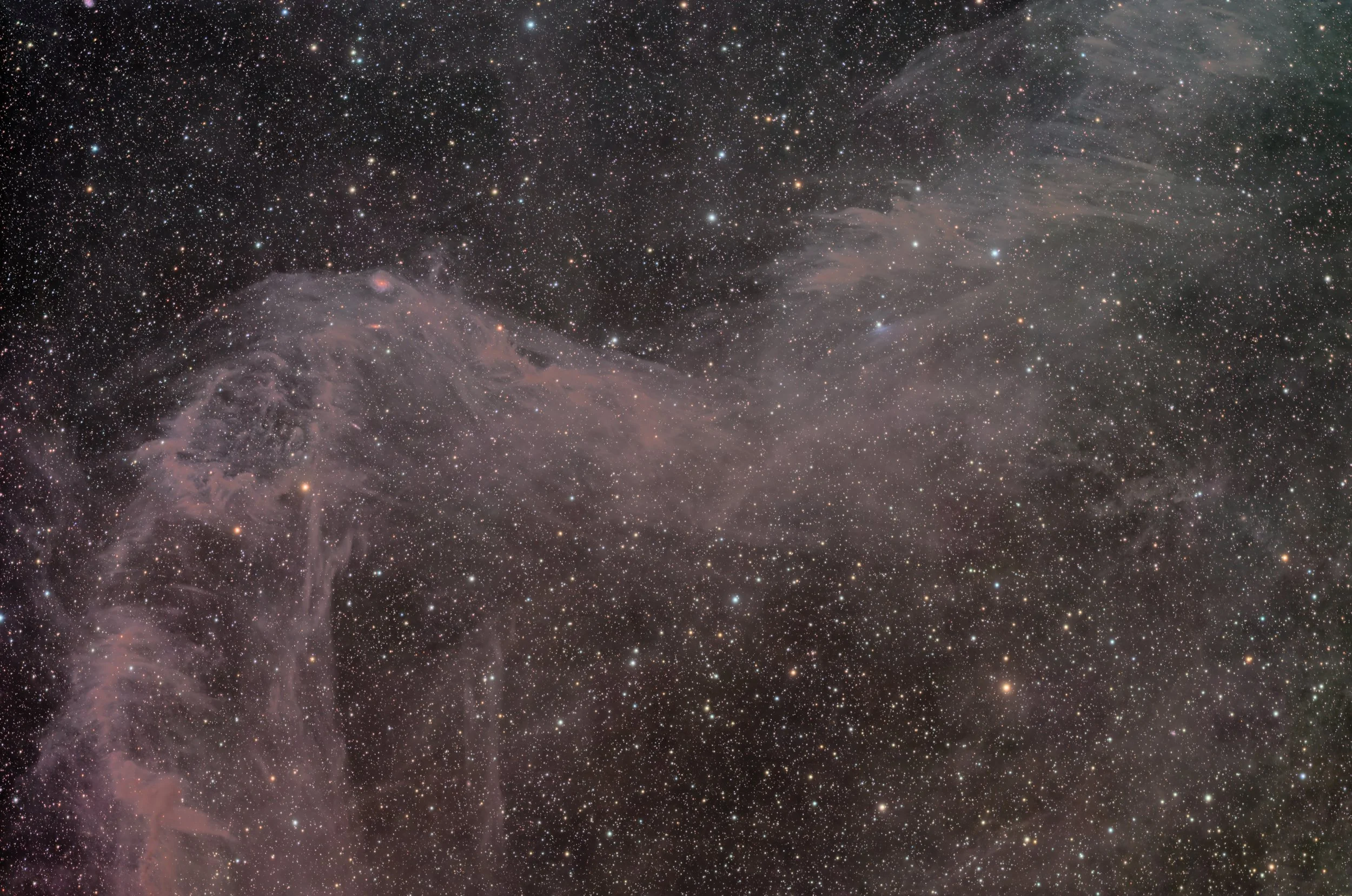
The Serpent of Apus — Mandel Wilson 9
Constellation Apus | Natural Colour RGB | Near the South Celestial Pole
Some objects name themselves. This one already had a name — I just didn't know it yet.
Mandel Wilson 9 is officially catalogued as the South Celestial Serpent, one of the most extraordinary and least-imaged objects in the southern sky. It is not a nebula in the conventional sense — there is no nearby star illuminating it, no supernova remnant powering it, no stellar nursery heating it from within. What you see here is an Integrated Flux Nebula — a vast complex of interstellar dust that floats high above the plane of the Milky Way, illuminated not by any single star but by the combined light of every star in the galaxy simultaneously. It glows with the integrated flux of a hundred billion suns, and yet it is almost invisibly faint.
This is one of the rarest categories of object in astrophotography. IFNs require exceptional darkness, exceptional transparency, exceptional patience, and exceptional skies — conditions that almost nowhere on earth can reliably provide. They are not dramatic in the way of emission nebulae. They do not announce themselves. They reveal themselves only to those willing to look long enough and carefully enough, under skies dark enough to let them speak.
The Serpent coils across more than three degrees of sky near the South Celestial Pole — a region of sky permanently invisible from the northern hemisphere. Its form is unmistakable: the great curved arc of the body sweeping from lower left, the head raised, the sinuous elongated form trailing away to the right, the extraordinary vertical streamer filaments hanging from something vast and ancient. It spans light years. It has been there, prowling silently above the galactic plane, since before our Solar System existed.
This image was made entirely in natural colour — no narrowband filters, no false palette. What you see is the true colour of this object: the subtle reddish luminescence of dust grains converting ultraviolet radiation to visible red light, the cool grey reflection of starlight scattered by interstellar particles, the deep black of intergalactic space behind it all.
15 hours 58 minutes integration across 12 nights in February and March | Kagga Kamma Remote Observatory, Cederberg Mountains, South Africa | Bortle 1 | Tele Vue 76mm at f/5 with 0.79x reducer | Natural colour RGB
Available as:— Metal print — the recommended format for this image. the subtle tonal range of the dust structures has exceptional presence on a reflective surface.— Acrylic print — exceptional depth and colour saturation— Fine art paper — archival giclée, satin or matte finish
Sizes from 12" to 40" on the long edge. Made to order.
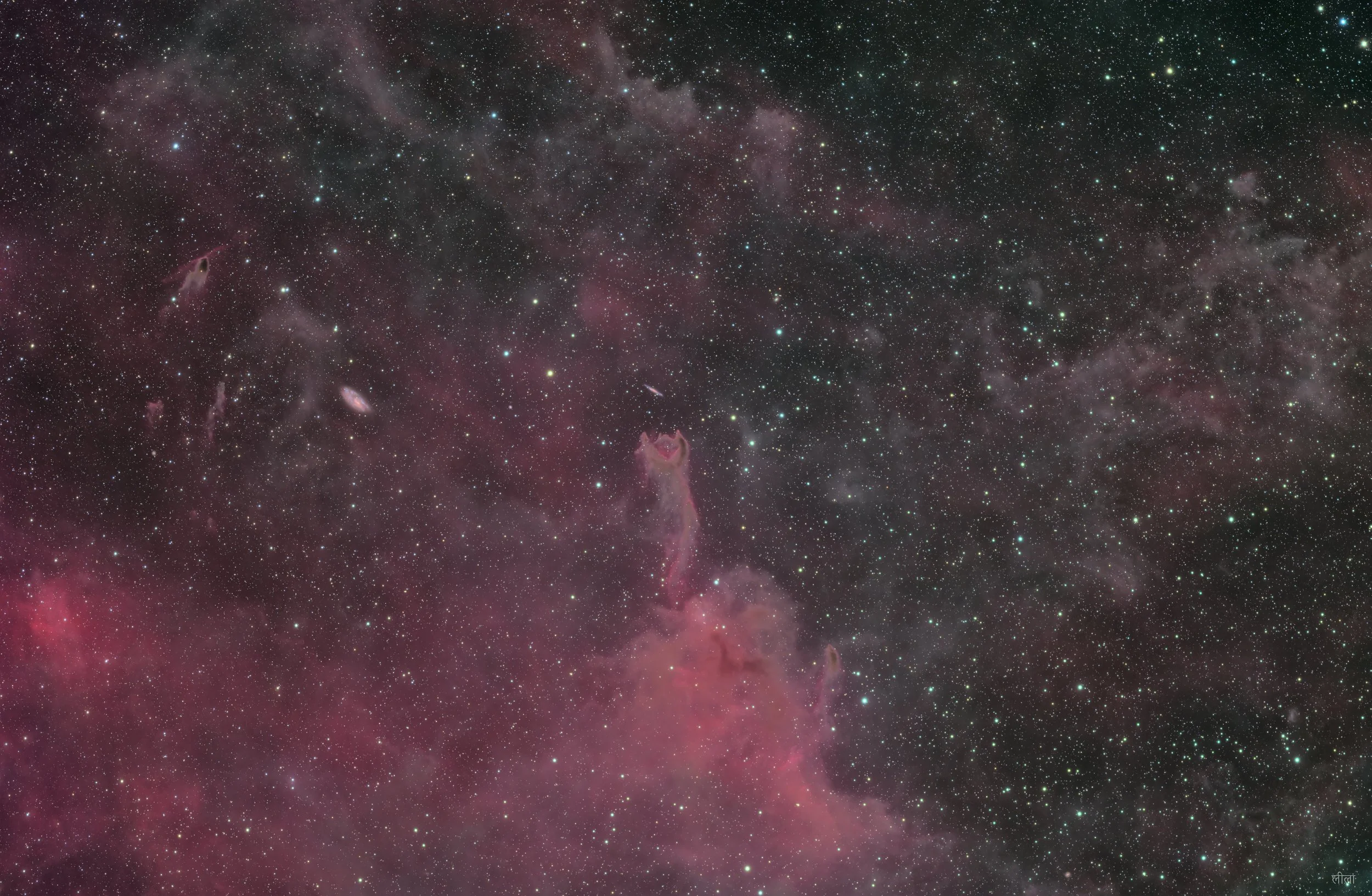
The Hand of God — Sandqvist 103
Constellation Puppis | Natural Colour RGB with added Ha
There is a moment in every drama when a hand is raised and the meaning of the gesture hangs in the air, unresolved. Is it reaching? Or has it just let something go? The same shape, the same outstretched form, but the difference between longing and release - between craving and surrender - is entirely interior. The universe does not say.
Sandqvist 103 is a dark molecular cloud — dense, cold, and opaque enough to block the light of everything behind it. A tendril of dark gas rises from the bright HII region below, fingers splayed, suspended. What it appears to gesture toward is a background spiral galaxy, floating serenely beyond — at least a hundred million light years further away, moving further still. Whether the hand is reaching for it, or has just released it, the outcome is the same. The distance between them is absolute.
The surrounding field is the audience — mists of ionised hydrogen drifting in pinks and magentas, lit from within by stars we cannot see, other galaxies watching from the margins. The protagonist, being absorbed entirely in its own journey, is oblivious to its environment and yet is completely bound by it. The same forces that draw the hand upwards hold it in place — preventing escape if that is what it hungers for, or suspending forever the moment of release if that is what it is offering.
Passion is not always gentle, and is never only one thing. It compresses, sculpts, and eventually collapses — the same forces that make these pillars will, in time, kindle new stars within them. The hand that reaches or the hand that releases will both, in the end, become the hand that builds and burns.
16 hours 20 minutes integration across March and April 2026 | Kagga Kamma Remote Observatory, Cederberg Mountains, South Africa | Bortle 1 | Tele Vue 76mm at f/5 with 0.79x reducer | Natural colour RGB with added Ha
Available as:— Metal print — the recommended format for this image. the subtle tonal range of the dust structures has exceptional presence on a reflective surface.— Acrylic print — exceptional depth and colour saturation— Fine art paper — archival giclée, satin or matte finish. Also available as a Starless print for a very different feel of the same drama.
Sizes from 12" to 40" on the long edge. Made to order.
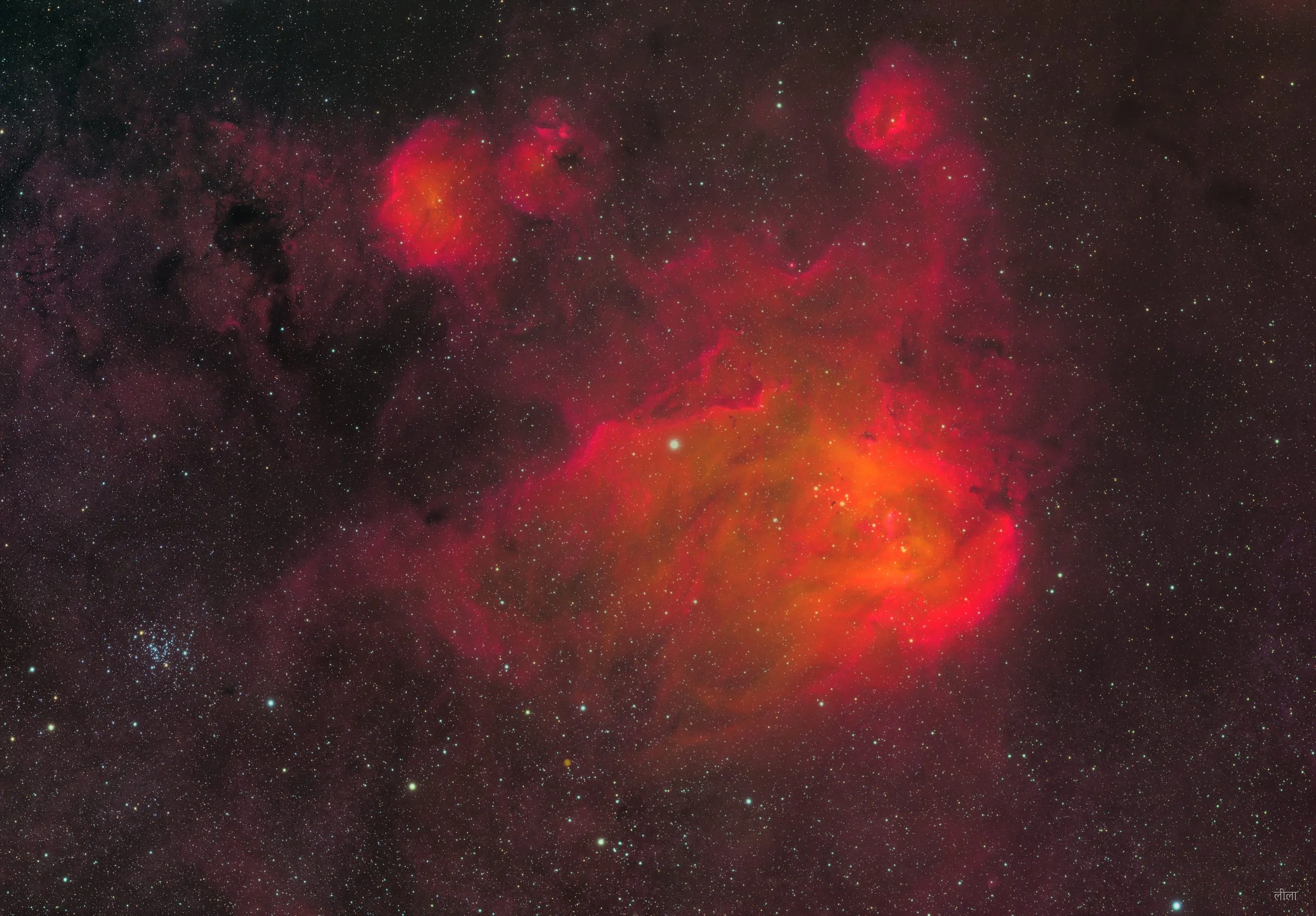
Figures Around A Campfire - Lambda Centauri Nebula
Constellation Centaurus | IC2944 | HOS palette with RGB stars
There is a moment, common to every culture that has ever existed, when people draw close to a source of light in the dark. They lean in. They share warmth. They tell stories about what lies beyond the firelight.
What you are looking at is a gathering of that kind — though the figures are made of gas and dust, and the fire has been burning for three million years.
IC 2944 is an active stellar nursery roughly 6,000 light-years away in Centaurus. The hot young stars of the Lambda Centauri association are the campfire itself — invisible here, their radiation the thing doing the work, stripping electrons from the surrounding hydrogen and setting it aglow. This image was made using a relatively unusual hydrogen-oxygen-sulphur narrowband palette — a mapping that is typically done in the HSO configuration, not the HOS you are seeing. Here, the palette has been deliberately pushed toward warmth: the oranges and golds pooling at the heart of the nebula are not an accident but a choice, an attempt to let the image feel the way the physics actually is — pressurised, plasma-like, alive with energy that has nowhere left to go but outward.
The dark shapes silhouetted against that glow are Thackeray's globules — dense knots of cold molecular gas and dust, some of them several times the mass of our sun. They were discovered by astronomer A. D. Thackeray in 1950, and they have puzzled astronomers ever since. In most nebulae, globules like these are stellar nurseries in waiting — cocoons from which new stars eventually emerge. Here, the radiation from the surrounding stars is winning. The globules are fragmenting, moving supersonically against each other, being steadily eroded from the outside in. What you see in this image are the broken remnants of what was once a single enormous pillar of gas — shattered by the same forces that make everything else here glow.
Whether any star will ever form inside them before they are entirely disappear remains, as of the latest observations, genuinely uncertain.
The figures lean in. The fire burns. The story is still being written.
You are made of this.
19 hours 56 minutes integration across 7 nights in March 2026 | Kagga Kamma Remote Observatory, Cederberg Mountains, South Africa | Bortle 1 | Tele Vue 76mm at f/5 with 0.79x reducer
Available as:— Metal print — the recommended format for this image — Acrylic print — exceptional depth and colour saturation— Fine art paper — archival giclée, satin or matte finish
Sizes from 12" to 40" on the long edge. Made to order.
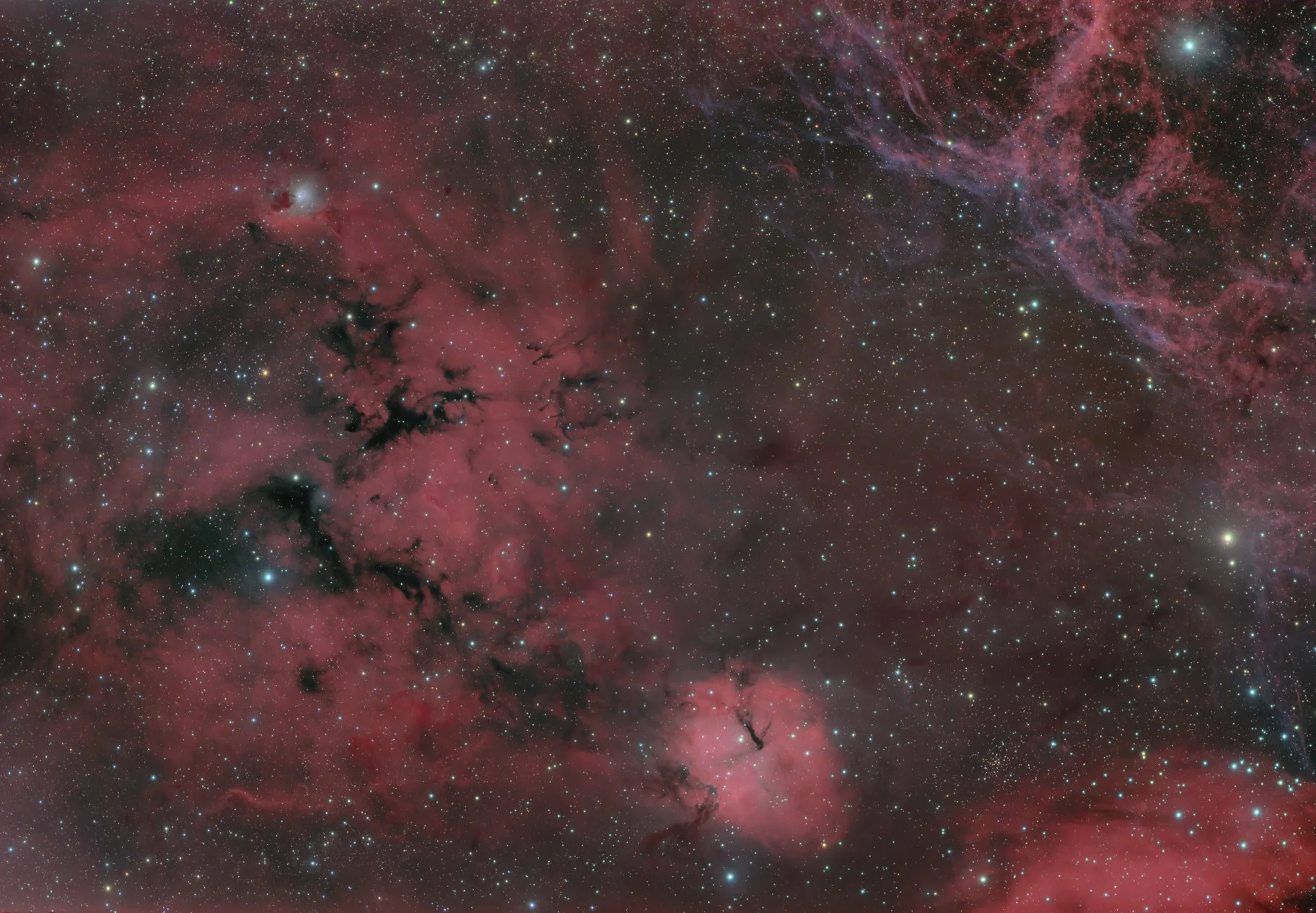
A Lighthouse in a StormRCW 17 | NGC 2626 | Ruprecht 64 | Gum 15 | Vela SNR | Constellation Vela | HOO+RGB | ~3,200 light years
This is not a single object. It is a stage — suspended in time, stretching simultaneously across eons and light years.
The frame is filled with the vast red glow of RCW 17, a great cloud of ionised hydrogen in the Vela Molecular Ridge — one of the southern Milky Way's most active star-forming regions. Dark molecular lanes weave through it, cold and dense, silhouetted against the glowing gas behind them. These are not dramatic structures. They are patient ones — clouds of raw material that have drifted through this region of the galaxy for millions of years, slowly, quietly, waiting for gravity to have its way with them.
In the upper left, small and intensely bright, is NGC 2626 — a reflection nebula about 3,200 light years away, illuminated by a young hot star embedded within it, burning blue-white against the surrounding red sea. It has been there long enough to have gathered 32 young stars around it, some still forming in the dark cloud that joins it. It is the lighthouse.
Along the bottom edge, Gum 15 glows — another stellar nursery, another knot of star formation in this crowded region, a separate story playing out at a different distance in the same wide field.
And in the upper right, barely there, the ghostly filaments of the Vela Supernova Remnant drift through the frame — the shockwaves of an explosion eleven thousand years old, still travelling.
Imagine a sailor in a lifeboat, drifting on a stellar sea of hydrogen, looking toward a far light on the horizon. Is it a warning of danger, or is it welcoming a refugee? The universe does not say. It simply glows, and waits, and continues.
21 hours 46 minutes integration | Kagga Kamma Remote Observatory, Cederberg Mountains, South Africa | Bortle 1 | Tele Vue 76mm at f/5 with 0.79x reducer | HOO+RGB
Available as:— Metal print — the recommended format for this image. the deep crimson emission and the blue of NGC 2626 have exceptional presence on a reflective surface.— Acrylic print — exceptional depth and colour saturation— Fine art paper — archival giclée, satin or matte finish
Sizes from 12" to 40" on the long edge. Made to order.
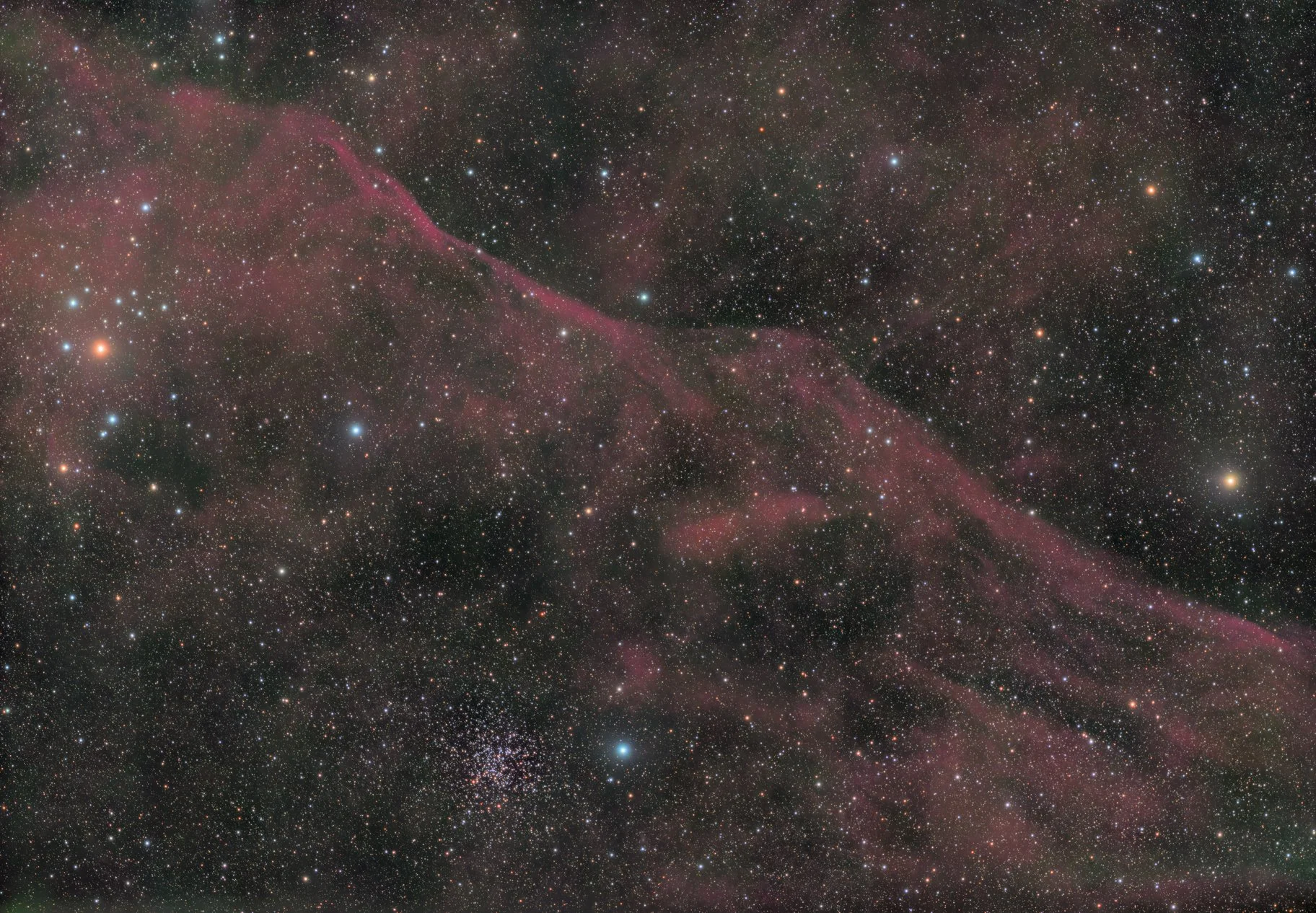
The Riches of Puppis — NGC 2477 & NGC 2451Constellation Puppis | RGBHSO | ~3,700 light years
This image contains more than it first appears to show.
Along the bottom edge, dense and glittering against the dark, is NGC 2477 — the Termite Hole Cluster, one of the top open clusters in the sky, containing around 300 stars packed into an area comparable to the full Moon, discovered by French astronomer Nicolas de Lacaille during his tour of South Africa in 1751. It looks like a globular cluster but isn't — it is an open cluster so richly populated and so uniformly distributed that it fools the eye. It is one of the richest and densest open clusters known, spanning about 37 light years at a distance of roughly 3,700 light years. It was too far south for Charles Messier to observe from Paris. Had he seen it, it would almost certainly have been in his catalogue.
Halfway up the left edge of the frame, larger and more scattered, is NGC 2451 — a second open cluster in the same wide field, its stars more loosely bound, a different chapter of the same story of stellar birth in this corner of Puppis.
The diagonal sweep of red and pink emission crossing the upper two thirds of the frame is a broad region of hydrogen and sulphur emission — unnamed, undesignated, part of the rich interstellar medium of the southern Milky Way that fills this field with glowing gas.
If you were to look at an annotated copy of this image , you would find literally dozens of background galaxies scattered across the field — PGC objects, distant island universes tens of millions of light years away, visible only because the Bortle 1 skies of Kagga Kamma allow them to speak. They are not the subject of this image. They are simply there, as they have always been, waiting to be noticed.
And then there is the structure that nobody can explain.
Visible only in the starless narrowband data — invisible in broadband because it gets drowned out by the continuum light of stars — two curved arcs face each other in the upper half of the frame, like the left and right curves of a skull, forming what appears to be a toroidal or compression wave structure of unknown origin. It is not the Vela Supernova Remnant. It does not correspond to any catalogued object in this field. It has been noted and posted, and so far no one knows what it is. It may be a bubble blown by a long-dead massive star. It may be a compression wave in the interstellar medium. It may be something else entirely. The universe does not always explain itself.
24 hours 24 minutes integration, mostly February 2026 | Kagga Kamma Remote Observatory, Cederberg Mountains, South Africa | Bortle 1 | Tele Vue 76mm at f/5 with 0.79x reducer | RGBHSO
Available as:— Metal print — the recommended format for this image. the rich star field and the diagonal emission sweep have exceptional presence on a reflective surface.— Acrylic print — exceptional depth and colour saturation— Fine art paper — archival giclée, satin or matte finish
Sizes from 12" to 40" on the long edge. Made to order.
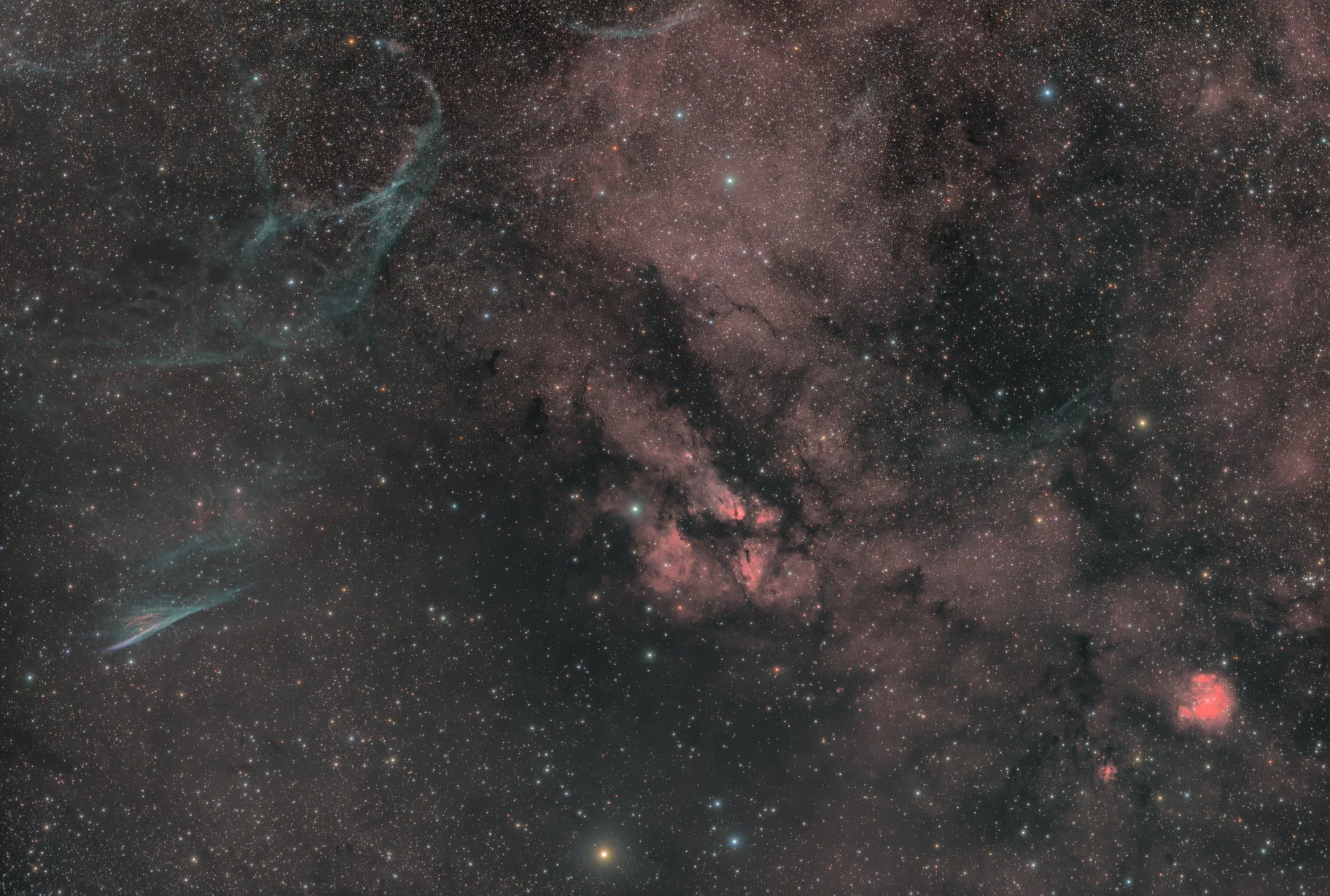
The Pencil and the Gum NGC 2736 — The Pencil Nebula | Gum 23 | Gum 25 | Vela SNR | Constellation Vela | LRGBHSO | ~815 light years
A field so old and patient, that even the aftermath of a supernova is but a flash in its eye.
On the left, unmistakable, is the Pencil Nebula — NGC 2736, the brightest part of the Vela Supernova Remnant, discovered by John Herschel in 1835 from South Africa, who described it as "an extraordinary long narrow ray of excessively feeble light." It is moving through space at roughly 644,000 kilometres per hour — not drifting, not floating, but hurtling. Its shape suggests it is part of the supernova shock wave that recently encountered a region of dense gas, causing it to glow like a rippled sheet seen edge-on. What appears as a delicate pencil stroke is in reality a wall of plasma, compressing everything in its path. The original Vela supernova would have been 250 times brighter than Venus, easily visible to southern observers in broad daylight — 11,000 years ago, our ancestors stood beneath these same skies and watched a new star blaze into existence without warning. The Pencil Nebula is what remains.
Above the Pencil, more Vela shock filaments drift through the upper left in teal — the broader remnant making itself known at the edges, reminding the viewer that the Pencil is just the brightest fragment of something vastly larger.
In the centre of the frame, the diffuse pink nebulosity of Gum 23 spreads through the dark molecular lanes — a faint HII region embedded in the rich interstellar medium of the southern Milky Way, part of the vast Gum complex that fills this corner of Vela and Puppis. The dark lanes weaving through it are cold molecular clouds, patient structures that have drifted through this region far longer than the supernova that lit the Pencil.
In the lower right, compact and intensely bright, Gum 25 glows — another HII region in the same complex, another knot of ionised gas catching the light of embedded hot stars, a separate story at a different distance in the same wide field.
This is a frame within frames within frames. Each object exists at its own distance, its own age, its own stage of evolution. The Pencil is eleven thousand years old. Gum 23 and Gum 25 are part of a complex that may be a million years old. The dark molecular clouds between them have been drifting since before the Solar System existed. All of it visible from one dark mountain in the Cederberg, in a single week's work.
19 hours 48 minutes integration, late December 2025 — early January 2026 | Kagga Kamma Remote Observatory, Cederberg Mountains, South Africa | Bortle 1 | Tele Vue 76mm at f/5 with 0.79x reducer | LRGBHSO
Available as:— Metal print — the recommended format for this image. the teal filaments of the Pencil against the dark field have exceptional luminosity on a reflective surface.— Acrylic print — exceptional depth and colour saturation— Fine art paper — archival giclée, satin or matte finish
Sizes from 12" to 40" on the long edge. Made to order.
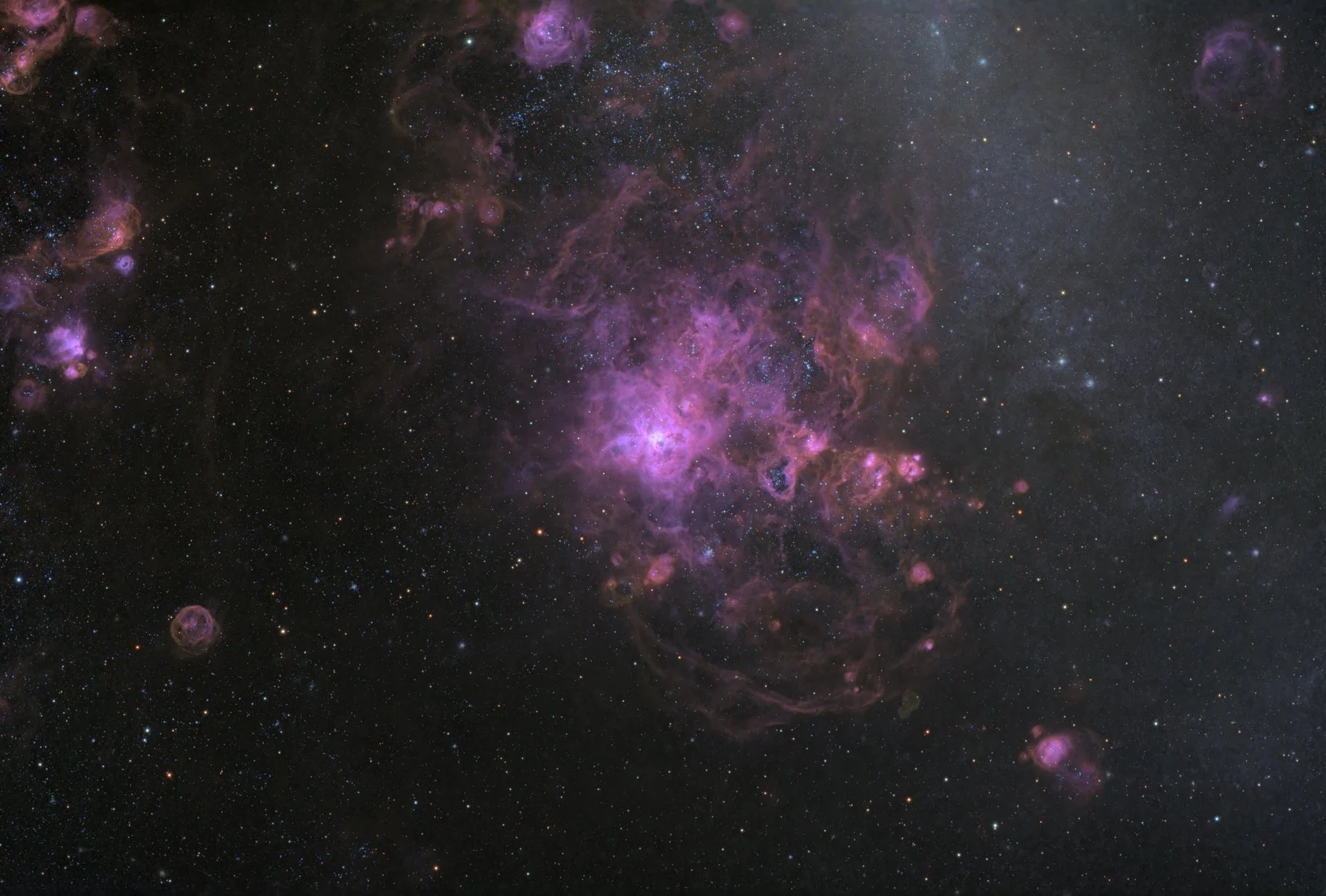
A Jellyfish Greets the TarantulaNGC 2070 — The Tarantula Nebula | Henize 70 | Large Magellanic Cloud | LRGBHSO | ~160,000 light years
This image looks across 160,000 light years into another galaxy.
The Tarantula Nebula — NGC 2070, also known as 30 Doradus — dominates the right half of the frame in extraordinary purple-pink complexity, its filamentary legs spreading outward from a blazing core of star formation. It is the most active starburst region known in the entire Local Group of galaxies. Its luminosity is so extreme that if it were as close to Earth as the Orion Nebula, it would cast visible shadows. At its heart, the star cluster R136 contains some of the most massive stars known — objects hundreds of times the mass of our Sun, burning so fiercely they will destroy themselves in cosmically brief lifetimes.
The Tarantula is not just a place of birth. The closest supernova observed since the invention of the telescope, Supernova 1987A, occurred in its outskirts — a star that ended its life within living memory, its light reaching Earth in 1987. And within this same field, astronomers have identified a dormant black hole — the first unambiguously detected outside the Milky Way — nine times the mass of the Sun, its presence revealed only by the orbital motion of its companion, the blue star VFTS 243, which circles something dark and silent at its side. The star that formed the black hole appears to have collapsed entirely, without the supernova explosion that normally accompanies a black hole's birth — simply vanishing, leaving only gravity behind. Birth, death, and silence, all in one frame.
To the left, scattered across the dark like luminous soap bubbles, are objects from the Henize catalogue — superbubbles and emission nebulae in the LMC, named after a remarkable man whose story deserves more space than this description can give it. That story will be told in another image in this collection, where his objects take centre stage.
21 hours 26 minutes integration, November 2025 | Kagga Kamma Remote Observatory, Cederberg Mountains, South Africa | Bortle 1 | Tele Vue 76mm at f/5 with 0.79x reducer | LRGBHSO
Available as:— Metal print — the recommended format for this image. the purple-pink palette of the Tarantula has exceptional luminosity on a reflective surface.— Acrylic print — exceptional depth and colour saturation— Fine art paper — archival giclée, satin or matte finish
Sizes from 12" to 40" on the long edge. Made to order.
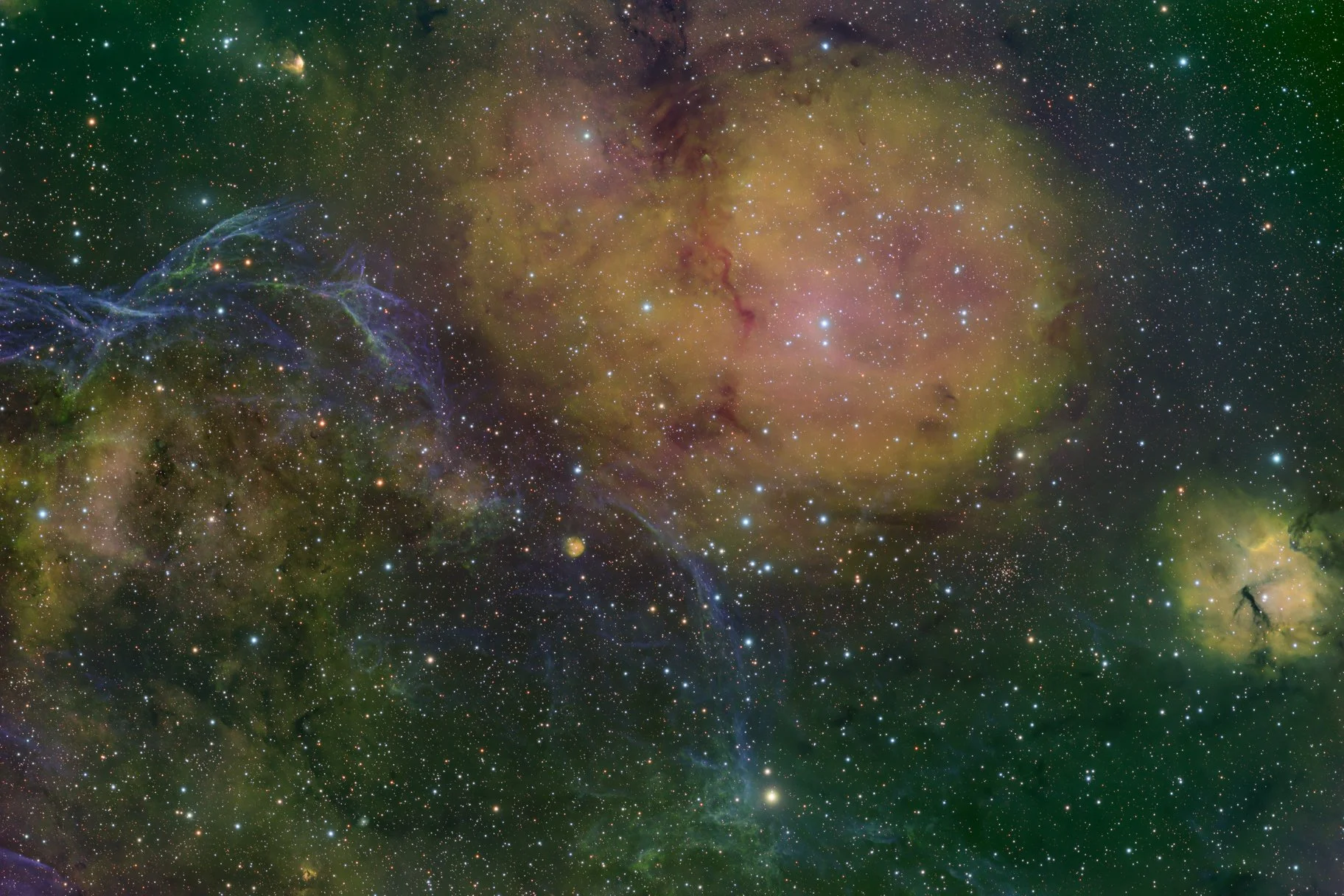
Vela's Treasure ChestGum 15 | Gum 17 / RCW 33 | NGC 2671 | Trumpler 10 | vdB Ha24 | RCW 34 / Gum 19 | Constellation Vela | LRGBHSO
This is such a rich, colourful and jewelled part of the sky that it is impossible not to think of it as a treasure chest — just lying there, spilling its contents with nary a care.
While the neighbouring Vela Supernova Remnant gets its justifiable attention, this region is abundant in colour and structure in its own right, and is seemingly under-imaged — which is baffling, given what it contains. As far as the NGC is concerned, there is only one object here. The catalogue barely scratches the surface.
So let us tour it, tracking from right to left.
On the right, Gum 15 — a vibrant HII region being ionised by stars within the cluster Collinder 197, and within it a homunculus-shaped dark nebula, a shadow puppet silhouetted against the glowing gas behind it.
Moving left, the only NGC object in the field: NGC 2671, a small open cluster, the sole representative of the New General Catalogue in a frame that deserves a catalogue of its own.
Then the far larger Gum 17, also known as RCW 33, glowing gold and pink in this narrowband palette — the dominant feature of the frame, an enormous HII region whose sheer scale dwarfs everything around it. Near it, the open cluster Trumpler 10, probably first noticed around 270 years ago, then rediscovered 200 years ago, and rediscovered again 120 years ago. Some objects refuse to stay found.
Continuing leftward, the OIII-rich shockwaves of the Vela SNR announce themselves in blue in the vdB Ha24 nebula — not to be confused with vdB 24, which is an entirely different object. vdB Ha54 is also present, and for those who look closely enough, the tiny planetary nebula K2-15, a stellar remnant so compact it is easily missed.
And above, a small tight knot of emission: RCW 34, also known as Gum 19, a nebula of two halves. One side glows bright, ionised by V391 Velorum — a variable star with a surface temperature of 30,000°C whose fierce ultraviolet radiation lights the hydrogen around it. The other side is dark, a curtain of dust behind which young stars are quietly forming, invisible to optical wavelengths, present nonetheless.
All those different colours and objects. Like precious stones and necklaces scattered across the floor of a chest that nobody thought to open.
18 hours 52 minutes integration, January — February 2026 | Kagga Kamma Remote Observatory, Cederberg Mountains, South Africa | Bortle 1 | Tele Vue 76mm at f/5 with 0.79x reducer | LRGBHSO
Available as:— Metal print — the recommended format for this image. the extraordinary colour range of this palette — gold, pink, teal, blue — has exceptional presence on a reflective surface.— Acrylic print — exceptional depth and colour saturation— Fine art paper — archival giclée, satin or matte finish
Sizes from 12" to 40" on the long edge. Made to order.
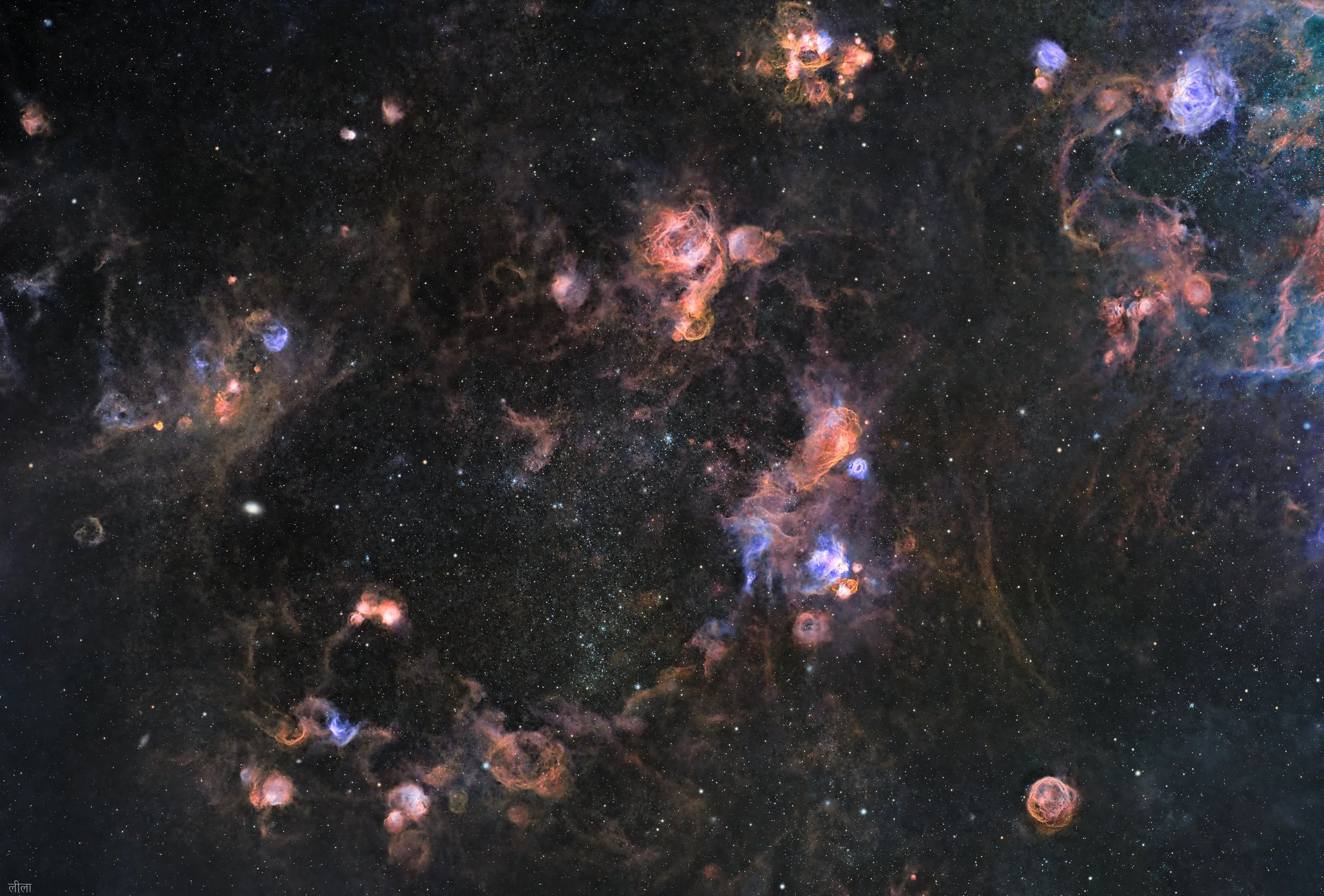
A Host of Henize Objects in the LMCHenize 51 | Henize 50 | Henize 55 | Henize 64ABC | Henize 148 | Large Magellanic Cloud | LRGBHSO | ~160,000 light years
This image looks across 160,000 light years into another galaxy — and what it finds there is a field scattered with luminous purple-pink superbubbles and HII regions, each one a world of star formation in its own right, each one bearing the name of the same man.
The field also contains 53 NGC objects and one IC object — a measure of just how rich this corner of the LMC is. But it is the Henize objects that give this image its character. They belong to the Henize catalogue, a survey of hydrogen-emission stars and nebulae in the Magellanic Clouds published in 1956 by Karl Gordon Henize. He was a farm boy from Ohio whose boyhood heroes were Buck Rogers and Edmund Hillary. He became an astronomer, catalogued over 2,000 southern sky objects from South Africa, and became a NASA astronaut at the age of 40 — the oldest American to fly in space when he finally got his turn aboard Challenger in 1985, after an eighteen-year wait. The objects that bear his name — including those scattered across this frame — will outlast all of us. His story is not finished here. There is another image in this collection, made in the skies of the Small Magellanic Cloud, where we will return to it.
In the meantime, let’s return to superbubbles: vast spheres of superheated gas, hundreds of light years across, blown outward by the combined stellar winds of massive hot stars and the shockwaves of supernova explosions, their interiors filled with tenuous expanding plasma at temperatures of over a million degrees. They are among the most energetic structures a galaxy can produce. Because superbubbles can expand through an entire galaxy, they offer a direct window into the connection between the life cycles of individual stars and the large-scale evolution of the galaxies they inhabit.
Our own Solar System, it turns out, sits near the centre of just such a structure — an old superbubble called the Local Bubble, carved out by supernovae millions of years ago, its walls still slowly expanding around us. We live inside one of these things. We just can't see it from here.
These objects are scattered across this frame like luminous soap bubbles — some compact and perfectly spherical, some elongated, some caught mid-expansion, some interacting with their neighbours. The blue star cluster anchoring the centre of the frame gives a sense of scale: those are real stars, each one a sun, and the bubbles surrounding them are structures that dwarf the distances between stars in our own galactic neighbourhood.
23 hours 10 minutes integration | Kagga Kamma Remote Observatory, Cederberg Mountains, South Africa | Bortle 1 | Tele Vue 76mm at f/5 with 0.79x reducer | LRGBHSO
Available as:— Metal print — the recommended format for this image. the purple-pink superbubbles against the deep black of intergalactic space have exceptional presence on a reflective surface.— Acrylic print — exceptional depth and colour saturation— Fine art paper — archival giclée, satin or matte finish
Sizes from 12" to 40" on the long edge. Made to order.
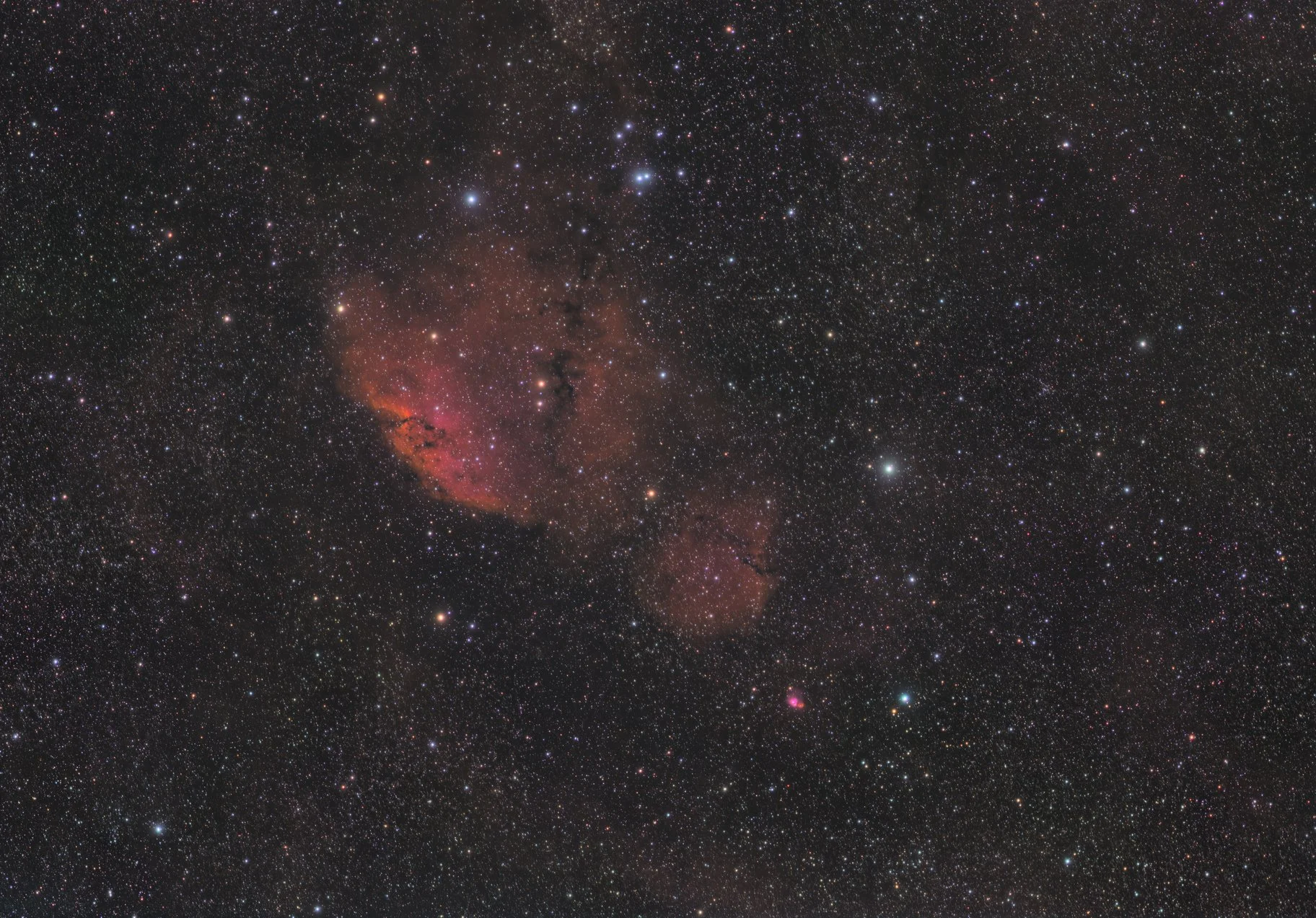
The Greenlandian Gum — RCW 19 in PuppisRCW 19 | Gum 10 | NGC 2579 | Constellation Puppis | RGBHSO | ~10,700 light years
The photons that made this image left their source approximately 10,700 years ago.
Think about what that means. When the light now captured here began its journey toward us, it was 8700 BC on Earth. The planet was in the earliest stage of the Holocene epoch — the Greenlandian age, a period of warming after the last great ice age, when the world was being remade. Humans were pre-pottery Neolithic, living in small communities, beginning the slow transition from hunting and gathering toward something that would eventually become civilisation. The Fertile Crescent — what is now southern Turkey, Kurdistan, Iraq — was at the vanguard of human progress. The site of Shillourokambos in Cyprus, where archaeologists have found the earliest known evidence of cat domestication and veneration — predating the ancient Egyptians by thousands of years — was still five centuries from being settled. Most of humanity lived as hunter-gatherers, looking up at the same stars we image today, knowing nothing of what they were.
Those photons have been travelling ever since. Through the Bronze Age, the Iron Age, the rise and fall of every empire, every war, every invention, every generation. They arrived at Kagga Kamma in January and February of 2026, and were captured by nineteen hours and forty-eight minutes of exposure time on a sensor the size of a thumbnail.
The object they reveal is RCW 19, also known as Gum 10 — a large emission nebula embedded in a giant molecular cloud in the constellation Puppis, about 155 light years in diameter, ionised by the hot O-type star HD 69464 at its heart. The two-lobed structure gives it an almost biological quality — like something cellular, something alive. The dark molecular lanes cutting through the bright emission add depth and drama, layers of cold dust silhouetted against the warm hydrogen glow behind them.
In the lower right, vivid and compact, sits NGC 2579 — a small but brilliantly pink knot of emission, a separate object at a different distance, a different story in the same frame.
This image has a name of my own invention: the Greenlandian Gum. Because the epoch those photons come from deserves to be remembered.
And now the question that cannot be answered: when the photons leaving RCW 19 tonight finally arrive at whatever is here to receive them, 10,700 years from now — what will human civilisation look like then?
19 hours 48 minutes integration, January — February 2026 | Kagga Kamma Remote Observatory, Cederberg Mountains, South Africa | Bortle 1 | Tele Vue 76mm at f/5 with 0.79x reducer | RGBHSO
Available as:— Metal print — the recommended format for this image. the deep red emission against the dark molecular lanes has exceptional presence on a reflective surface.— Acrylic print — exceptional depth and colour saturation— Fine art paper — archival giclée, satin or matte finish
Sizes from 12" to 40" on the long edge. Made to order.
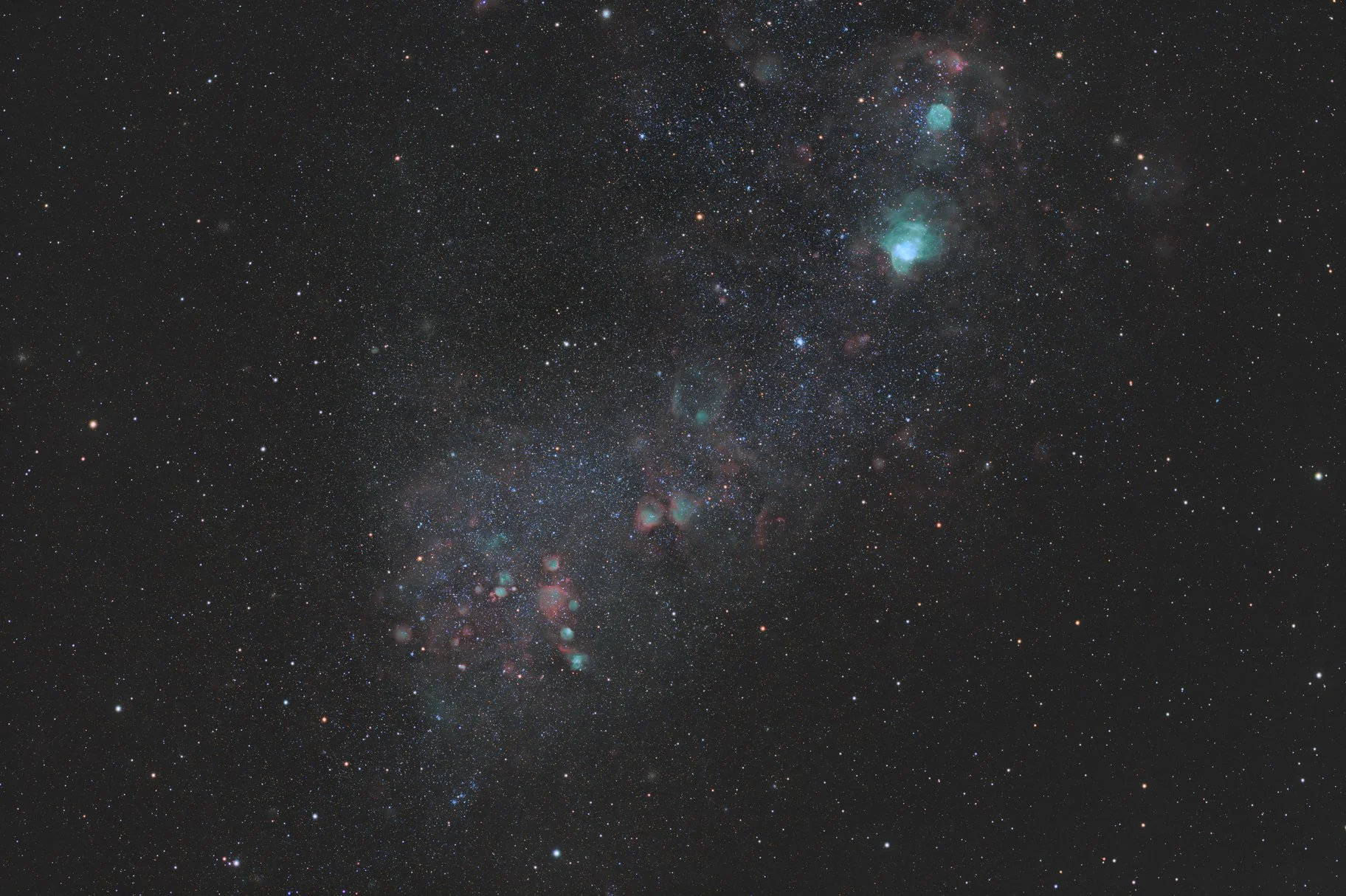
The Henizes of the SMCSmall Magellanic Cloud | Constellation Tucana | LRGBHSO | ~200,000 light years
This is another galaxy. Not a region of ours, not a nearby nebula — another galaxy entirely, 200,000 light years away, rendered here in a HOO narrowband palette that maps its hydrogen and oxygen emission into cool teal and warm rose, the Henize objects scattered across it like embers.
People have been looking at this object for as long as people have looked up. Aboriginal Australians knew it as the camp of an old woman beside a fire — the Large Magellanic Cloud the camp of her husband nearby, a star between them their shared flame. A celestial model, encoded in story, of care for elders and the sharing of food. The Persian polymath Ibn Qutaybah described what were likely the Magellanic Clouds in the 9th century CE. Portuguese and Dutch sailors called them the Cape Clouds, navigating by them in the age of exploration. It was only when Antonio Pigafetta — a writer, not an astronomer, which is perhaps why his account survived — described them during Magellan's circumnavigation of 1519 to 1522, that they entered the European record in a form that lasted. The name Magellan is the one that stuck, though the clouds had been known to the peoples of the southern hemisphere for tens of thousands of years before any European ship rounded the Cape.
The Henize objects glowing in this frame — emission nebulae and HII regions within the SMC itself — bear the name of a man who catalogued them from South Africa in the early 1950s, and whose story was begun in the companion image of the Large Magellanic Cloud. Karl Gordon Henize catalogued over 2,000 southern sky objects, became a NASA astronaut at 40, flew on Challenger in 1985 after an eighteen-year wait. He was 58 — the oldest American to fly in space at the time. And then, in October 1993, Karl Henize died on the slopes of Mount Everest at 21,000 feet, of high altitude pulmonary edema, testing equipment for NASA. His boyhood heroes had been Buck Rogers and Edmund Hillary (along with Tenzing Norgay, the first team to summit Everest). Henize was buried on the mountain at his own request, near the Changtse Glacier — quite a journey from Ohio via space.
The objects that bear his name — in the LMC, in the SMC, scattered across two galaxies — will still be there long after the mountain has eroded to nothing.
20 hours 32 minutes integration, November — December 2025 | Kagga Kamma Remote Observatory, Cederberg Mountains, South Africa | Bortle 1 | Tele Vue 76mm at f/5 with 0.79x reducer | LRGBHSO
Available as:— Metal print — the recommended format for this image. the cool teal HOO palette of the SMC against the deep black of intergalactic space has exceptional presence on a reflective surface.— Acrylic print — exceptional depth and colour saturation— Fine art paper — archival giclée, satin or matte finish
Sizes from 12" to 40" on the long edge. Made to order.
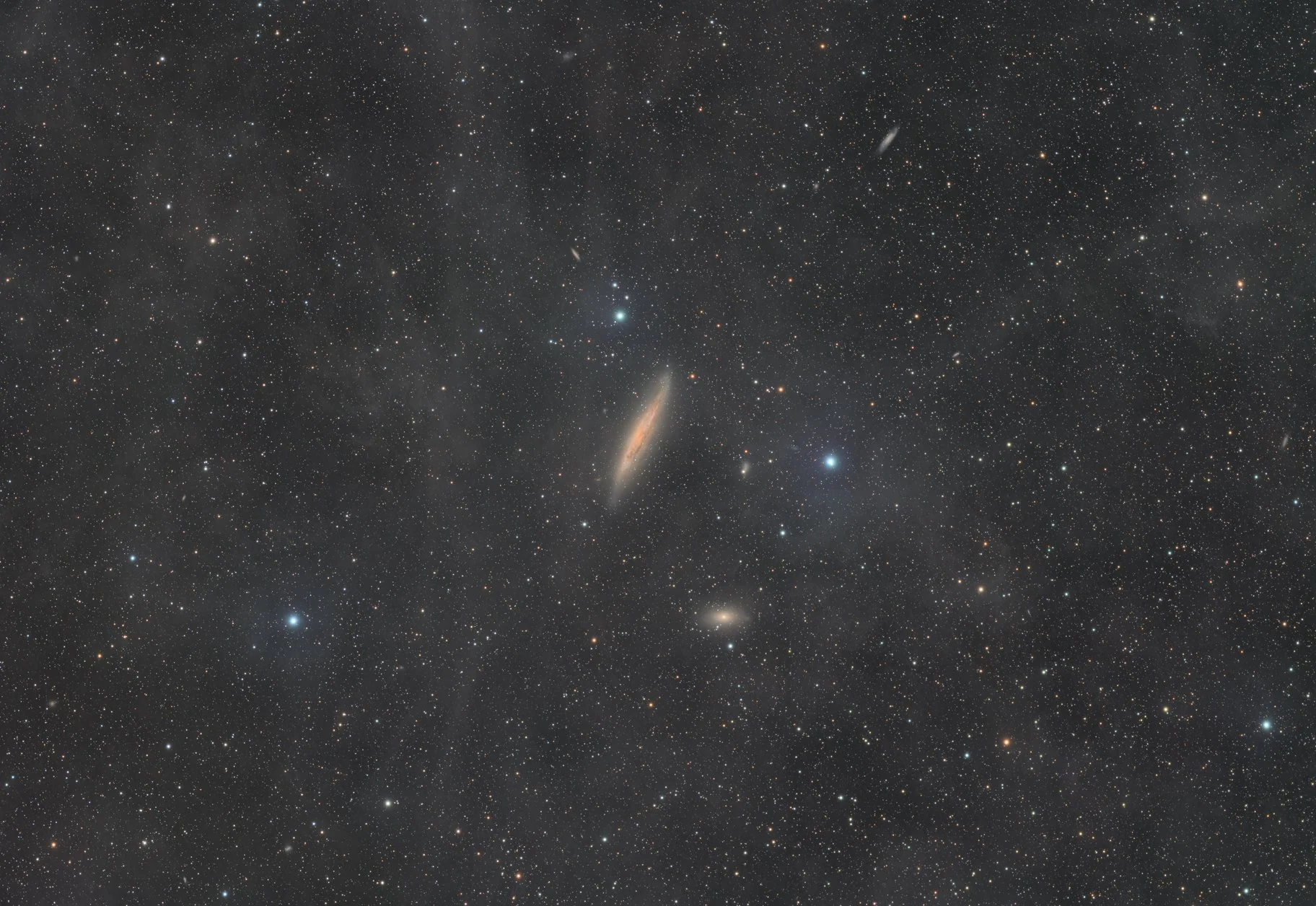
The Punctum Galaxy through DustNGC 4945 | NGC 4976 | Constellation Centaurus | LRGBH | ~11 million light years
This image contains one of the most scientifically remarkable galaxies within reasonable reach of an amateur telescope — and most people have never heard of it.
NGC 4945 is a barred spiral galaxy in Centaurus, about 11 million light years away, discovered by the Scottish astronomer James Dunlop in 1826 from New South Wales, Australia. Seen almost exactly edge-on, it glows warm orange-gold against the subtle grey veil of Milky Way integrated flux nebulae — dust from our own galaxy, lying between us and it, giving the image a quality like looking through ancient glass at something luminous and distant.
It is a galaxy of firsts. In 1979, NGC 4945 became the source of the first water megamaser ever detected outside the Local Group of galaxies. A megamaser is a naturally occurring microwave laser — a region of gas, typically water molecules in this case, stimulated by intense radiation from an active galactic nucleus into emitting coherent microwave radiation about 100 million times more powerful than ordinary masers. The water megamaser in NGC 4945 arises from gas orbiting within a fraction of a parsec of the galaxy's supermassive black hole, tracing the structure of the accretion disc around it with extraordinary precision. It is a cosmic instrument for measuring things that cannot be measured any other way.
At the heart of NGC 4945 is a Seyfert 2 active nucleus — an intensely energetic core, heavily obscured by dust, harbouring a supermassive black hole surrounded by a dense torus of molecular clouds. The starburst region around it is at least five million years old, concentrated in a region of just 330 light years, generating half the luminosity of the entire core.
And then, in October 2023, something new was found. Astronomers using ALMA discovered an unknown object about 200 light years from the galactic centre — a highly polarised millimetre continuum source of synchrotron radiation, bright in radio, essentially invisible in optical wavelengths and extremely faint in X-rays. They named it Punctum — Latin for "point" or "dot." What it is remains uncertain. It is simply there, present but unexplained, a dot of radio emission in a galaxy 11 million light years away, waiting for someone to work out what it means.
In the lower right of the frame, the elliptical galaxy NGC 4976 — also a member of the Centaurus group — glows softly. A third galaxy, currently undesignated in standard catalogues, is also visible in the field. All three galaxies, the IFN dust veil, the megamaser, and the mysterious Punctum — in one image, made under Bortle 1 skies with a 76mm refractor.
15 hours 58 minutes integration, January 2026 | Kagga Kamma Remote Observatory, Cederberg Mountains, South Africa | Bortle 1 | Tele Vue 76mm at f/5 with 0.79x reducer | LRGBH
Available as:— Metal print — the recommended format for this image. the warm orange-gold of NGC 4945 against the subtle dust veil has exceptional presence on a reflective surface.— Acrylic print — exceptional depth and colour saturation— Fine art paper — archival giclée, satin or matte finish
Sizes from 12" to 40" on the long edge. Made to order.
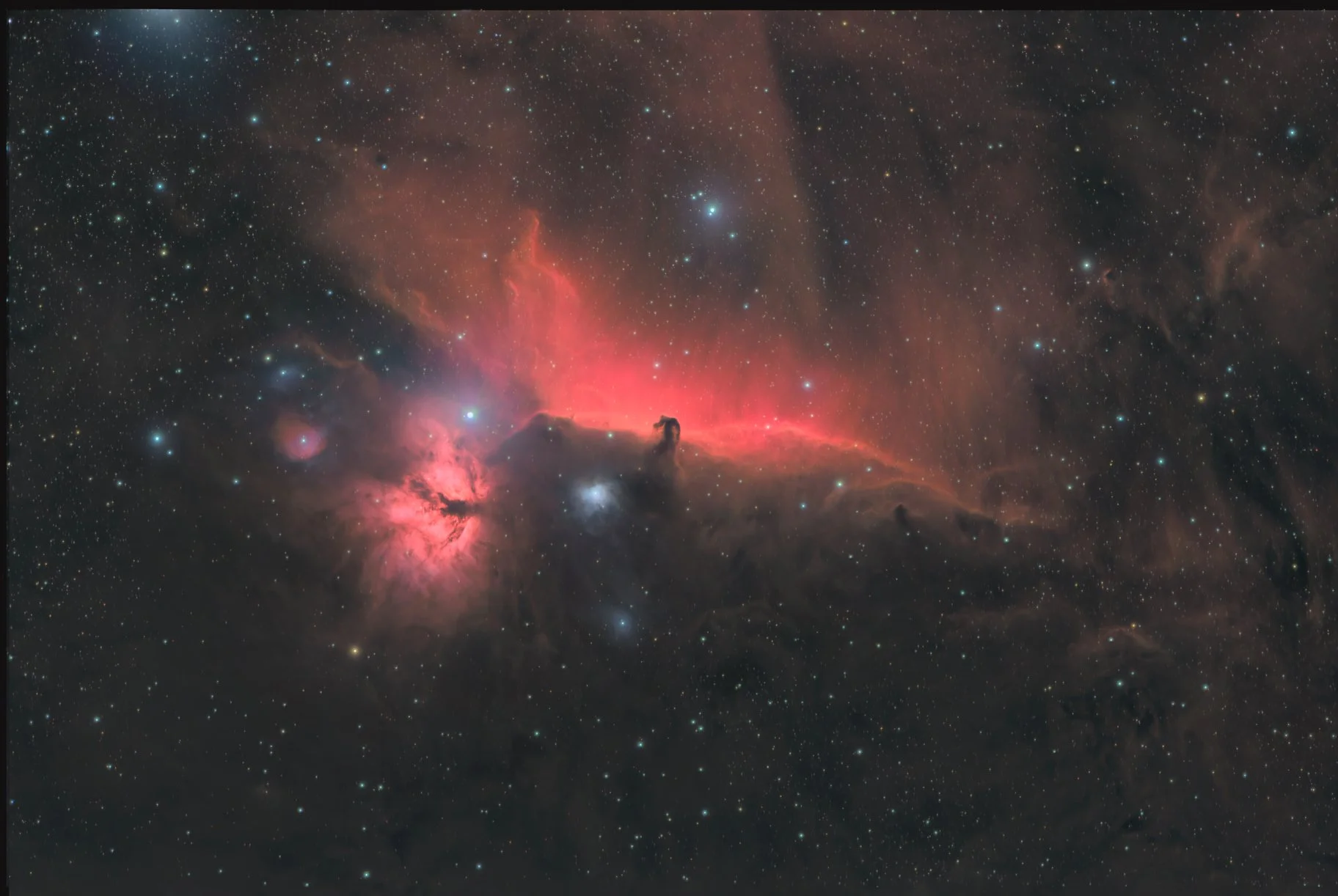
The Flame and the Horse — B33 & NGC 2024Barnard 33 | IC 434 | NGC 2024 | NGC 2023 | Constellation Orion | LRGBHSO | ~1,375 light years
Some objects are so famous that imaging them feels like a statement rather than a discovery. This is one of them — and that is exactly the point.
The Horsehead Nebula, catalogued as Barnard 33, is one of the most recognised shapes in all of astronomy. The dark pillar of cold molecular dust rearing against the fierce red glow of IC 434 — a wall of ionised hydrogen lit by the massive star Sigma Orionis — is an image burned into the collective memory of anyone who has ever looked up with curiosity. It was first spotted in 1888 by Williamina Fleming, a Scottish astronomer working at the Harvard College Observatory, who described it simply as a semicircular indentation in the nebulosity south of Zeta Orionis. She was not credited for the discovery for twenty years. The shape she noticed is approximately 3.5 light years across — a column of dust so dense it blocks everything behind it, while the young stars forming at its base slowly erode it from within.
To its left in this frame, the Flame Nebula — NGC 2024 — glows in the pink and blue palette of this LRGBHSO composite, its intricate dust lanes crossing the interior of the emission region like fault lines in something geological. Between the two, the blue reflection nebula NGC 2023 catches the light of a central star and scatters it back across the frame — a cooler note between the two warmer, fiercer objects that flank it.
All of this is a northern sky winter object. In the northern hemisphere it climbs high on January nights, a staple of cold-weather imaging sessions from observatories in Europe and North America. In the southern hemisphere — from a Bortle 1 plateau in the mountains of the Northern Cape — it is a summer object, imaged here in December. Half a world away from where most of its photographs are taken, under skies that most astrophotographers will never access, with a clarity and depth that makes the familiar strange again.
That is the intention. To take objects everyone has seen, and show them from somewhere else entirely.
12 hours 12 minutes integration, December 2025 | Kagga Kamma Remote Observatory, Cederberg Mountains, South Africa | Bortle 1 | Tele Vue 76mm at f/5 with 0.79x reducer | LRGBHSO
Available as:— Metal print — the recommended format for this image. the deep red of IC 434 and the dark geometry of the Horsehead have exceptional graphic presence on a reflective surface.— Acrylic print — exceptional depth and colour saturation— Fine art paper — archival giclée, satin or matte finish
Sizes from 12" to 40" on the long edge. Made to order.
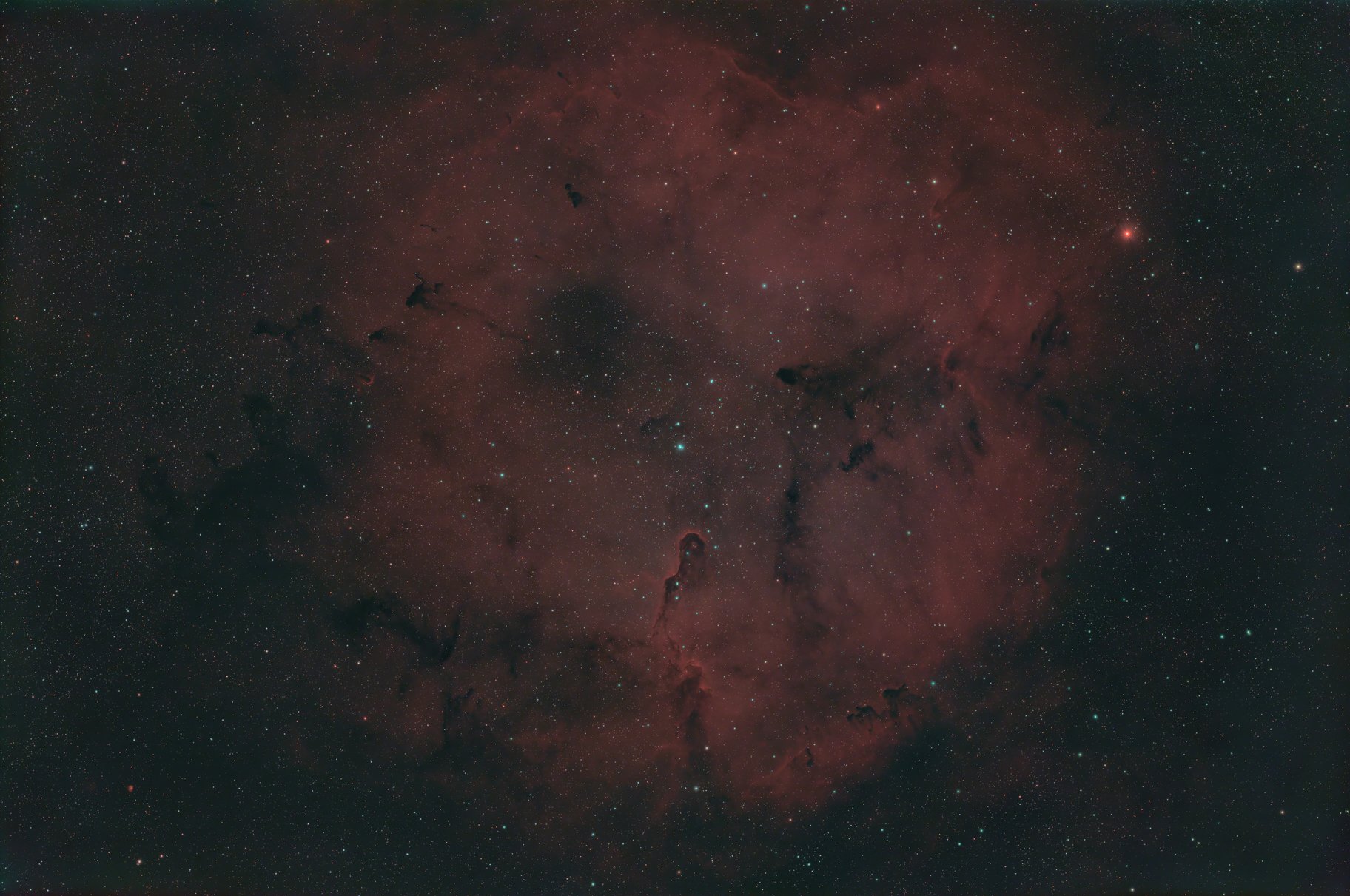
The Elephant's Trunk — IC 1396IC 1396 | Mu Cephei — The Garnet Star | Constellation Cepheus | Multi-filter LRGB + HaOIII + HbSii | ~2,400 light years
This image was made from the heart of a global city of nine million people, under skies so bright that most deep sky objects are simply invisible. That is the point.
IC 1396 is a large emission region and open cluster in Cepheus, about 2,400 light years away, spanning nearly three degrees of sky — one of the most active star-forming regions in our section of the Milky Way. Within it, sculpted by the fierce radiation of the hot young stars at its centre, are cometary globules — dark pillars of cold molecular dust being slowly eroded from the outside in, their tips glowing where the radiation meets the denser material within. The most prominent of these, curling up from the lower centre of the frame, is the Elephant's Trunk — a column of gas and dust approximately 20 light years long, a stellar nursery in the process of being destroyed by the very stars whose formation it once facilitated.
The dark globules scattered across the field are each a separate story — cold, dense knots of material that have survived the radiation long enough to begin forming stars within them, though for how much longer is uncertain. This is star formation and stellar erosion happening simultaneously in the same frame.
Towards the upper right of the nebula glows a star so red it arrests the eye even in an image dominated by crimson hydrogen emission. This is Mu Cephei — the Garnet Star, named by William Herschel in 1783, who described it as "a very fine deep garnet colour." It is one of the largest and most luminous red supergiants known, with a radius somewhere between 1,200 and 1,650 times that of the Sun. Were it placed at the centre of our solar system, it would engulf the orbits of Jupiter and Saturn. It is more than 100,000 times brighter than the Sun in visual light alone. It is also dying — it has almost certainly stopped fusing hydrogen in its core and is burning through heavier elements, moving inexorably toward a supernova that will likely leave a black hole behind. When that happens, on a timescale that is short in cosmic terms, will the star that Herschel admired briefly outshine the entire galaxy before vanishing?
This image was made from London in August 2024, using narrowband filters to cut through the light pollution that renders broadband imaging almost impossible. The Bortle 9 urban sky contains this. You just have to be patient enough to find it.
9 hours 8 minutes integration, August 2024 | London, UK | Bortle 9 | Takahashi FSQ106N | Astronomik CLS-CCD + Antlia ALP-T HaOIII + HbSii
Available as:— Metal print — the recommended format for this image. the deep crimson of the emission region and the dark geometry of the cometary globules have exceptional graphic presence on a reflective surface.— Acrylic print — exceptional depth and colour saturation— Fine art paper — archival giclée, satin or matte finish
Sizes from 12" to 40" on the long edge. Made to order.
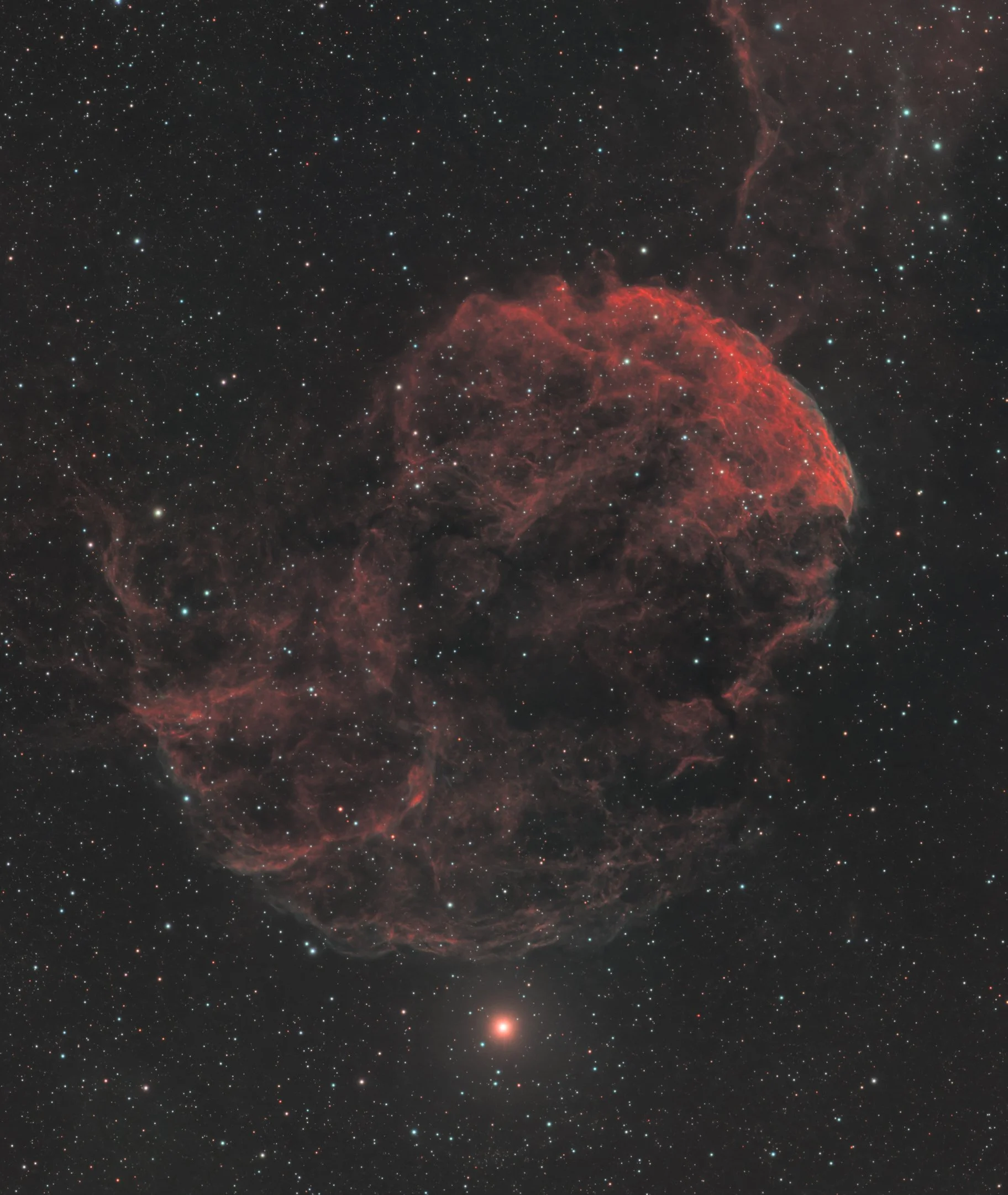
The Lion's Mane Jellyfish — IC 443IC 443 | Sharpless 248 | Constellation Gemini | Multi-filter LRGB + HaOIII + HbSii | ~5,000 light years
This image took eleven months.
Not eleven months of continuous imaging — eleven months because London's urban sightlines, weather, and light pollution conspired to allow only occasional usable nights on this target across the better part of a year. Each usable window was seized. The data was accumulated patiently, night by night, across seasons, until there was enough.
The result is IC 443 — the Jellyfish Nebula, also known as Sharpless 248, a supernova remnant in Gemini about 5,000 light years away. The name most astrophotographers use is the Jellyfish. But look at it. The great billowing dome of crimson filaments, the trailing tendrils curling downward, the dense internal structure visible through the emission shell — this is not just a jellyfish. This is a lion's mane jellyfish, the largest of the entire cnidarian phylum, its bell drifting through the deep, its trailing mass of tentacles spreading beneath it. The name is exact in a way the conventional one isn't.
The structure you see here is the physical remains of a star that destroyed itself somewhere between 3,000 and 30,000 years ago — the age is genuinely uncertain, which is itself remarkable. The shock wave from that explosion has been propagating outward ever since, encountering molecular clouds of different densities and being decelerated at different rates, which is why the two halves of the remnant have different radii and centres. In the denser southeastern region the blast wave has slowed to around 30 kilometres per second. In the less dense northeastern region — the bright upper right of this image — it is still moving at 80 to 100 kilometres per second. The same explosion producing two very different structures simultaneously.
At the southern edge of the remnant, a neutron star has been identified — the crushed remnant of the stellar core that caused all of this. It is moving away from the explosion site at approximately 800,000 kilometres per hour. It will still be moving long after the visible nebula has faded.
The bright red star sitting below the nebula in this frame is Eta Geminorum — the star by which IC 443 is located on sky charts. It is there in every image of this object, a reference point, a witness.
16 hours 28 minutes integration across 11 months, 2024–2025 | London, UK | Bortle 9 | Takahashi FSQ106N | Astronomik CLS-CCD + Antlia ALP-T HaOIII + HbSii
Available as:— Metal print — the recommended format for this image. the deep crimson filaments and the dark internal structure of the remnant have exceptional presence on a reflective surface.— Acrylic print — exceptional depth and colour saturation— Fine art paper — archival giclée, satin or matte finish
Sizes from 12" to 40" on the long edge. Made to order.
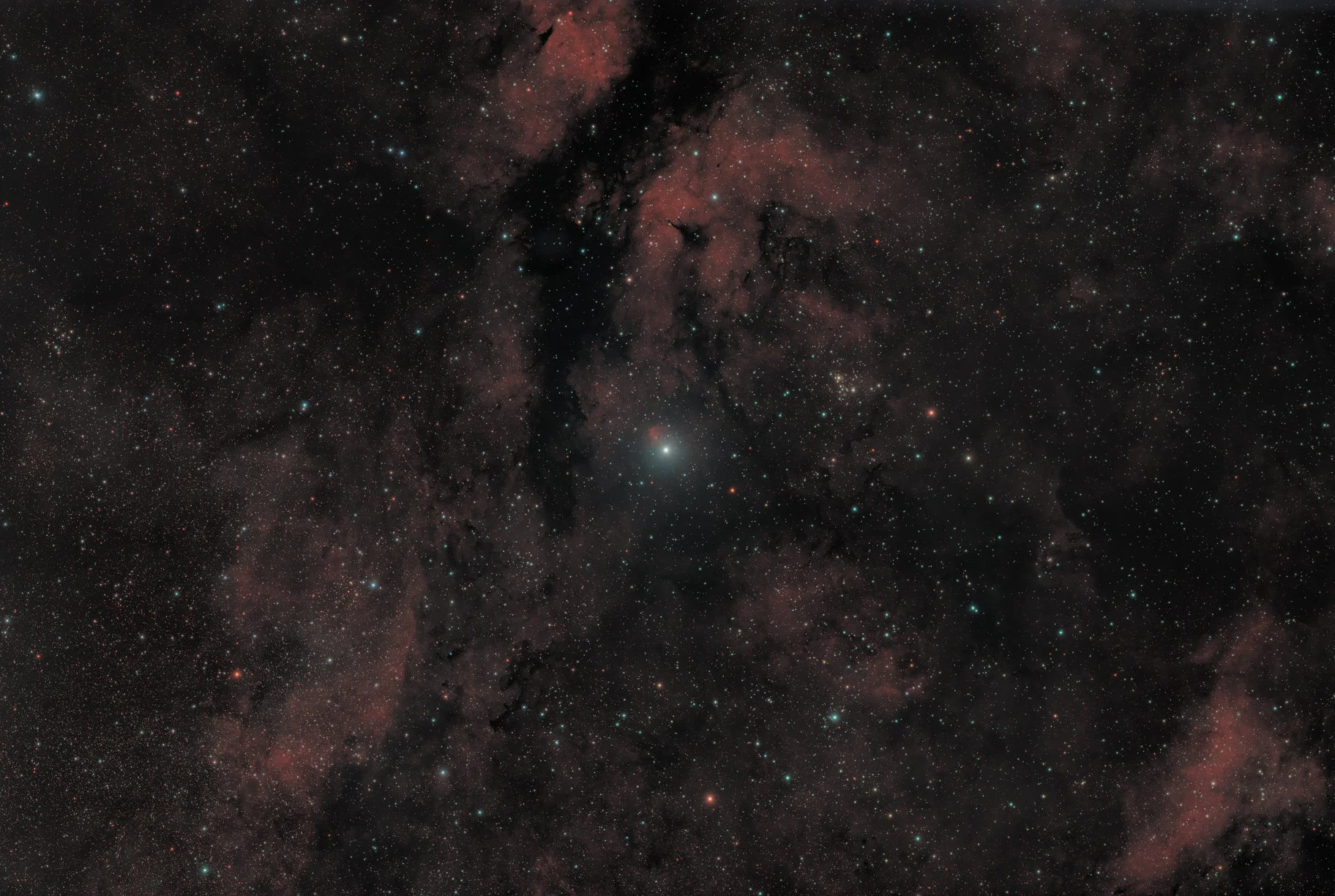
Sadr and the Butterfly — IC 1318IC 1318 | LDN 889 | Gamma Cygni — Sadr | Constellation Cygnus | Multi-filter LRGB + HaOIII + HbSii | ~4,900 light years
The brilliant star blazing at the centre of this image is not part of the nebula surrounding it. It just looks that way.
Sadr — Gamma Cygni, the star that marks the heart of the Swan and the intersection of the Northern Cross — sits about 1,800 light years from Earth, its name derived from the Arabic for "chest." It is a yellow-white supergiant, 12 times the mass of the Sun, 150 times its radius, more than 33,000 times its luminosity. It appears to float at the centre of the emission nebula that surrounds it in this image — but the nebula, IC 1318, is nearly 5,000 light years away. Sadr and the Butterfly are not related. They share only a line of sight, and our presence at a particular point in the galaxy, looking outward in a particular direction, at a particular moment in cosmic time.
IC 1318 itself is a giant HII region spanning more than 100 light years, one of the brightest emission clouds in the entire Cygnus complex. What gives it the butterfly name is the dark dust lane designated LDN 889 — a physical structure 20 light years thick that bisects the nebula into two lobes. The symmetry is not accidental — the two wings are a single cloud, physically separated by an intervening wall of cold molecular dust that blocks the light between them. The butterfly is a shadow, as much as it is an object.
But the most extraordinary thing in this image is not the nebula, and not Sadr. It is the dark material threading through the entire frame — the great sweeping lanes of the Cygnus Rift, part of the largest dark nebula complex visible in the northern sky, a series of overlapping molecular clouds that create the dark division running through the Milky Way in Cygnus. In long-exposure images under dark skies it is dramatic. From a Bortle 9 urban site, with narrowband filters cutting through the light pollution, it becomes something else — an almost geological presence, ancient and immovable, older than any of the stars visible through it.
10 hours 56 minutes integration, July 2025 | London, UK | Bortle 9 | Takahashi FSQ106N | Astronomik CLS-CCD + Antlia ALP-T HaOIII + HbSii
Available as:— Metal print — the recommended format for this image. the contrast between Sadr's electric blue-white and the deep crimson emission field has exceptional graphic presence on a reflective surface.— Acrylic print — exceptional depth and colour saturation— Fine art paper — archival giclée, satin or matte finish
Sizes from 12" to 40" on the long edge. Made to order.
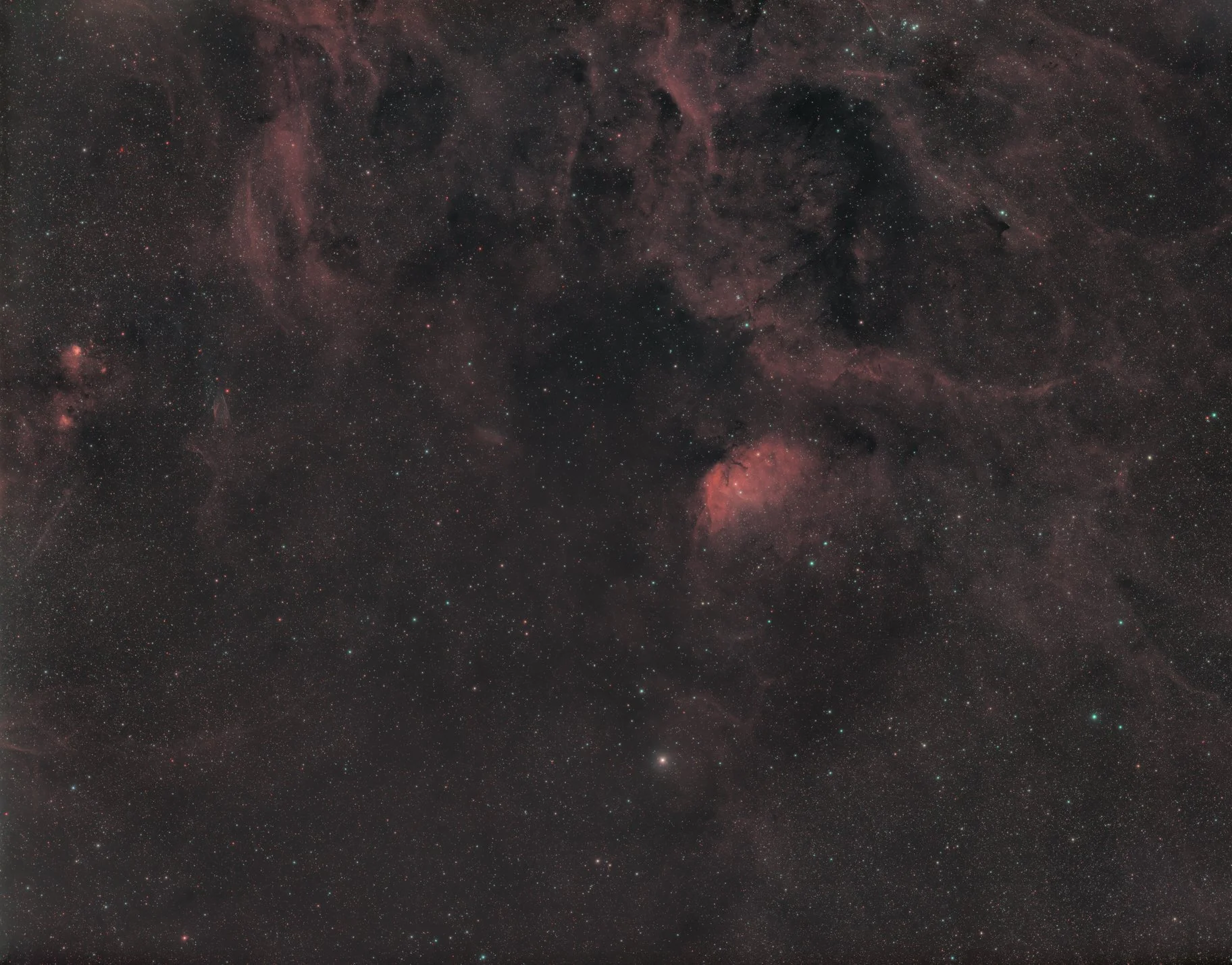
The Tulip in the Swan — Sh2-101Sharpless 101 | Cygnus X-1 | K3-50A | Constellation Cygnus | Dual-band HaOIII + HbSii | ~6,000 light years
There is a black hole in this image. You cannot see it directly. But you can see what it is doing.
The Tulip Nebula — Sharpless 101, catalogued by astronomer Stewart Sharpless in 1959 — is an HII emission region in Cygnus, about 6,000 light years away, its lobed structure giving rise to the name. It sits in a rich and turbulent corridor of the Milky Way, embedded in hydrogen emission that fills the entire frame. The Tulip itself glows in the centre-right of the image, compact and bright against the surrounding complexity.
About fifteen arcminutes west of the Tulip — in the same field of view, at roughly the same distance — lies Cygnus X-1, one of the most studied objects in modern astrophysics and one of the first candidates ever proposed for a black hole. It consists of a blue supergiant star, HDE 226868, 21 times the mass of our Sun, orbiting an unseen companion every 5.8 days at a separation of only 0.2 astronomical units — closer than Mercury is to our Sun. The companion has a mass of 15 solar masses and a Schwarzschild radius of just 45 kilometres. It is a black hole, consuming material from the supergiant's stellar wind, feeding an accretion disc that blazes in X-rays. When astronomers first detected those X-rays in the 1960s, they had found something they had no name for. It took decades to confirm what it was.
The black hole's relativistic jet — a stream of energetic particles fired perpendicular to the accretion disc — is colliding with the surrounding interstellar medium, creating a bowshock: a curved arc of compressed, glowing gas where the jet meets resistance. That bowshock is visible in this image — faint, subtle, requiring careful examination of the starless data to find, but present. A bow wave made by a black hole, rendered from a garden in London with a narrowband filter and patience.
Also caught in this frame is K3-50A — a compact HII region in the same rich Cygnus field, one of many objects that populate this dense corridor of the Milky Way, each with their own story, each sharing only a line of sight.
This image was made with dual-band narrowband filters only — no broadband RGB — in July 2024. In Bortle 9 skies, narrowband is not a compromise. It is the only instrument that lets the city's light through without bringing all of it.
10 hours 40 minutes integration, July 2024 | London, UK | Bortle 9 | Takahashi FSQ106N | Antlia ALP-T HaOIII & HbSii dual-band
Available as:— Metal print — the recommended format for this image. the rich hydrogen emission and the subtle bowshock arc have exceptional tonal range on a reflective surface.— Acrylic print — exceptional depth and colour saturation— Fine art paper — archival giclée, satin or matte finish
Sizes from 12" to 40" on the long edge. Made to order.
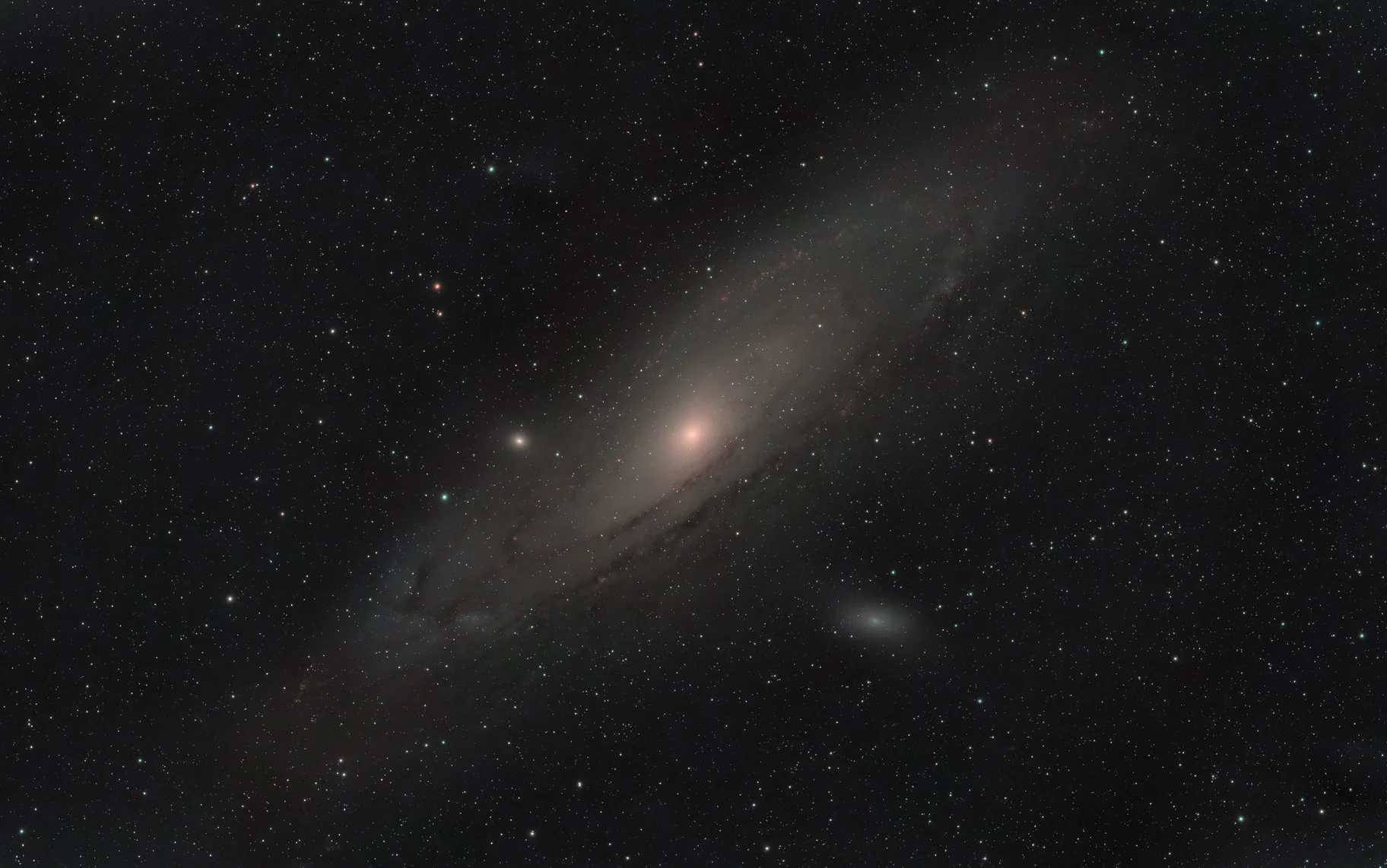
The Andromeda Galaxy — M31Messier 31 | M32 | M110 | Constellation Andromeda | Broadband LRGB + HaOIII + HbSii | ~2.5 million light years
This is the most distant object normally visible to the naked eye. On a clear dark night, without any optical aid, you can look up and see a faint smudge of light in Andromeda — and what you are seeing is a trillion stars, 2.5 million light years away. The light reaching your eye left before our species existed.
Messier 31 — the Andromeda Galaxy — is the largest member of our Local Group of galaxies and our nearest large spiral neighbour. It is roughly twice the diameter of the Milky Way, containing perhaps a trillion stars to our galaxy's 300 to 400 billion. In this image, made from London with broadband and dual-band narrowband filters combined, the disc extends across nearly the full width of the frame — the dust lanes clearly visible, the faint outer halo peeping at the edges, and, scattered through the disc, the pink knots of HII star-forming regions that the narrowband data has pulled out of the urban sky.
To the lower right of the main disc sits M32 — a compact elliptical satellite galaxy, small and dense, its stars tightly packed around a supermassive black hole at its centre. To the upper left, the larger and more diffuse M110 — another elliptical companion, its outer halo barely distinguishable from the surrounding sky. Both satellites have been orbiting Andromeda for billions of years. Both will be part of whatever comes next.
Because something is coming. Andromeda is approaching the Milky Way at roughly 110 kilometres per second, dragged toward us by the mutual gravitational attraction of two galaxies and the dark matter halos surrounding them. For decades, astronomers predicted an almost certain head-on collision in about four billion years — an event that would eventually merge both galaxies into a single giant elliptical, nicknamed Milkomeda. But new calculations published in 2025, using data from the Gaia and Hubble space telescopes, now suggest the picture is more uncertain than previously thought. When the gravitational influence of the Large Magellanic Cloud and Triangulum galaxy are properly accounted for, there is now roughly a 50% chance the two galaxies miss each other entirely, passing at a distance of half a million light years before slowly spiralling inward. The collision that seemed inevitable turns out to be merely possible.
Either way, the stars will not collide. Galaxies are mostly empty space — if the Sun were a ping-pong ball, its nearest neighbour would be a pea 680 miles away. Even in the densest regions, stars pass through each other's presence without touching. What changes is the orbits, the shapes, the future.
This is the galaxy that is coming toward us. Imaged through the light pollution of one of the largest cities on Earth, on autumn nights in 2024, with narrowband filters pulling colour from a sky that should not allow it.
17 hours 40 minutes integration, October — November 2024 | London, UK | Bortle 9 | Takahashi FSQ106N | Astronomik CLS-CCD + Antlia ALP-T HaOIII & HbSii dual-band
Available as:— Metal print — the recommended format for this image. the warm tones of the galactic core against the dark field have exceptional presence on a reflective surface.— Acrylic print — exceptional depth and colour saturation— Fine art paper — archival giclée, satin or matte finish
Sizes from 12" to 40" on the long edge. Made to order.
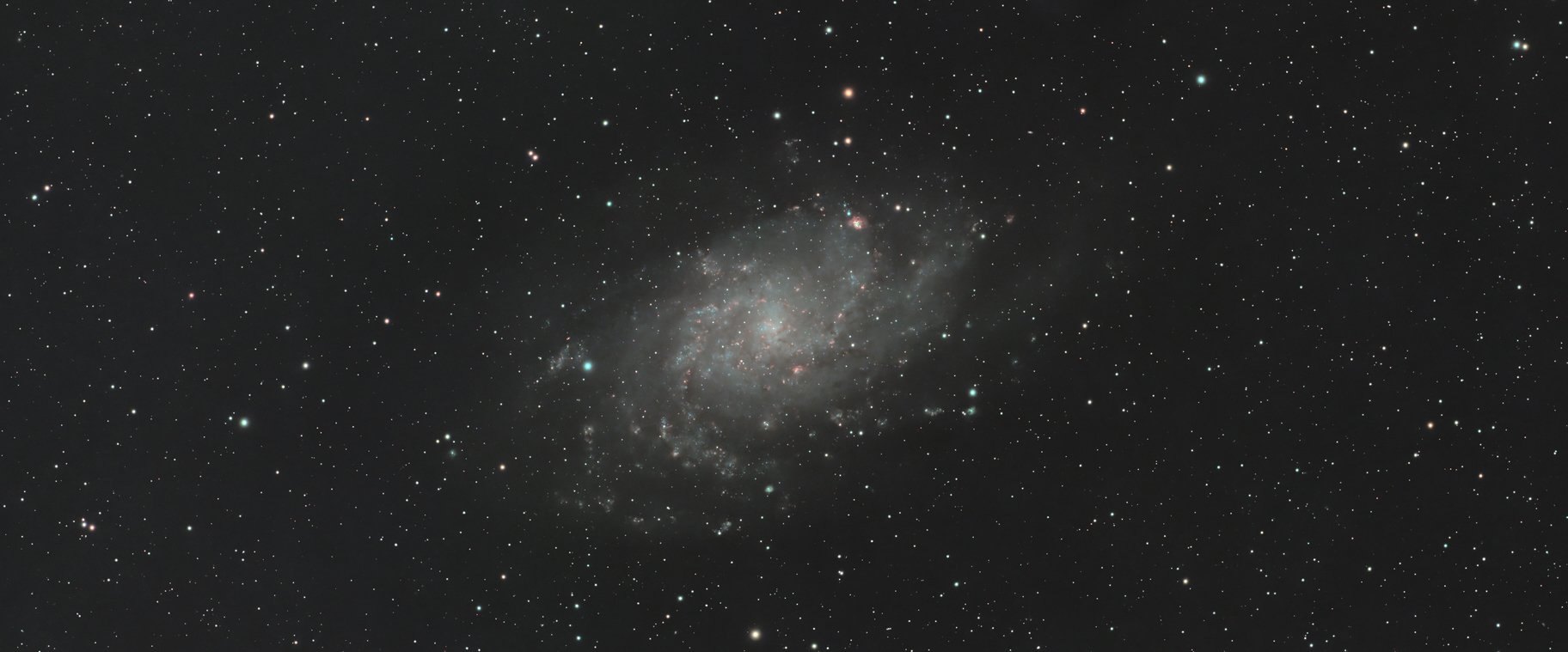
The Triangulum Galaxy — M33Messier 33 | NGC 604 | Constellation Triangulum | Broadband LRGB + HaOIII + HbSii | ~2.7 million light years
Three million light years away, face-on, and almost too faint to find with the naked eye despite being one of the largest galaxies in the Local Group.
M33 — the Triangulum Galaxy — is the third major member of our Local Group, after the Milky Way and Andromeda. At roughly 2.7 million light years distant it is actually slightly further than Andromeda, and yet its face-on orientation spreads its light across a large area of sky, making it one of the most challenging naked-eye objects there is. Under perfect dark skies with fully dark-adapted eyes it can be glimpsed — but only just. From London, it is invisible without a telescope. With a telescope, a camera, twelve hours of integration, and narrowband filters layered over broadband data, it becomes this.
The cool blue-grey tones of the spiral arms are the natural colour of a galaxy dominated by young hot blue stars and active star formation — M33 is forming stars at a vigorous rate, its loose flocculent arms scattered with HII regions that glow pink in this composite. The largest of these — NGC 604, visible as a bright knot in the upper spiral arm — is one of the largest known HII regions in the Local Group, roughly 1,500 light years across, hundreds of times the size of the Orion Nebula. It contains several hundred of the most massive stars known, and if it were as close to us as the Orion Nebula, it would cast shadows on the ground at night.
M33 is gravitationally bound to Andromeda and orbits it at an enormous distance. In the 2025 recalculation of the Milky Way-Andromeda collision probability, M33's gravitational influence was one of the factors that made the outcome more uncertain — its pull on the system runs at an angle to the Milky Way-Andromeda approach, complicating the dynamics considerably. Whether it eventually joins a merger, flies through, or is flung outward entirely remains genuinely unknown.
This image was made across five nights in November 2024. On one of those nights, cosmic ray activity became unusually intense requiring careful rejection during stacking, with more data lost than kept from that session. What survived the process across all five nights is twelve hours of photons from a galaxy three million light years away, gathered through the glow of the London night sky.
12 hours integration, November 2024 | London, UK | Bortle 9 | Takahashi FSQ106N | Astronomik CLS-CCD + Antlia ALP-T HaOIII & HbSii dual-band
Available as:— Metal print — the recommended format for this image. the cool blue-grey of the spiral arms against the dark field has a quiet, distinctive presence on a reflective surface.— Acrylic print — exceptional depth and colour saturation— Fine art paper — archival giclée, satin or matte finish
Sizes from 12" to 40" on the long edge. Made to order.
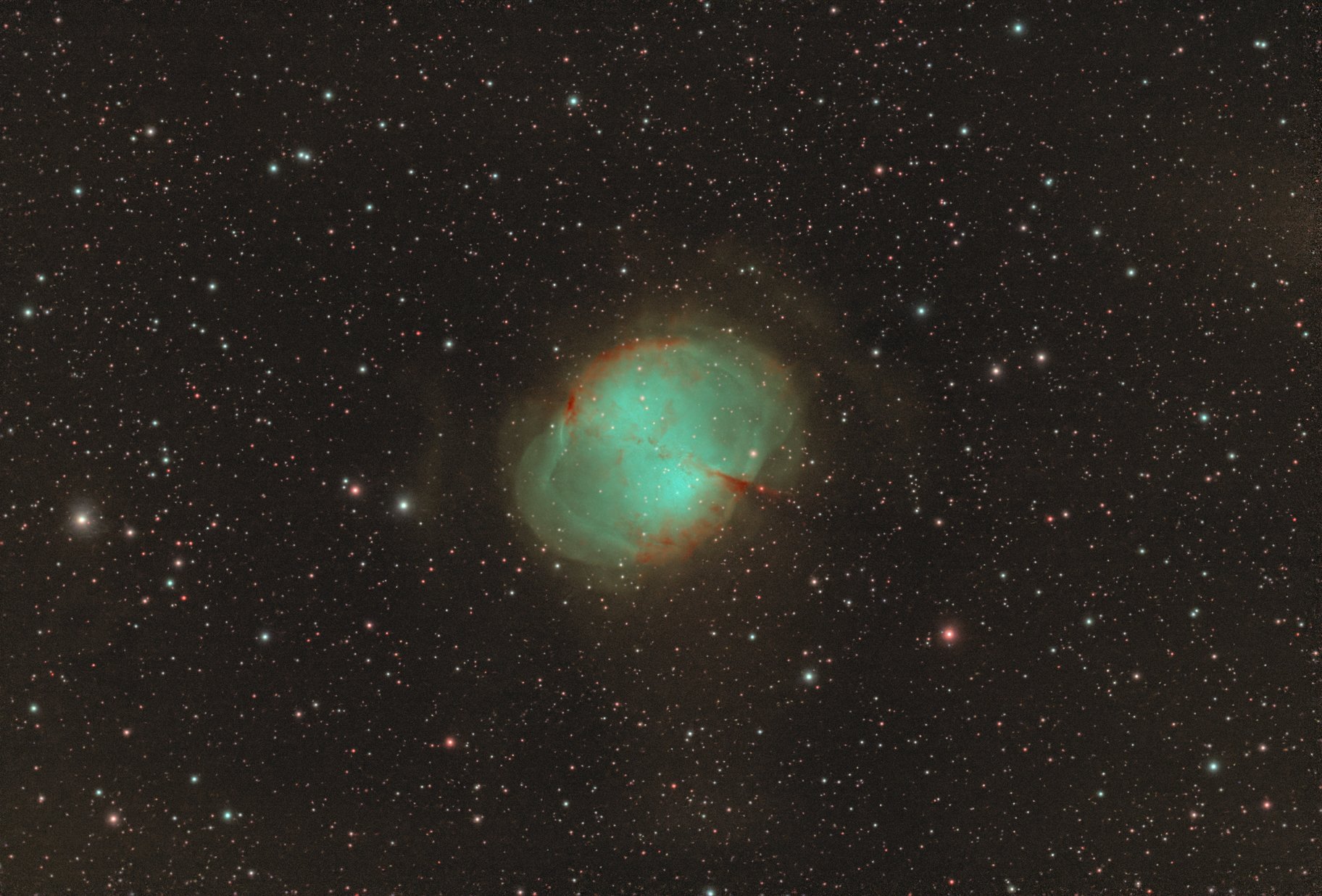
The Dumbbell Nebula — M27Messier 27 | NGC 6853 | Constellation Vulpecula | SHO | ~1,360 light years
This is what our Sun will look like in about five billion years.
Messier 27 — the Dumbbell Nebula — was the first planetary nebula ever discovered, found by Charles Messier in 1764 in the tiny constellation Vulpecula, the Little Fox. It sits about 1,360 light years away and spans roughly 2.5 light years across. What you see here is the outer layers of a star that has already died — a sun-like star that exhausted its nuclear fuel, shed its outer atmosphere over tens of thousands of years, and left behind a white dwarf at its centre. That white dwarf, visible as the brilliant point at the heart of the nebula, has a surface temperature of around 85,000 Kelvin — one of the hottest known white dwarfs, its fierce ultraviolet radiation ionising the surrounding gas and causing it to glow.
In this SHO narrowband palette, hydrogen emission dominates in luminous teal-green, filling the lobes and outer halo with the characteristic glow of ionised gas expanding outward from the dying star, while sulphur traces the warmer red filaments that thread through the inner structure — the denser, hotter regions where the shock front between the fast stellar wind and the slower-moving expelled material compresses and heats the gas. Oxygen contributes to the cooler blue component of the teal, visible particularly in the outer halo where the gas has expanded and cooled furthest from the central white dwarf.
The name Dumbbell comes from the object's visual appearance through small telescopes — those two pinched lobes that give it a weight-like shape. In long-exposure photography the full roughly spherical outer halo becomes visible, and the object reveals itself as something richer and more complex than the name suggests.
The instrument that made this image was never designed for deep sky imaging. The Meade ETX125 is a 127mm Maksutov-Cassegrain — a compact visual telescope, sold primarily for planetary and lunar observation, running at f/15 with a focal length of approximately 1,900mm. It was deforked from its original alt-az mount, fitted with a Wegat visual back adapter, and placed on an equatorial pier. The SHO data was acquired using two dual-band filters — an Altair HaOIII and an Altair SiiOIII — with the channels subsequently decomposed and recombined into a true SHO composite. With patience, ten hours of data, and optics that were made properly in the first place, it produced this.
The city sky contains things you would not expect. You just have to be willing to find them with whatever you have.
10 hours 20 minutes integration, June 2025 | London, UK | Bortle 9 | Meade ETX125 Maksutov-Cassegrain f/15 | Altair HaOIII + SiiOIII dual-band, SHO composite
Available as:— Metal print — the recommended format for this image. the luminous teal of the hydrogen shell against the dark field has exceptional colour presence on a reflective surface.— Acrylic print — exceptional depth and colour saturation— Fine art paper — archival giclée, satin or matte finish
Sizes from 12" to 40" on the long edge. Made to order.
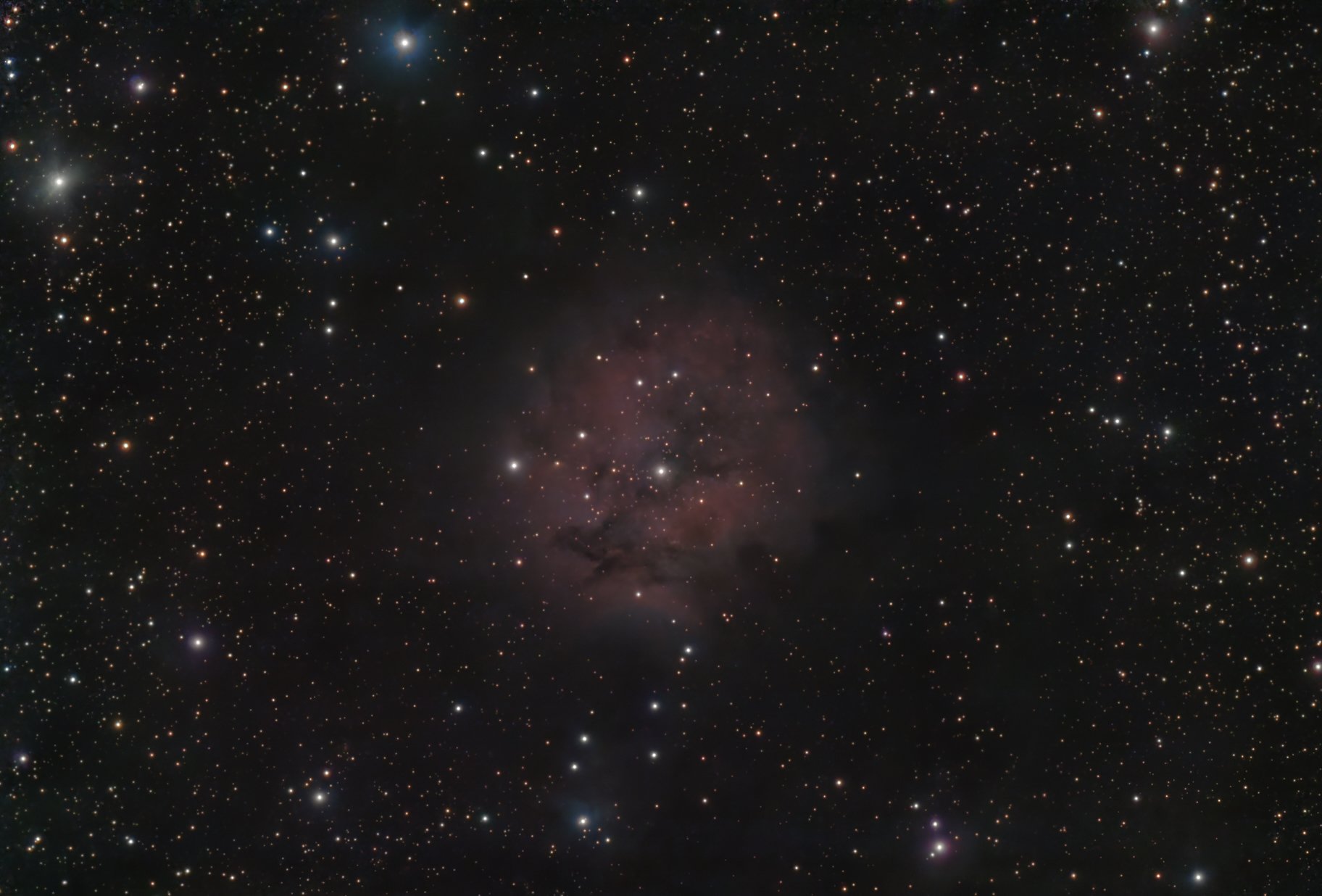
The Cocoon Nebula — IC 5146IC 5146 | Barnard 168 | Collinder 470 | Constellation Cygnus | Broadband LRGB | ~3,000 light years
At the end of a long dark river, a cocoon.
Barnard 168 — the dark nebula threading in from the left of this image — is a trail of cold molecular dust stretching across nearly two degrees of sky, a dark lane visible in binoculars under good conditions and dramatic in long-exposure photography. It leads the eye eastward to its terminus: IC 5146, the Cocoon Nebula, where the darkness gives way to a soft pink glow of emission and reflection, young stars scattered through the interior like sparks still settling after something has ignited.
The Cocoon is a rare combination of three nebula types simultaneously — emission, where hydrogen ionised by the central star glows in its own right; reflection, where surrounding dust scatters the blue light of young stars back toward us; and absorption, where denser dark lanes within the nebula itself block the light of everything behind them. All three are visible here, layered over each other in natural broadband colour, without narrowband enhancement. What you see is close to what the object truly looks like.
The central illuminating star — BD +46°3474, the brightest point near the heart of the cocoon — is estimated to be only 100,000 years old. In stellar terms that is newborn. It has a mass of around 14 times the Sun and has already carved a cavity in the surrounding molecular cloud through which nebular material flows outward toward us. The open cluster forming around it — Collinder 470 — contains stars that are similarly young, still embedded in the gas and dust of their birth environment, still surrounded by the cocoon that named them.
This image was made with a deforked Meade ETX125 Maksutov-Cassegrain at f/15 through an Optolong Skyglow broadband filter from London — not a narrowband filter, not a specialist instrument, just a visual telescope adapted for imaging with patience. The 8 hours 48 minutes of integration time came from 1,372 individual frames at exposures of 15, 30 and 60 seconds — kept short because the London sky would otherwise overwhelm the signal entirely. The result is a galaxy three thousand light years away rendered in natural colour from a garden in one of the most light-polluted cities on Earth.
8 hours 48 minutes integration, 1,372 frames, August 2023 | London, UK | Bortle 9 | Meade ETX125 Maksutov-Cassegrain f/15 | Optolong Skyglow broadband
Available as:— Metal print — the recommended format for this image. the soft pink of the cocoon against the dark molecular lane has a quiet intimacy on a reflective surface.— Acrylic print — exceptional depth and colour saturation— Fine art paper — archival giclée, satin or matte finish
Sizes from 12" to 40" on the long edge. Made to order.
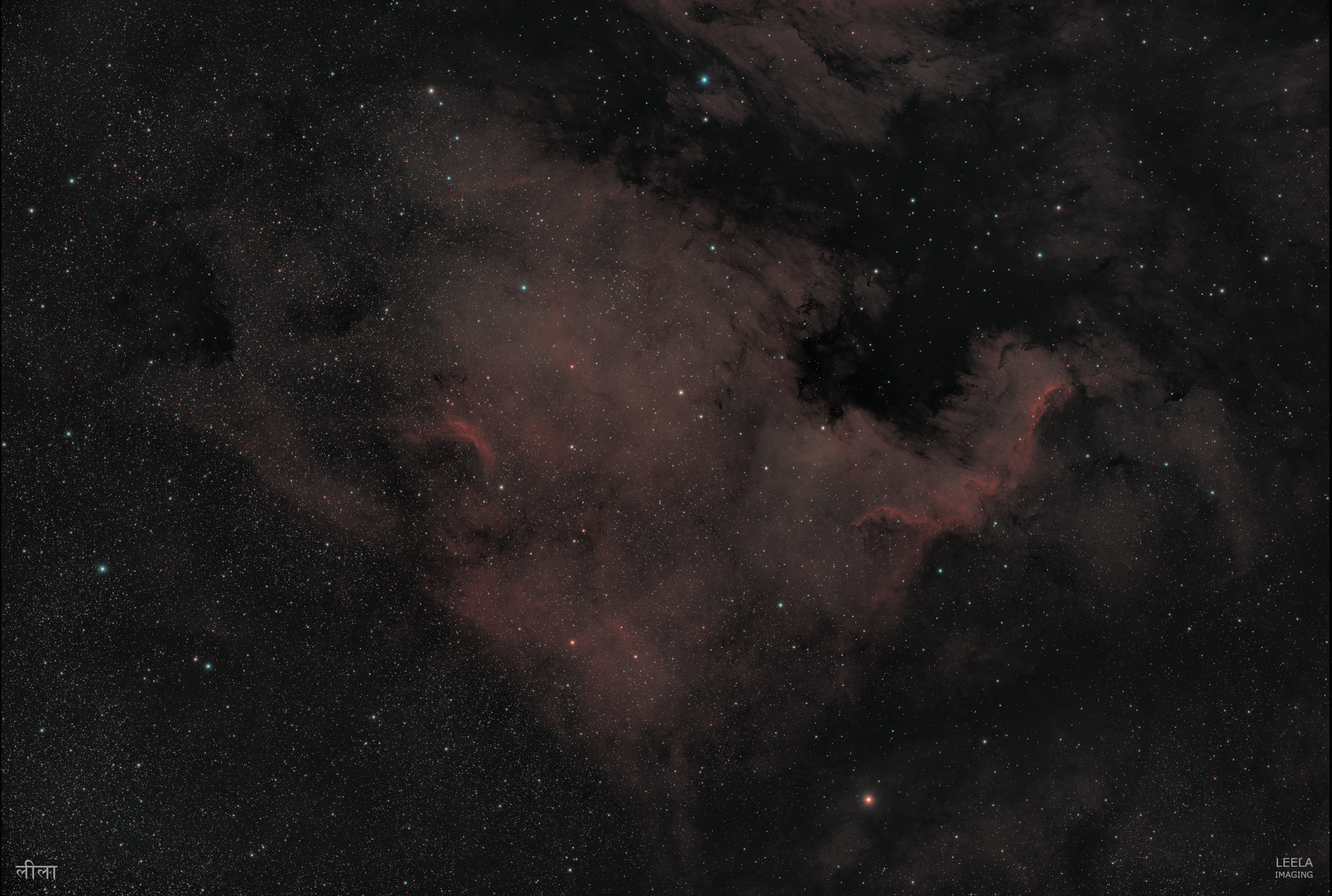
The North America Nebula — NGC 7000NGC 7000 | IC 5070 — The Pelican | LDN 935 | Constellation Cygnus | Broadband LRGB + HaOIII + HbSii | ~1,600 light years
Look at the darkness in this image. Not space. Clouds.
This was the realisation this image produced — that the great sweeping black regions that divide the North America Nebula into its recognisable continental shape are not voids, not emptiness, not the absence of anything. They are cold molecular clouds, tens of light years deep, silhouetted against the glowing hydrogen emission behind them. The darkness has mass. It has temperature. It has structure. Space itself, at these wavelengths and these depths, is not that black.
The shape is immediately recognisable: the eastern seaboard running upper left, the Gulf of Mexico the great dark bay at centre, the Cygnus Wall the dramatic bright ridge on the right edge — an ionisation front where the radiation from young hot stars is actively eroding the molecular cloud behind it, one of the most concentrated regions of active star formation in this part of the Milky Way. At the upper right, just peeping into the frame, the bill of the Pelican Nebula — IC 5070, a separate catalogued object but physically part of the same enormous hydrogen cloud, separated from the North America Nebula only by the dark lane of LDN 935 cutting across the field.
And hidden within that dark lane — the star that lights the whole thing. For decades astronomers assumed the nearby supergiant Deneb was responsible for ionising this nebula, but Deneb is not hot enough — its surface temperature of 8,500 Kelvin cannot account for the nebula's emission spectrum, which requires a star hotter than 30,000 Kelvin. In 2004, after a careful infrared search behind the obscuring dust, astronomers found it: a star catalogued J205551.3+435225, nicknamed the Bajamar Star, an O3.5 type with a surface temperature over 40,000 Kelvin. It sits right at the centre of the entire complex, just off the Florida coast of the nebula, dimmed by nearly 10,000 times by the dark cloud in front of it. Invisible in optical light. Hidden in plain sight.
The warm chocolate and rose palette of this image comes from the combination of the Astronomik CLS-CCD broadband filter with Antlia narrowband — a natural colour foundation with narrowband enhancement layered over it, pulling signal from a sky that offers almost none. Made from London in August 2024.
12 hours 36 minutes integration, August 2024 | London, UK | Bortle 9 | Takahashi FSQ106N | Astronomik CLS-CCD + Antlia ALP-T HaOIII & HbSii dual-band
Available as:— Metal print — the recommended format for this image. the warm palette and the graphic continental shape have exceptional presence on a reflective surface.— Acrylic print — exceptional depth and colour saturation— Fine art paper — archival giclée, satin or matte finish
Sizes from 12" to 40" on the long edge. Made to order.
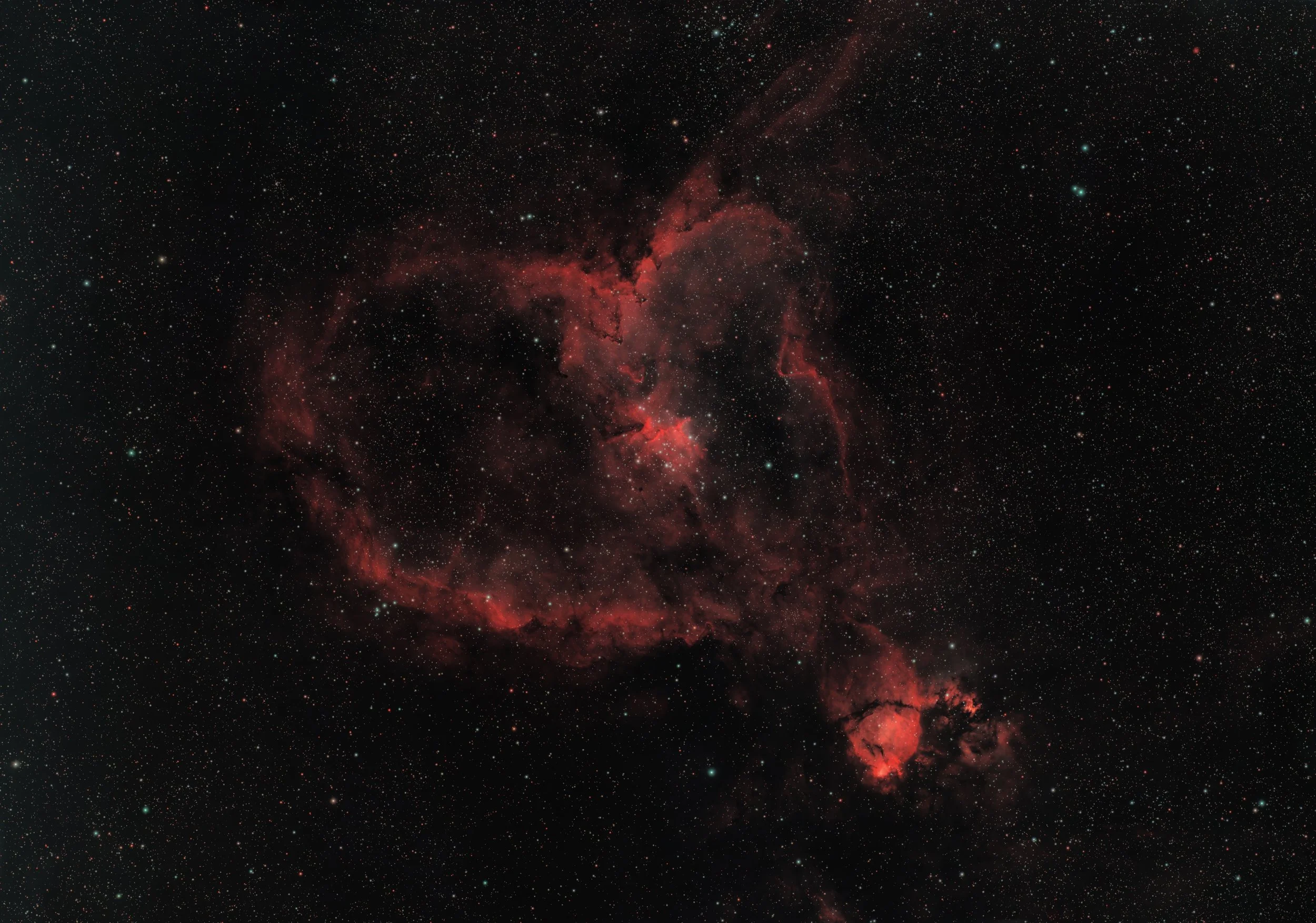
The Heart Nebula IC 1805 | Melotte 15 | Constellation Cassiopeia | HaOIII + HbSii dual-band | ~7,500 light years
This image was made under a moon between 74 and 87 percent full. Narrowband filters do not care about moonlight.
IC 1805 — the Heart Nebula — is an emission nebula in Cassiopeia, about 7,500 light years away in the Perseus Arm of the Milky Way, spanning roughly 200 light years across — an area of sky nearly four times the diameter of the full Moon. Its shape, in long-exposure images, resembles a human heart well enough that the name has stuck since Max Wolf first photographed it. The great looping shell of crimson hydrogen emission, the dark molecular lanes threading through its interior, the concentrated brightness of its centre — all of it visible here in the clean red tones of dual-band narrowband pulled from a London autumn sky while the Moon blazed overhead.
At the heart of the Heart is Melotte 15 — the open cluster blazing at the nebula's centre, visible as the bright stellar concentration in the upper interior of the loop. Its stars are only about 1.5 million years old — newborn by any cosmic measure — and several have masses approaching 50 times that of the Sun. Their fierce ultraviolet radiation is what ionises the surrounding hydrogen and causes the entire nebula to glow. They are also actively eroding the dark dust pillars that surround them, sculpting the interior of the nebula with stellar winds that blow outward at thousands of kilometres per second. Melotte 15 once contained something stranger still — a microquasar, a radio-emitting X-ray binary system, a stellar-mass black hole consuming a companion star. It was expelled from the cluster millions of years ago. Where it is now, no one knows.
At the lower right of the frame, the Soul Nebula — IC 1848 — just enters the field. Heart and Soul are physically related, part of the same vast star-forming complex, separated by only 2.5 degrees on the sky. Between them they contain seven open clusters of young stars. This is one of the most active stellar nurseries within reach of a northern hemisphere telescope.
10 hours 4 minutes integration, October — November 2025 | London, UK | Bortle 9 | Takahashi FSQ106N | Antlia ALP-T HaOIII & HbSii dual-band | 74–87% moon
Available as:— Metal print — the recommended format for this image. the deep crimson loop of the nebula against the dark field has exceptional graphic presence on a reflective surface.— Acrylic print — exceptional depth and colour saturation— Fine art paper — archival giclée, satin or matte finish
Sizes from 12" to 40" on the long edge. Made to order.
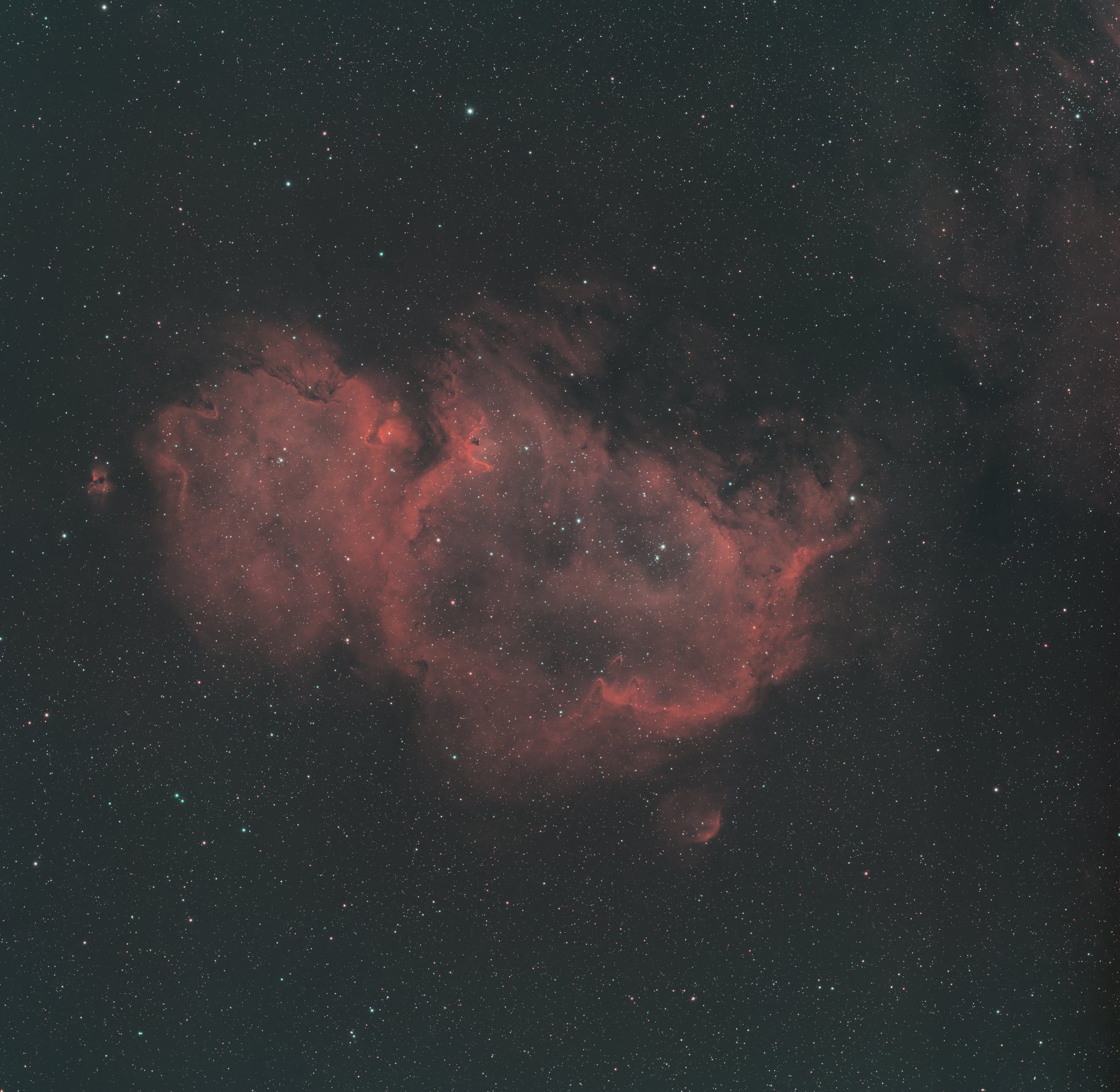
The Soul Nebula IC 1848 | Westerhout 5 | Constellation Cassiopeia | HaOIII + HbSii dual-band | ~7,500 light years
At the end of Stanley Kubrick's 2001: A Space Odyssey, the Star Child floats above the Earth — vast, luminous, foetal, looking down. Something that has passed through transformation and emerged as something else entirely. Something that is not quite born yet, but is no longer what it was.
Look at this image for long enough and you will see it.
The Soul Nebula — also known, less poetically but more accurately, as the Embryo Nebula — is an emission nebula in Cassiopeia, about 7,500 light years away, roughly 100 light years across. It is the eastern companion of the Heart Nebula, connected to it by a bridge of gas, the two forming one of the most active star-forming complexes within reach of a northern hemisphere telescope. The stars embedded within it — the young clusters IC 1848, Collinder 34, and others — are only about a million years old. Compared to our Sun's five billion years, they are newborns. They are still surrounded by the gas and dust from which they formed, still shaping their environment with stellar winds and ultraviolet radiation, still in the process of becoming what they will be.
The cavity at the centre of the nebula — that dark hollow interior — was excavated by those same young stars. Their winds and radiation blow outward, compressing the surrounding material, eroding the denser columns and pillars that resist them. What remains at the edges is what could not be destroyed. The shape of the nebula is the record of a battle between radiation and matter, still ongoing, visible across 7,500 light years.
This image was made in January 2026 under a 95% full moon. A moon that bright overwhelms broadband imaging entirely — the sky background becomes too bright to recover signal from a diffuse nebula. Dual-band narrowband filters, isolating only specific wavelengths of light, reduce the moon's contribution to near-irrelevance. 14 hours of integration later, the Star Child appeared.
14 hours 8 minutes integration, January 2026 | London, UK | Bortle 9 | Takahashi FSQ106N | Antlia ALP-T HaOIII & HbSii dual-band | 95% moon
Available as:— Metal print — the recommended format for this image. the warm crimson of the emission against the dark teal sky has exceptional colour contrast on a reflective surface.— Acrylic print — exceptional depth and colour saturation— Fine art paper — archival giclée, satin or matte finish
Sizes from 12" to 40" on the long edge. Made to order.
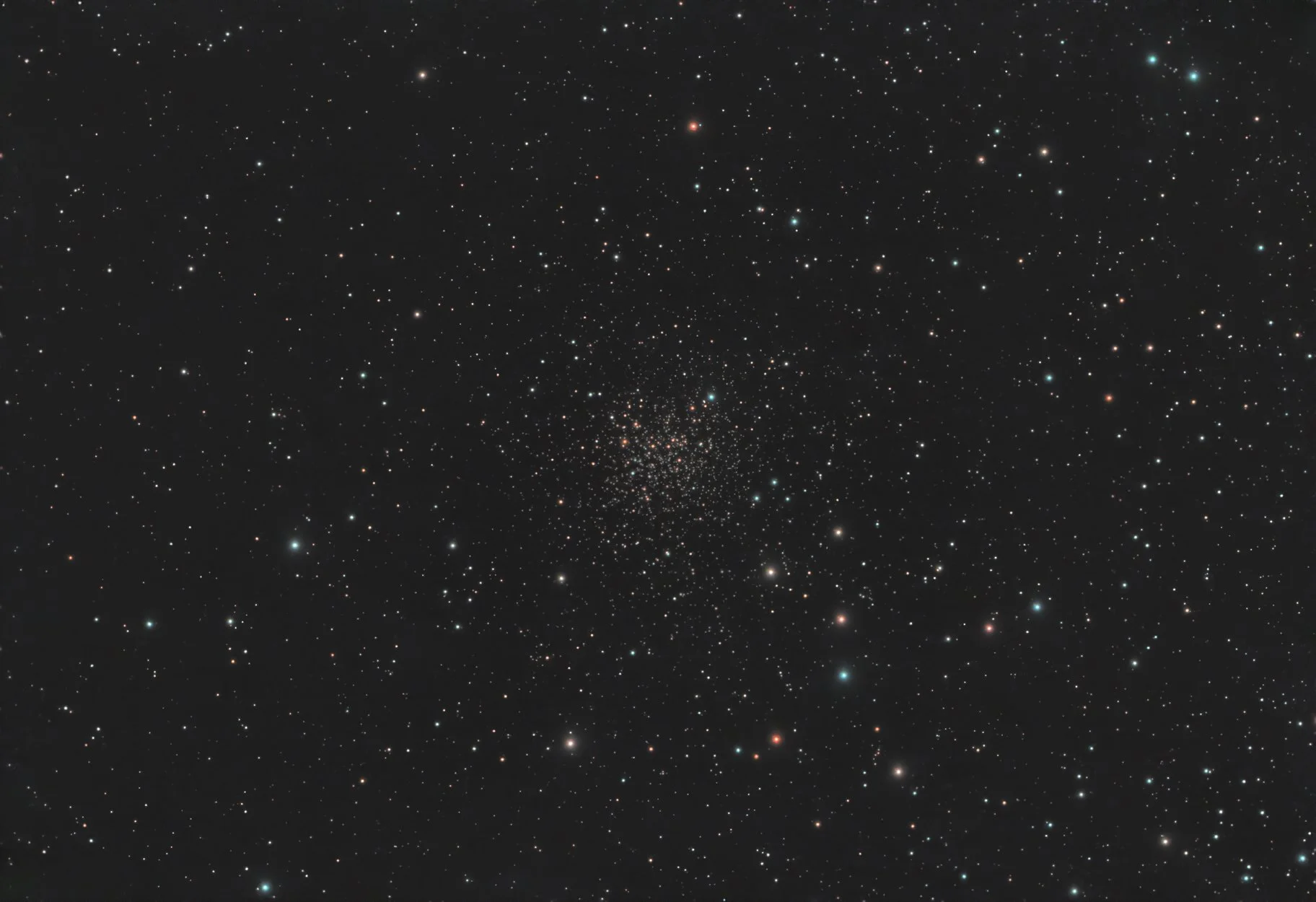
The Holocene Open Cluster NGC 2158 | Constellation Gemini | Broadband LRGB | ~11,000 light years
The light in this image left its source approximately 11,000 years ago.
At that moment, the Holocene epoch was just beginning — the current geological age of the Earth, the interglacial warming period that followed the last ice age, the world that produced everything we recognise as human civilisation. Agriculture was not yet invented. The wheel did not exist. Writing would not be developed for another six thousand years. The people who looked up at the night sky from which these photons were already travelling had no way to know that one day someone would build an instrument to catch them.
NGC 2158 is an open cluster in Gemini, about 11,000 light years away, containing roughly 3,000 stars packed into a radius of only 8 light years. It is about 2 billion years old — so ancient and so densely packed that it was long mistaken for a globular cluster. It is not. It has a diffuse core that betrays its true open cluster nature, but its richness and compactness at this distance give it a globular-like appearance that no other open cluster in amateur reach can quite match. It sits half a degree southwest of Messier 35 in the same field of view — but M35 is only 2,800 light years away. What looks like a neighbouring cluster is separated from NGC 2158 by 9,000 light years of space. The two objects share only a line of sight.
This image was made with the deforked Meade ETX125 Maksutov-Cassegrain — the same instrument that captured the Dumbbell and the Cocoon — this time through an Altair CLS-CCD broadband filter, under a 6% moon, in February 2025. Three hours and sixteen minutes of integration. Not a long session by any measure. But the ETX125 at f/15 and 1,900mm focal length gives a tight, deep field that suits a compact object at 11,000 light years perfectly. The optics did what they were built to do.
The photons that made this image started their journey before our species had a word for anything. They arrived in London in February 2025, and were caught.
3 hours 16 minutes integration, February 2025 | London, UK | Bortle 9 | Meade ETX125 Maksutov-Cassegrain f/15 | Altair CLS-CCD broadband | 6% moon
Available as:— Metal print — the recommended format for this image. the dense stellar field and the warm tones of the cluster have exceptional presence on a reflective surface.— Acrylic print — exceptional depth and colour saturation— Fine art paper — archival giclée, satin or matte finish
Sizes from 12" to 40" on the long edge. Made to order.
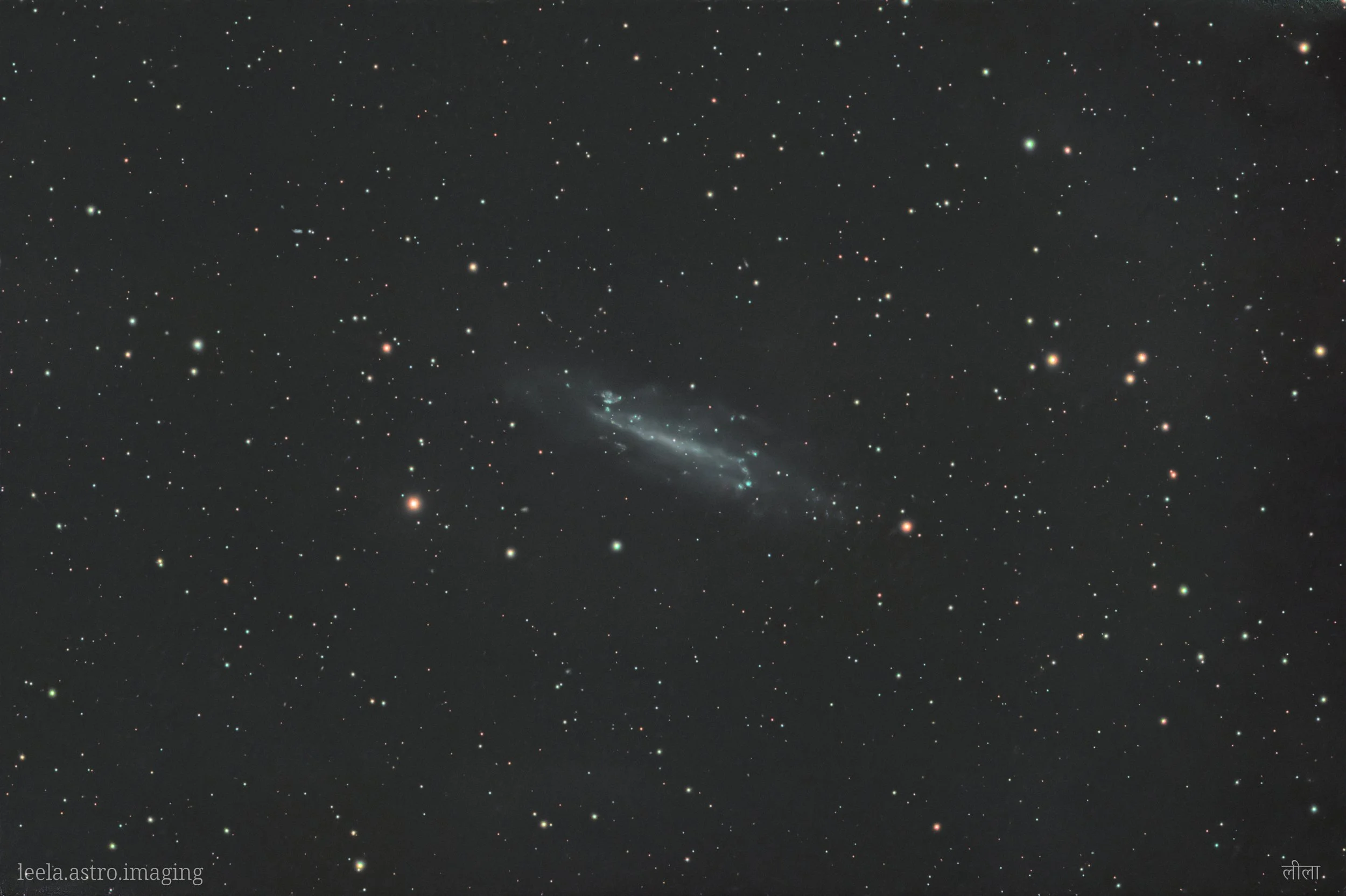
NGC 4236 — The Dragon's TailNGC 4236 | Caldwell 3 | Constellation Draco | Broadband + HaOIII + SiiOIII | ~11.7 million light years
Eleven and a half million light years away, nearly edge-on, and one of the most challenging objects in the Caldwell catalogue.
NGC 4236 is a barred Magellanic spiral galaxy in Draco, a member of the M81 Group — the same local cluster of galaxies that contains the spectacular Bode's Galaxy M81 and the starburst Cigar Galaxy M82. It sits at the periphery of that group, somewhat removed from its more celebrated neighbours, spanning roughly 22 arcminutes across the sky — nearly as wide as the full Moon — but so diffuse in its surface brightness that it demands both patience and integration time to render well.
When William Herschel discovered it on 6 April 1793 — observing from Slough, a few miles west of London — he had no way of knowing he was looking at a galaxy. The concept did not yet exist. He recorded it as a nebula, describing it as "very large... immensely large, very faint, much extended, very gradually brighter in the middle." He was right about all of it. What he could not have known was the scale: that the faint smear of light in his eyepiece was a structure containing more than 100 billion stars, 11.7 million light years away.
This image was made exactly 233 years after he discovered it, from the heart of the same city. Broadband data provides the colour foundation, layered with HaOIII and SiiOIII dual-band narrowband to isolate the emission from ionised gas within the galaxy itself — the active star-forming regions knotted along the disc.
The galaxy sits in Draco, the Dragon — toward the tail end of the constellation, stretched thin and faint across the northern sky, circumpolar from London, available on any clear night of the year. The light in this image left before our genus existed.
18 hours 12 minutes integration | London, UK | Bortle 9 | Takahashi FSQ106N
Available as:— Metal print — the recommended format for this image. the cool teal of the galaxy against the dark field has a quiet, distinctive presence on a reflective surface.— Acrylic print — exceptional depth and colour saturation— Fine art paper — archival giclée, satin or matte finish
Sizes from 12" to 40" on the long edge. Made to order.
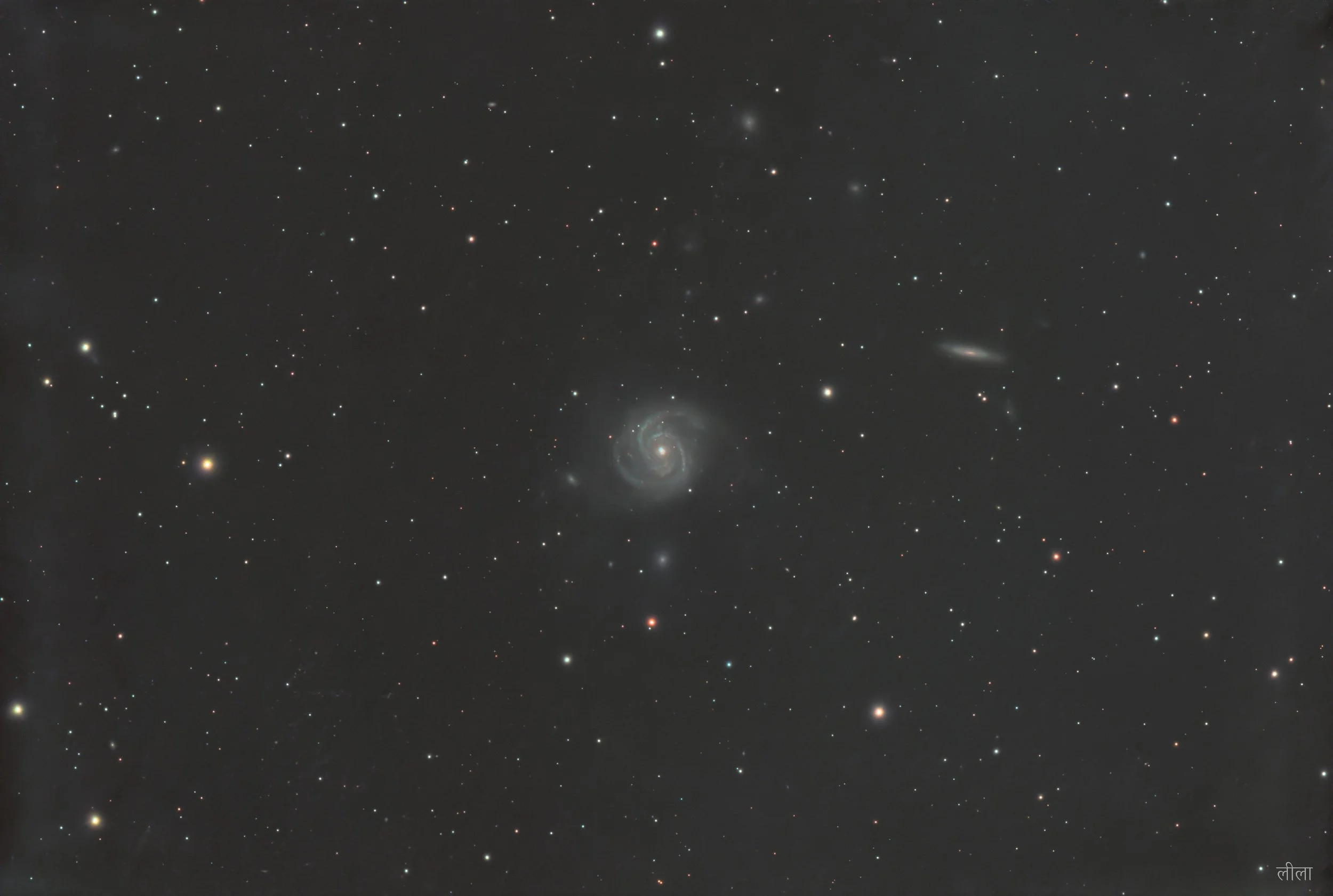
M100 — The Mirror Galaxy l M100 | NGC4312 | Constellation Coma Berenices | Broadband | ~55 million light years
London generates around 11 million kilowatt hours of artificial light every single night. Most of it goes upward. Most of it is wasted. And most of the people living beneath it have never seen the Milky Way, will never see it from where they stand, and have quietly stopped expecting to.
This image was made from inside that city.
M100 is a grand design spiral galaxy in Coma Berenices, approximately 55 million light-years away and one of the largest and brightest members of the Virgo cluster of galaxies. Its arms are not chaotic or ragged: they are swept back, symmetrical, structured by the same gravitational choreography that shapes every grand design spiral — density waves moving through the disc like ripples through still water, triggering star formation as they pass, lighting up the arms in blue-white from the young stars born in their wake.
To photograph it from a bortle 9 sky is to do something slightly unreasonable. The background glow of the city competes with the faint outer structure of a galaxy 55 million light-years away, and the city mostly wins. What this image represents is the part that doesn't lose — the signal that survived the noise, the structure that persisted despite everything stacked against it.
Scattered across the frame are the companions: background galaxies, some of them other members of the Virgo cluster itself, most of them far more distant — entire island universes reduced to soft smudges by distance and atmosphere and the ambient glow of almost ten million people who mostly aren't looking up.
You are made of this. Even here. Even now.
9 hours 58 minutes integration | London, UK | Bortle 9 | Takahashi FSQ106N
Available as:— Metal print — the recommended format for this image. — Acrylic print — exceptional depth and colour saturation— Fine art paper — archival giclée, satin or matte finish
Sizes from 12" to 40" on the long edge. Made to order.
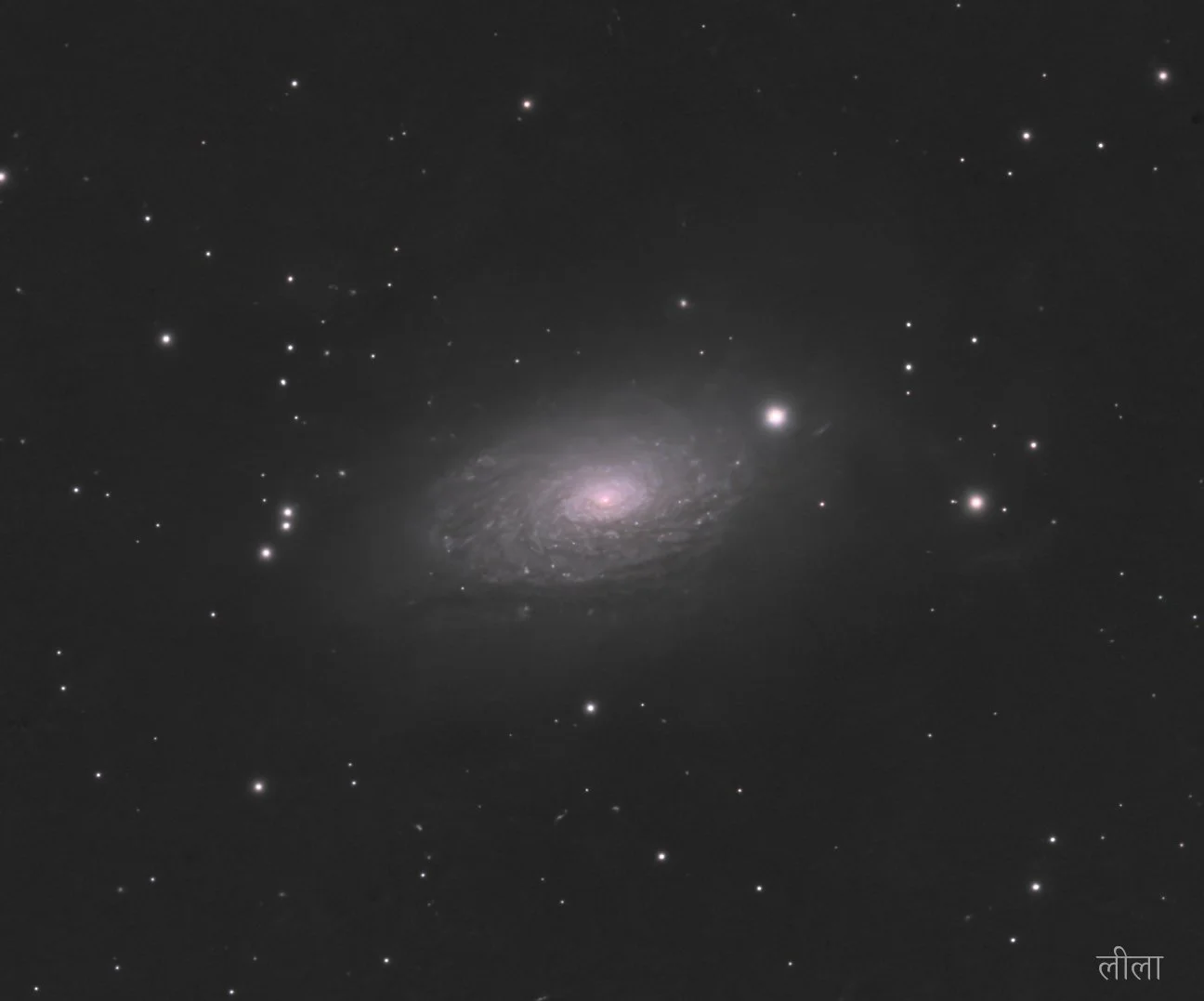
A Sunflower l M63 | NGC5055 | Constellation Canes Venatici | Broadband | ~29 million light years
Not every spiral follows the rules.
M100, imaged elsewhere in this collection, is a grand design spiral — its arms vast, sweeping, mathematically precise, organised by density waves that propagate through the disc like the grooves of a record. M63 is something different. Its arms do not sweep. They fragment, branch, and multiply — dozens of short, disconnected segments winding loosely around the core, each one a separate knot of star formation, none of them joining into a single coherent structure. Astronomers call this flocculent. It means, roughly, woolly. Tuft-like. The opposite of grand.
It is, in its own way, more honest about how messy the process of making stars actually is.
The soft extended halo surrounding the disc — visible here as a faint, ghostly oval extending well beyond the bright inner regions — is the accumulated glow of hundreds of billions of older stars, the galaxy's deep past radiating quietly outward. The pink warmth at the nucleus is the signature of an older stellar population, redder and cooler than the blue-white knots of active star formation scattered through the arms.
M63 sits roughly 29 million light-years away in Canes Venatici, the hunting dogs — a constellation that contains more than its share of remarkable galaxies, as if something about that quiet patch of sky invites them to gather.
This image was made from London. The halo you can see at the edges of the disc — that faint, extended structure that takes the most integration time, the most patience, the most sky — is the hardest thing to pull from a bortle 9 sky. It is there.
You are made of this. Every tuft of it.
9 hours 24 minutes integration | London, UK | Bortle 9 | Takahashi FSQ106N
Available as:— Metal print — the recommended format for this image. — Acrylic print — exceptional depth and colour saturation— Fine art paper — archival giclée, satin or matte finish
Sizes from 12" to 40" on the long edge. Made to order.
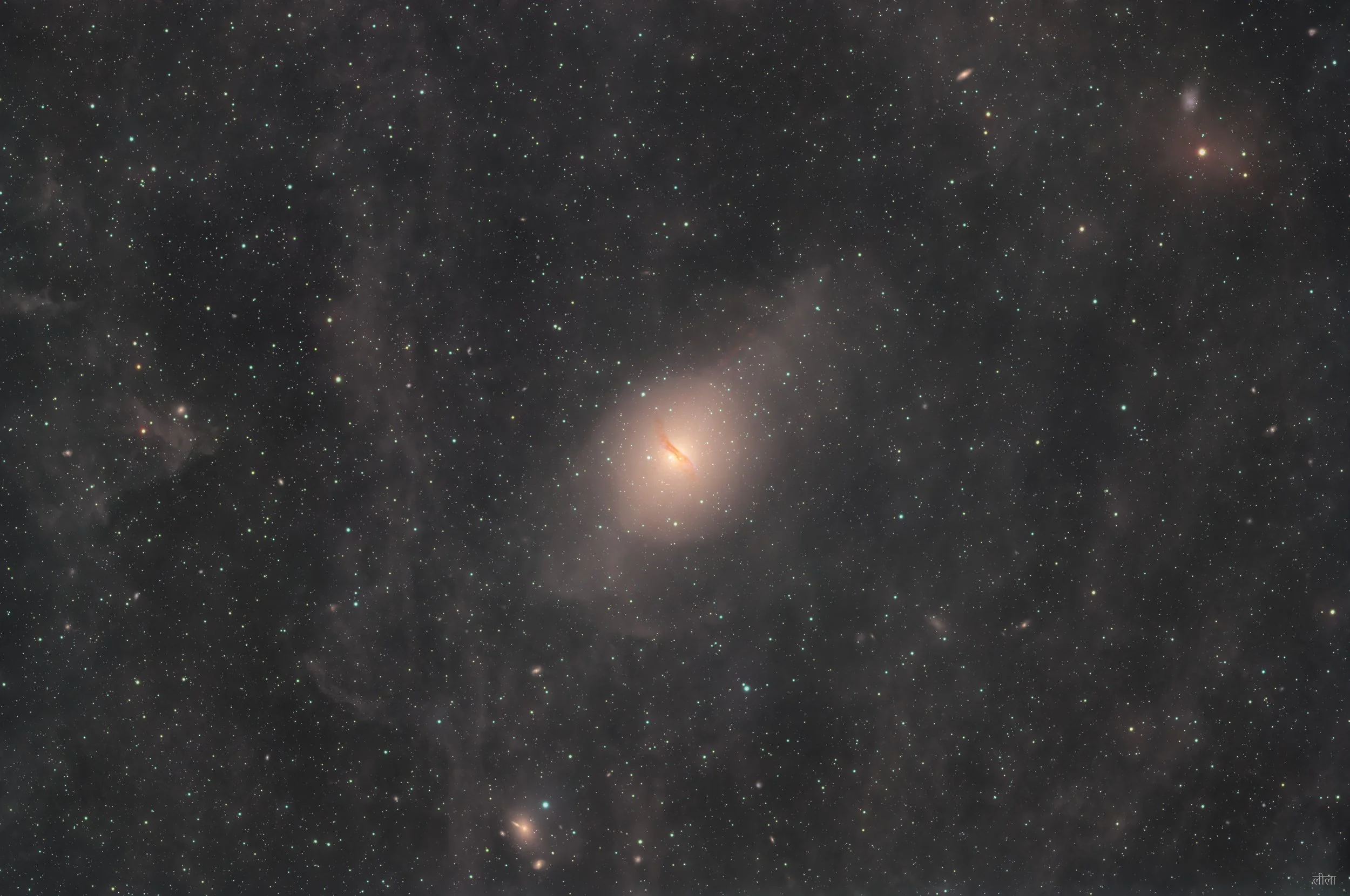
Centaurus A l NGC5128 | Constellation Centaurus | RGBH | ~13 million light years
Some things announce themselves quietly. Centaurus A sits in the southern sky like a question posed in two languages at once — the soft ellipse of an ancient galaxy, hundreds of billions of stars old, bisected by a dark seam of dust that does not belong to it. That dust is the remnant of a smaller spiral galaxy, swallowed whole millions of years ago. The merger is still written across the sky for anyone patient enough to read it.
At the heart of it, a black hole perhaps fifty-five million times the mass of the sun is doing what such things do — pulling everything inward, converting what it cannot hold into twin jets of plasma fired outward at nearly the speed of light. One of those jets is visible here, a warm filament cutting across the core. The other is pointed away from us, hidden in the geometry of space. These jets stretch for up to millions of light years depending on what frequency you look in.
Centaurus A is the loudest radio source in the southern sky. It has been transmitting for longer than our species has existed to listen.
Surrounding it, barely visible, the faint tracery of hydrogen — interstellar dust and gas threaded through the field, older than the galaxy itself, drifting. The universe leaving notes to no one in particular.
16 hours 32 minutes integration | Kagga Kamma Remote Observatory, South Africa | Bortle 1 | Tele Vue 76 running at f5
Available as:— Metal print — the recommended format for this image. — Acrylic print — exceptional depth and colour saturation— Fine art paper — archival giclée, satin or matte finish
Sizes from 12" to 40" on the long edge. Made to order.
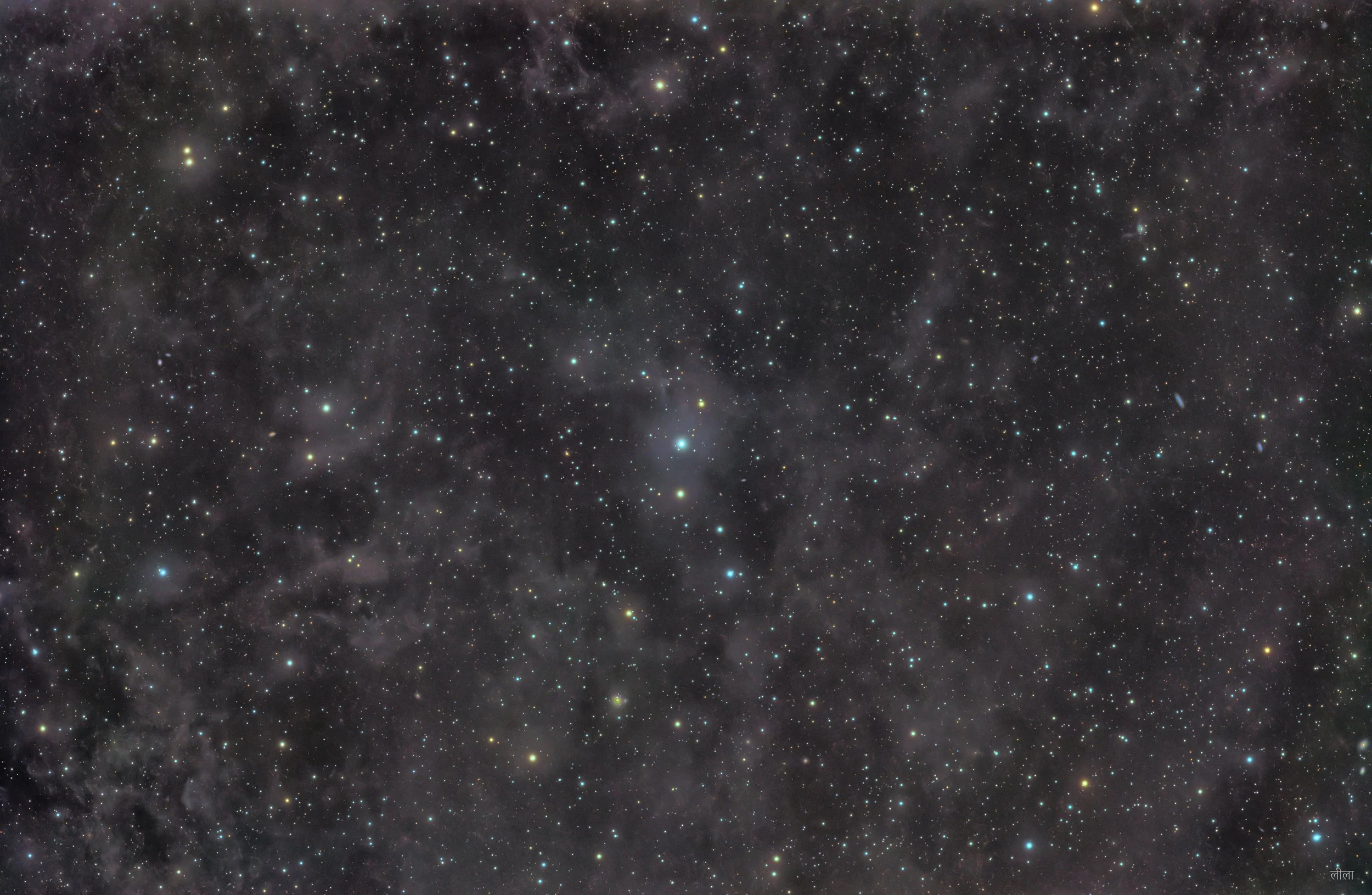
Bartels CCV IFN1 l Constellation Corvus, Crater, Virgo | RGB
This is what nothing looks like. A field of scattered stars, a dark and apparently empty sky — until you look more carefully, and the nothing begins to resolve into something vast and strange. Faint grey-purple mist threading between the stars, shifting in density, pooling in places and thinning in others. Not an absence of light, but light so ancient and attenuated that the sky itself seems to be exhaling it.
What you are seeing is interstellar cirrus — dust and gas suspended within our own galaxy, so close in cosmic terms that it has no measurable redshift, yet so diffuse that it is nearly invisible even to instruments. This particular field required extreme patience to extract: many hours of integration, careful processing, and a willingness to trust that signal was present in what appeared to be blank sky. It was. From the very darkest sites on the very darkest nights, expert visual observers such as Mel Bartels have glimpsed these structures at the eyepiece — gossamer, uncertain, at the threshold of perception.
Behind the cirrus, the field is far from empty. Several named galaxies float in the middle distance, tens of millions of light years away, their light passing through the same dust that now catches your eye. NGC 4285, an emission-line galaxy in Virgo, sits at roughly 300 million light years — its light left before the first dinosaurs walked the Earth. And behind that, hundreds of catalogued but anonymous galaxies, their distances unmeasured, their light older still.
Three layers of the universe in a single frame that first appeared to contain nothing at all.
14 hours 20 minutes integration | Kagga Kamma Remote Observatory, South Africa | Bortle 1 | Tele Vue 76 running at f5
Available as:— Metal print — the recommended format for this image. — Acrylic print — exceptional depth and colour saturation— Fine art paper — archival giclée, satin or matte finish
Sizes from 12" to 40" on the long edge. Made to order.
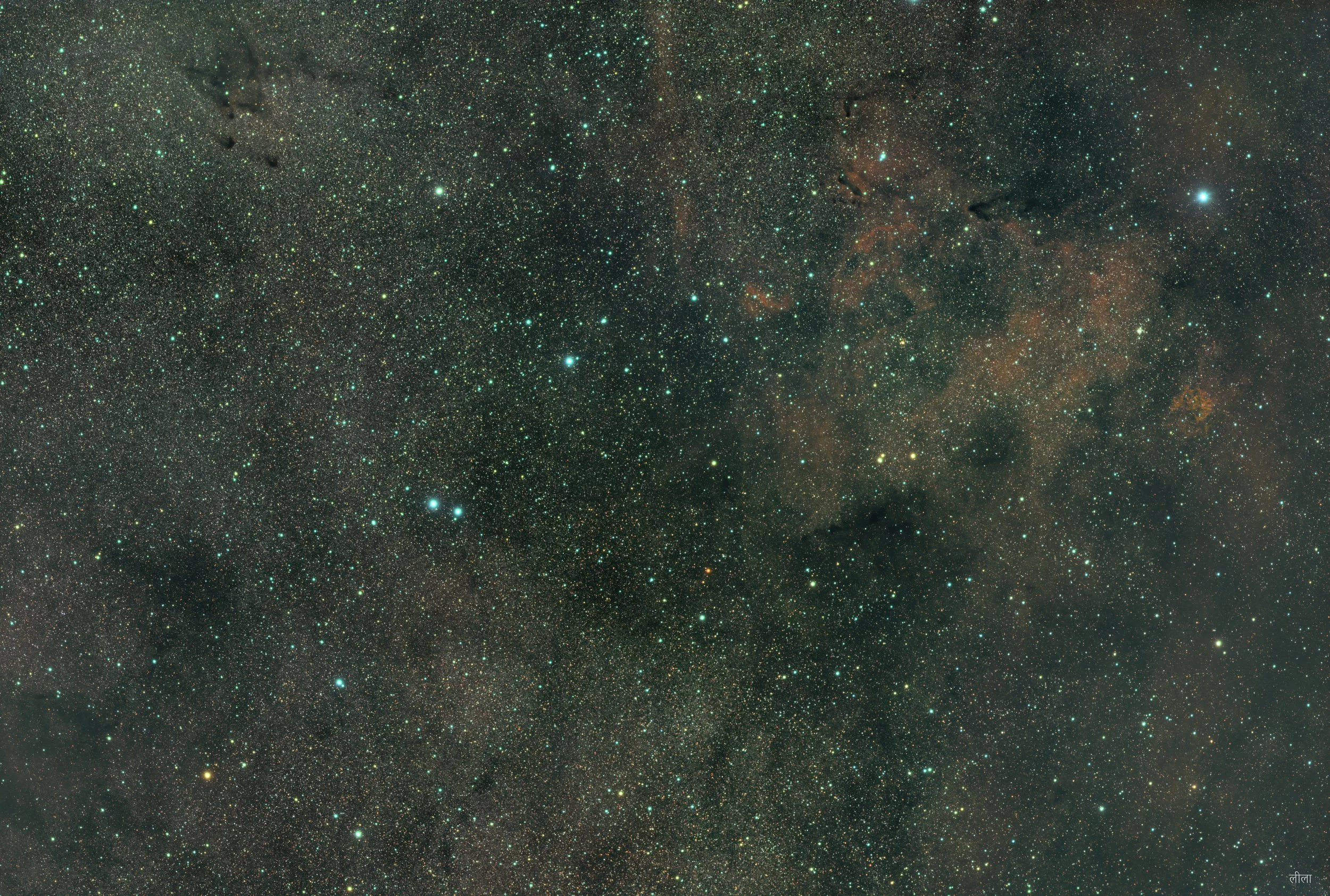
Terra Incognita - a field in Circinus l Constellation Circinus | RGB & HSO
The old cartographers wrote terra incognita at the edges of their maps — not because the land wasn't there, but because they hadn't been. The land, of course, carried on regardless.
This field sits in one of the less-visited corners of the southern Milky Way, in the small constellation of Circinus. The charts are thin here. Sandqvist 173 is catalogued — a dark molecular cloud, dense enough to silence the stars behind it. The Southern Dark Cloud SDC 319.3-3.5 is noted. The open clusters Pismis 20 and 21 are recorded. But the warm amber nebulosity that dominates the right of the frame has no name that can be readily found. It glows in hydrogen and sulphur, lit from within by stars whose radiation ionises the surrounding gas — a process that has been underway for millions of years, long before anyone thought to look.
A reef with no name on any chart still exists. It is still host to everything that lives on it. It does not require a catalogue entry to be real, or to matter, or to continue its slow and patient work of being. Attention is not what validates a thing.
This image combines hydrogen-alpha, sulphur II and oxygen III data with RGB stars, rendering the ionised gas in warm ambers and teals against the extraordinary stellar density of the galactic plane — a reminder that even the most overlooked corners of the sky repay patience.
20 hours 08 minutes integration | Kagga Kamma Remote Observatory, South Africa | Bortle 1 | Tele Vue 76 running at f5
Available as:— Metal print — the recommended format for this image. — Acrylic print — exceptional depth and colour saturation— Fine art paper — archival giclée, satin or matte finish
Sizes from 12" to 40" on the long edge. Made to order.
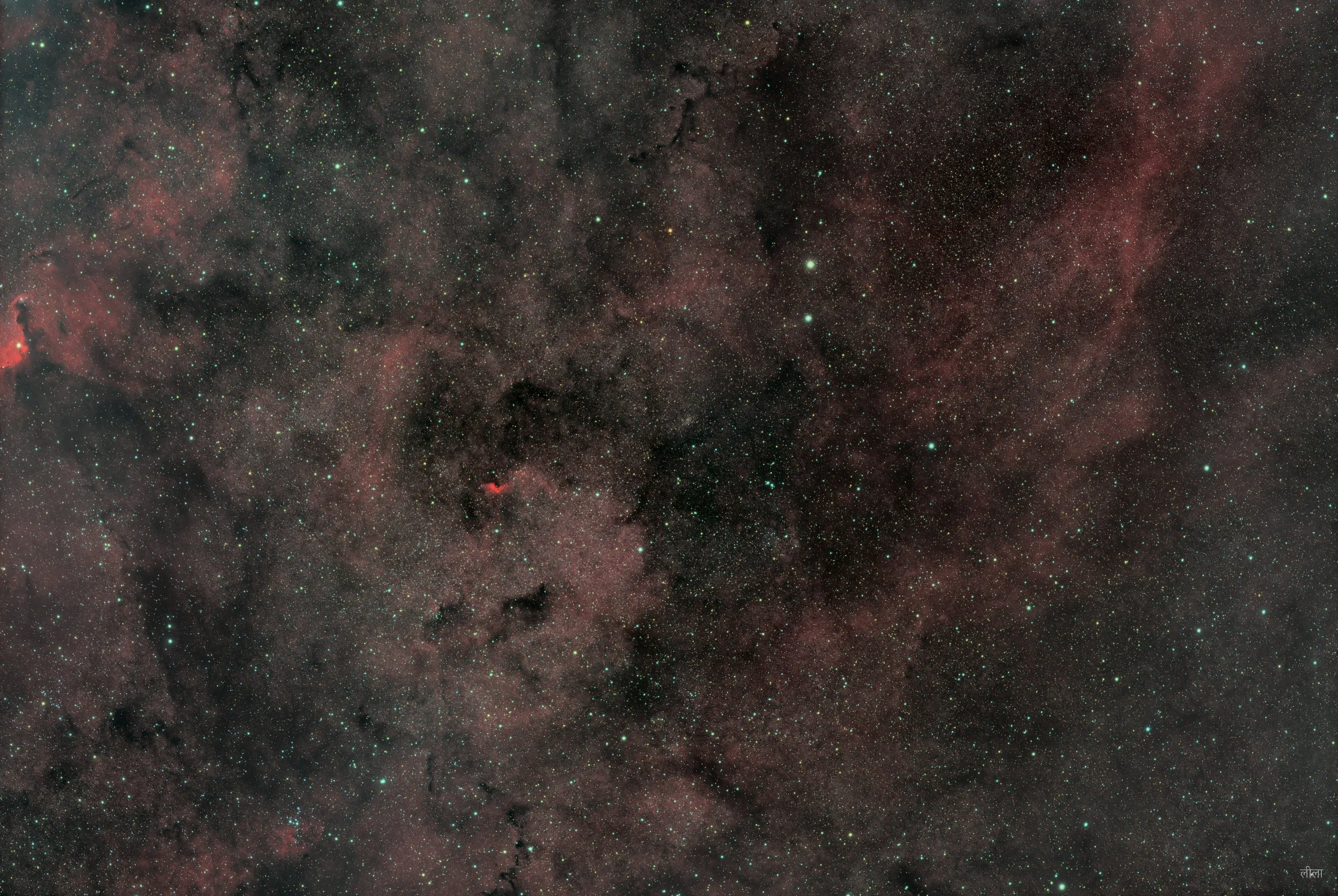
Reefs of Centaurus l Constellation Centaurus | RGB & HSO
Beneath the surface of a glowing sea of hydrogen in a quiet corner of the sky lie the Reefs of Centaurus — and they hold their secrets close.
This wide expanse of southern Milky Way captures Cederblad 122, a vast and genuinely faint HII region in Centaurus lying some 5,700 light-years distant. Ionised hydrogen washes across the frame in diffuse crimson — an ocean of glowing gas so tenuous that to the naked eye, even under the darkest skies, this region presents itself simply as an overwhelming river of stars. But look closer and the sea is not empty. Threading through the luminous medium are cold molecular clouds, dark reefs of dust and compressed gas silhouetted against the glow behind them. These are not the dead rocks of a sailor's nightmare — they are incubators, dense and veiled, where gravity is quietly winning its ancient argument with dispersion, and where stars are being born in the dark.
Anchored within the nebula is Collinder 271, an open cluster whose stars have already emerged from just such a crucible, now contributing their own ultraviolet light to the illumination of the surrounding gas. At the left edge of the frame, the brighter structured emission of RCW 75 — also catalogued as Gum 48a — marks a distinct and more active HII region some 6,500 light-years away, its dramatic forms sculpted by the young cluster Stock 16 burning within it. Near the centre, a small vivid knot betrays the presence of Wray 17-60, a planetary nebula candidate — perhaps a single star's final exhalation, a brief bright punctuation in the longer story of stellar life and death playing out across this field.
21 hours 04 minutes integration | Kagga Kamma Remote Observatory, South Africa | Bortle 1 | Tele Vue 76 running at f5
Available as:— Metal print — the recommended format for this image. — Acrylic print — exceptional depth and colour saturation— Fine art paper — archival giclée, satin or matte finish
Sizes from 12" to 40" on the long edge. Made to order.
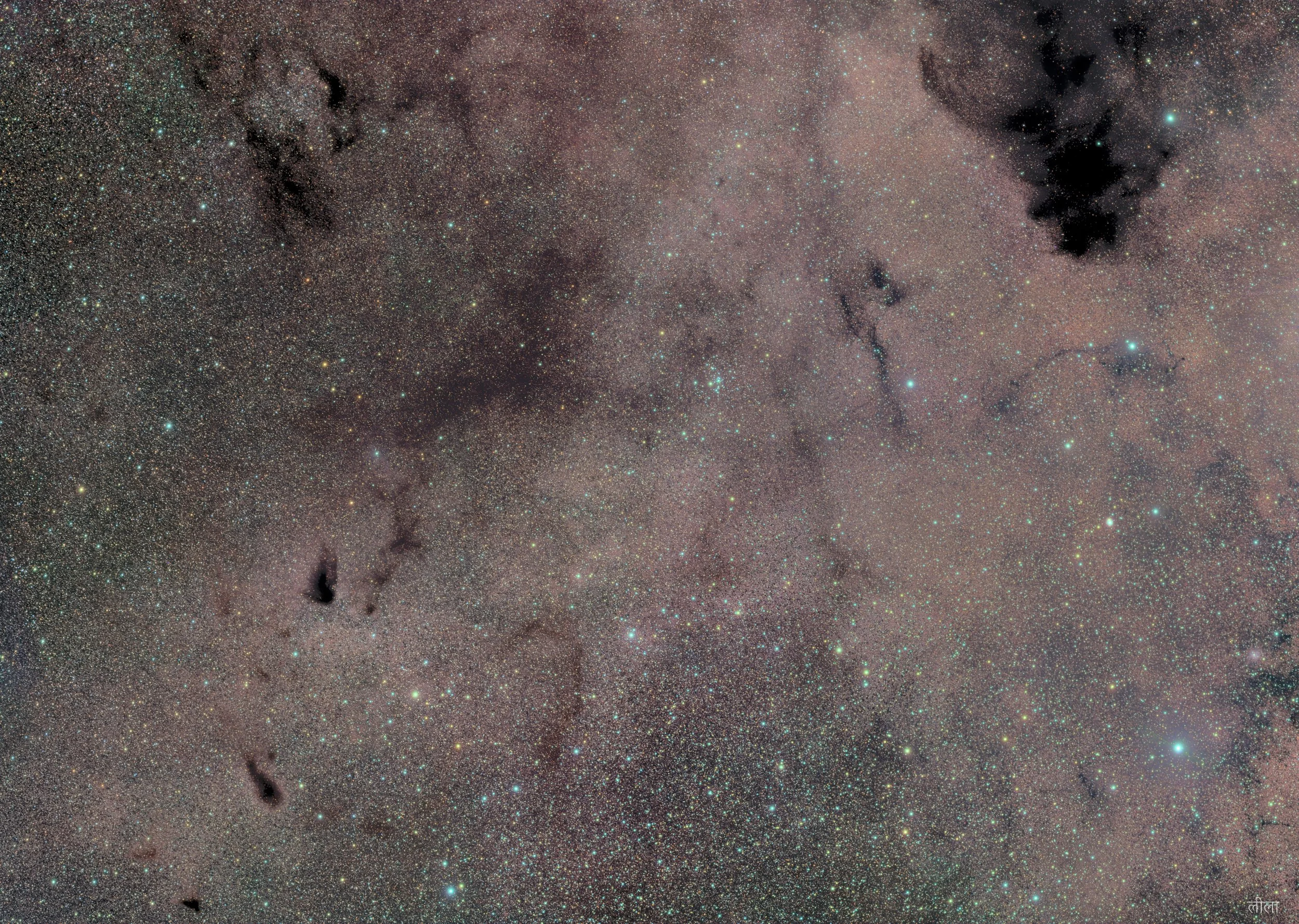
Persisting Against The Light l Constellation Musca | RGB
Light doesn't fill space evenly. Look carefully at this field and you begin to see it — the subtle shafts, the way brightness seems to radiate downward from somewhere just beyond the top of the frame, as if a source of immense illumination is casting its light at an angle through the stellar field, picking out what it touches and leaving the rest in comparative shadow. The stars respond. The dust between them glows faintly pink with diffuse emission, lit from sources too distant or too numerous to single out.
But the dark clouds do not respond. They persist.
Sandqvist 148 is a complex of dark molecular nebulae in the deep southern sky, near the Coal Sack — one of the most prominent dark regions visible to the naked eye, a void in the Milky Way that has been known to indigenous Australians for tens of thousands of years as a sky emu taking shape in the darkness rather than the stars. These clouds are cold and dense, opaque to the light passing through and around them. They are visible only because of what they refuse to transmit. Their existence is defined by resistance — not active resistance, but the simple, structural fact of their density. Light passes around them. They remain.
What they contain, as always, is the next generation — compressed gas and dust, the raw material of stars not yet born, waiting in the cold for the conditions that will tip them into collapse and ignition. The darkness that persists against the light is also the darkness that eventually becomes the light. It has no urgency about this. It simply continues to be what it is, indifferent to the illumination surrounding it, carrying its potential in silence.
10 hours 00 minutes integration | Kagga Kamma Remote Observatory, South Africa | Bortle 1 | Tele Vue 76 running at f5
Available as:— Metal print — the recommended format for this image. — Acrylic print — exceptional depth and colour saturation— Fine art paper — archival giclée, satin or matte finish
Sizes from 12" to 40" on the long edge. Made to order.
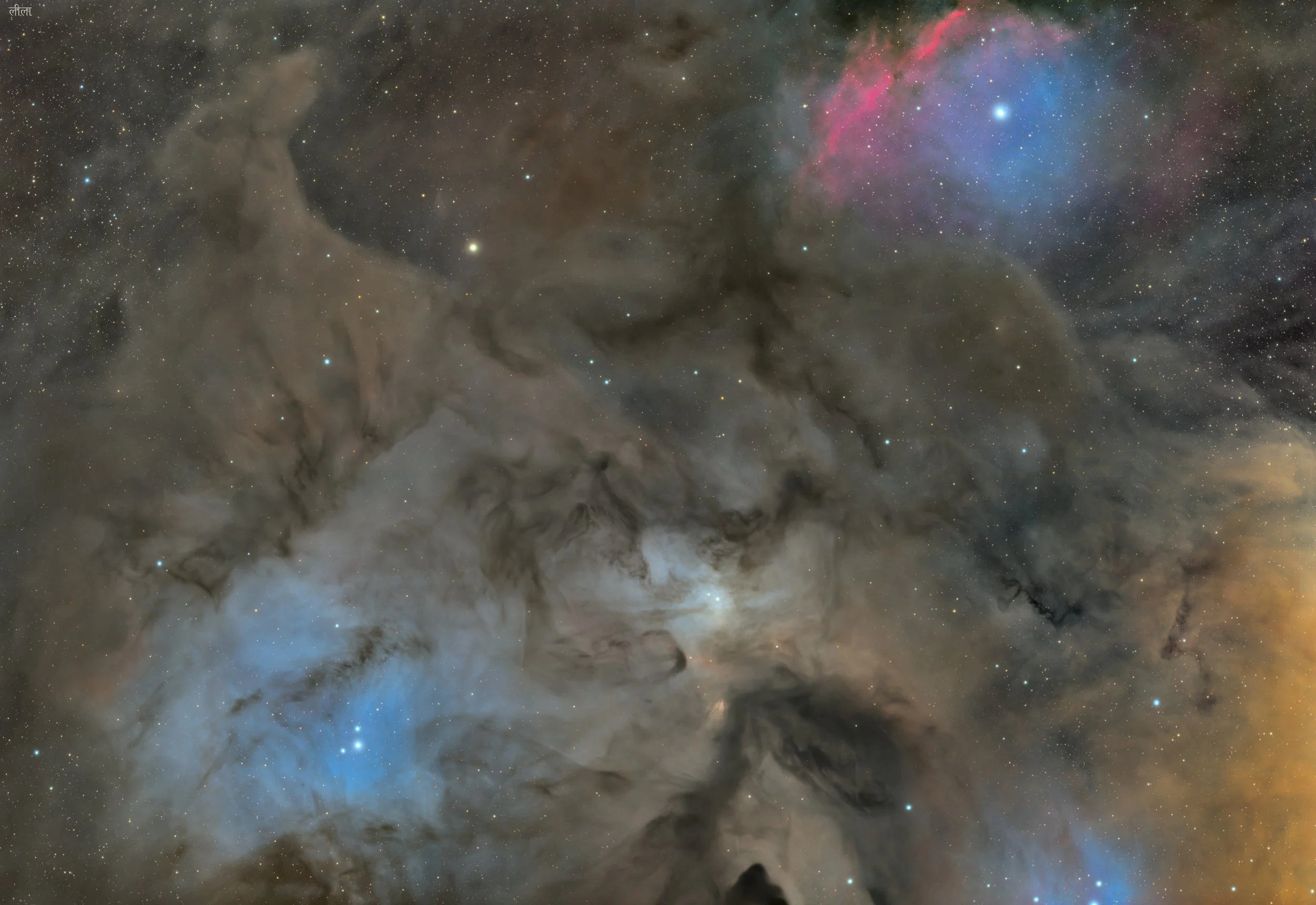
The Rendezvous l Constellation Ophiuchus | RGB
There is a particular quality of light in a forest at night when mist has settled. It doesn't illuminate so much as suggest — shapes emerging and dissolving at the edge of perception, familiar forms made strange by the softening of their edges. The light itself seems to have weight and colour, pooling in the hollows, catching in the moisture, turning blue-white where it is cold and amber where something warmer breathes at the margins.
IC 4603 is a reflection nebula in the great Ophiuchus molecular cloud — one of the nearest stellar nurseries to our own solar system, a vast complex of gas and dust stretching across hundreds of light years of the southern sky. The blue luminosity is not emission but reflection — nearby stars scattering their light through the surrounding dust, the way moonlight catches in fog. The dark forms rising through it are the silhouettes of denser cloud structures, cold molecular material opaque enough to block everything behind them. They do not glow. They stand.
At the centre of the frame, in a small clearing where the mist thins and the light gathers, two figures appear to meet. Whether this is arranged or accidental, welcomed or dreaded, the forest does not say. It folds around them — neither threatening nor protective, or perhaps both simultaneously. The amber warmth at the edges could be a distant hearth, a fire kept burning by someone waiting. Or it could be the torches of a search party.
The mist makes no distinctions. The trees stand in it regardless. The meeting happens, or has already happened, or is about to — and the forest, old and alive, continues to be what it has always been, and does what it was always intended to do for the figures.
9 hours 16 minutes integration | Kagga Kamma Remote Observatory, South Africa | Bortle 1 | Tele Vue 76 running at f5
Available as:— Metal print — the recommended format for this image. — Acrylic print — exceptional depth and colour saturation— Fine art paper — archival giclée, satin or matte finish
Sizes from 12" to 40" on the long edge. Made to order.
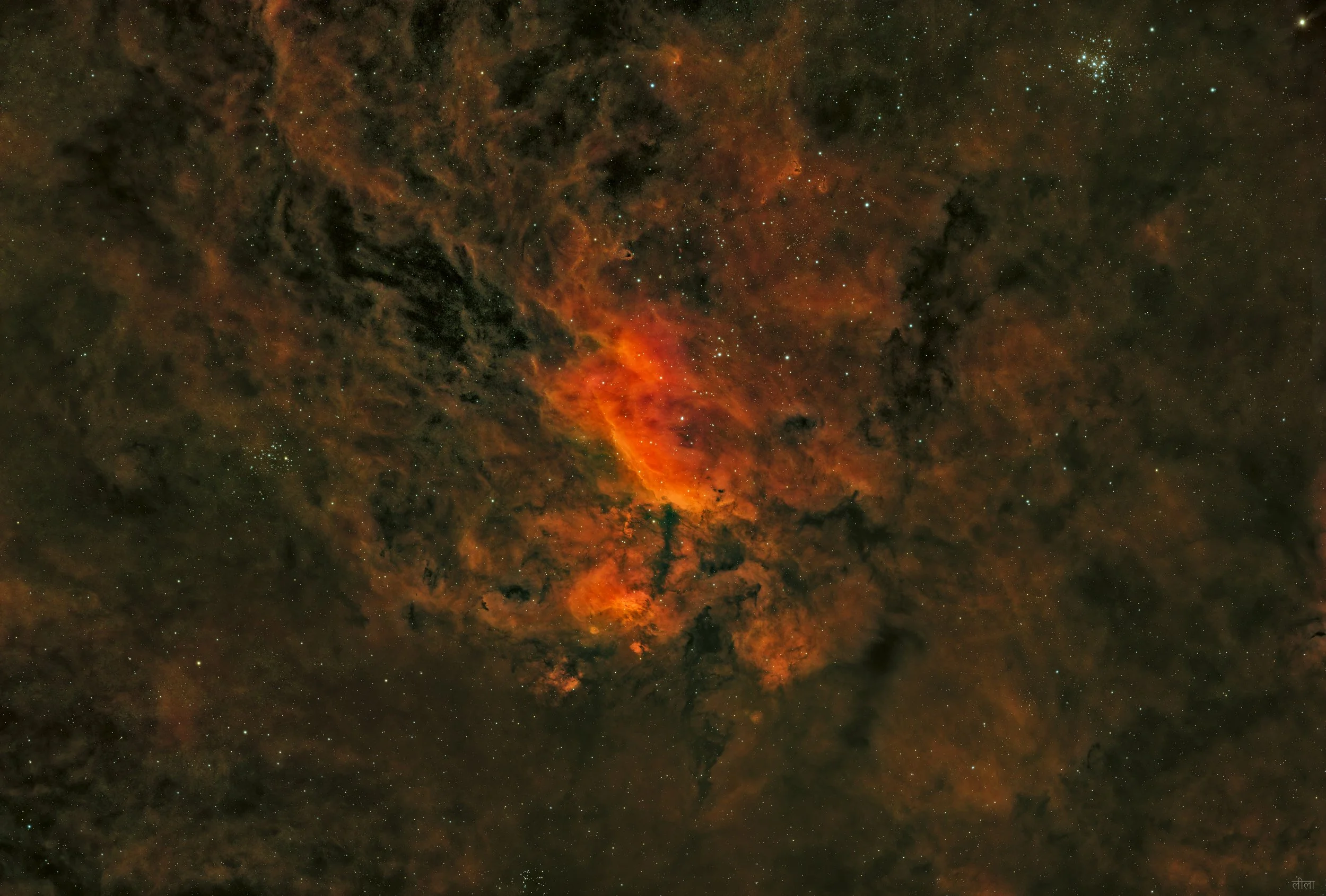
The Fissure l Constellation Scorpius | RGBHSO
The surface of things is not the whole of things. Six thousand light years away in the constellation Scorpius, the fabric of the sky has cracked open — or appears to have — and what pours through the gap is sulphurous and molten, amber and deep red, shot through with the black smoke of dark nebulae that rise like fumes from something far below. The central dark lane is not a structure on the surface. It reads as a fissure, a split, a place where the visible universe has given way to reveal what lies beneath.
IC 4628 is a vast emission nebula, stretching 250 light years across, its ionised gas energised by the ultraviolet radiation of the hot young stars embedded within it. Despite this scale — a region four times the apparent size of the full Moon — it is almost entirely invisible to the naked eye, its light arriving in wavelengths our eyes cannot register. It takes narrowband imaging to make the fissure visible: hydrogen and sulphur and oxygen mapped into colour, the invisible rendered legible. What you see here is a translation of something that was always present but always hidden.
At the margins, two open clusters of young stars watch from a distance — Collinder 316 and Trumpler 24 — already formed, already cooling, already moving on. They were made by processes like these, in places like this, and they have left. Below them, the forge is still working.
The universe, it turns out, has an underneath. It does not often show it. When it does, it looks like this — not elegant, not serene, but hot and pressured and indifferent to the distinction between creation and destruction. The fissure does not open for anyone. It simply is open. Whether you see it depends entirely on how you choose to look.
19 hours 32 minutes integration | Kagga Kamma Remote Observatory, South Africa | Bortle 1 | Tele Vue 76 running at f5
Available as:— Metal print — the recommended format for this image. — Acrylic print — exceptional depth and colour saturation— Fine art paper — archival giclée, satin or matte finish
Sizes from 12" to 40" on the long edge. Made to order.

The Moor’s Last Sigh l Constellation Ophiuchus | RGB
There is a particular kind of knowing that arrives only in departure. The traveller understands this, who has crossed a mountain pass and paused — not to rest, but because something behind them has finally come into full view, precisely because it is now receding. The sigh is not grief exactly. It is the weight of a thing apprehended whole, at the moment it becomes impossible to return to.
Barnard 44 is a dark nebula embedded in the great Ophiuchus molecular cloud — the same vast complex of gas and dust that holds IC 4603 and dozens of its kin, one of the nearest star-forming regions to our own solar system. The darkness at the centre of this image is not empty. It is ancient material: cold molecular cloud, dense enough to block the light of everything behind it. Stars exist on the other side of this cloud. The blue-white luminosity of IC 4603 blazes beyond and around it. But none of it passes through. The dust simply stands — testimony to older times.
But the darkness and the light are not opposed. They are a thing to be apprehended whole. Light exists here as a consequence of the dust's geometry: scattered, shaped, given its particular quality of diffusion by the very material that refuses to transmit it. And compressed within the cold molecular material are the conditions of the next generation: gas and dust that will, when the balance tips, collapse into new stars, new systems, new light.
The dust does not simply obscure — it shelters, patiently, without urgency, the thing it is in the process of becoming.
The moor does not simply leave. He carries what he has seen. The sigh, then, is not an ending. It is the moment before.
17 hours 48 minutes integration | Kagga Kamma Remote Observatory, South Africa | Bortle 1 | Tele Vue 76 running at f5
Available as:— Metal print — the recommended format for this image. — Acrylic print — exceptional depth and colour saturation— Fine art paper — archival giclée, satin or matte finish
Sizes from 12" to 40" on the long edge. Made to order.
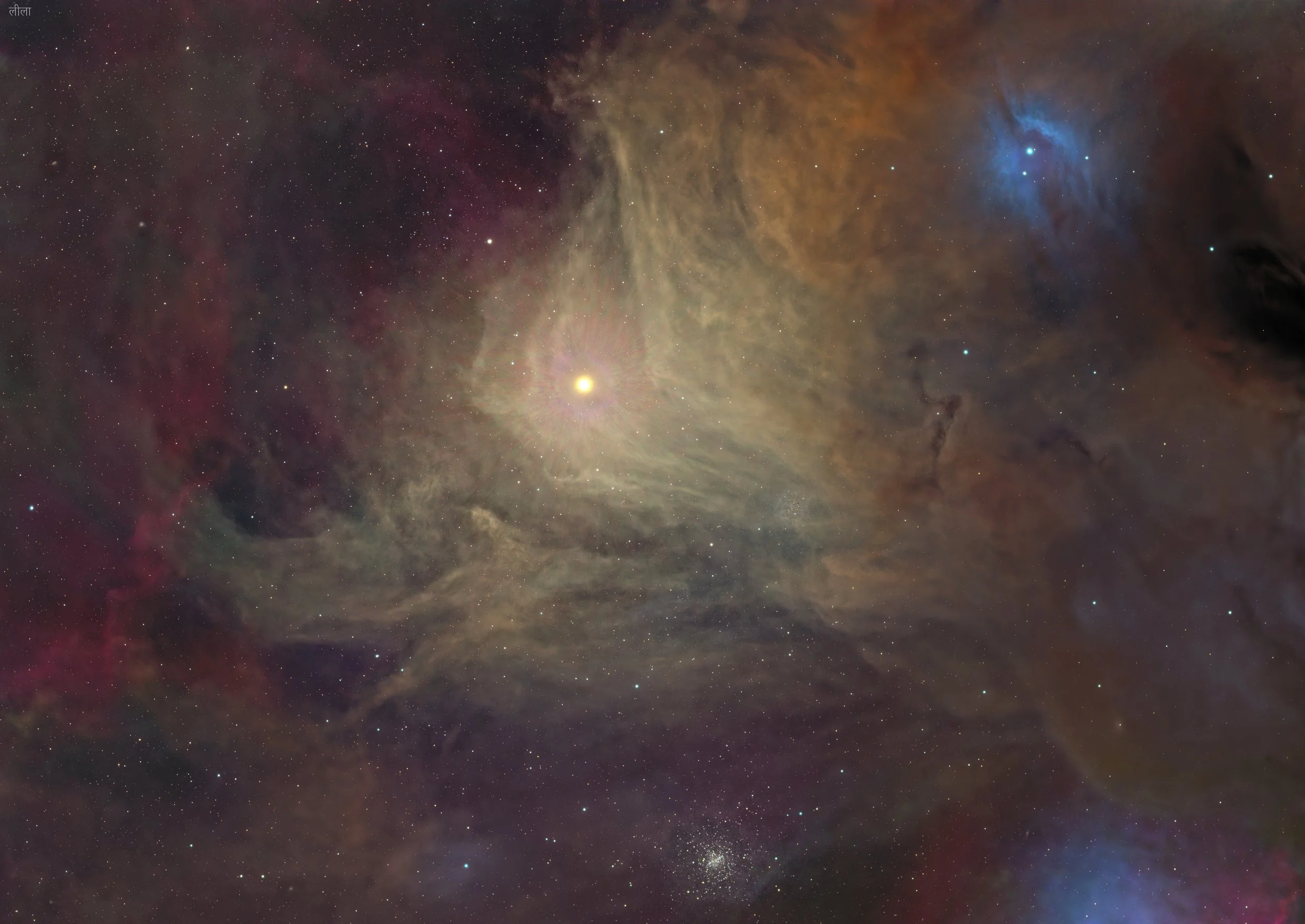
The Light of Tabor l Constellation Scorpius | RGB
There is a moment in any scene when the central figure has already left. Not departed — left. Still present to the eye, still within the frame, and yet somehow no longer available to those around it. The witnesses reach, attend, offer what comfort they can carry. The figure at the centre receives none of it — not through refusal, but because it has moved beyond the jurisdiction of comfort. It is already oriented toward what comes next. It is already becoming.
Antares — the heart of Scorpius, its name meaning rival to Mars — sits here at the centre of its own nebulosity, the surrounding gas and dust folding around it like fabric brought by attendants. The fabric is offered with care. It is not needed. Only twelve million years old, Antares is already a red supergiant burning through the last of its fuel on its way to becoming a supernova. Helium fusing into heavier elements, the closing chapters of a stellar life, proceeding with the certainty of something that has always known how it ends. It does not levitate through effort. It levitates because it has looked through a threshold, and knowing what lies ahead, faces it unafraid — already becoming.
At the margins, two ancient globular clusters attend in silence. M4 and NGC 6144 carry the light of stars ten billion years old. They have witnessed this before. They know the trajectory, the sequence, the outcome. And still they cannot look away — because there is an unbridgeable distance between knowing about a journey and taking it. The witnesses, however ancient, however rapt, remain on this side of that distance. They always will.
In the Eastern Orthodox tradition, the Light of Tabor is the uncreated light seen by the apostles at the Transfiguration — not a physical phenomenon but a divine presence that was always radiating, perceived only by those whose quality of attention had been transformed sufficiently to receive it. The light of Antares has been pouring outward for twelve million years, indifferent to whether anyone was looking.
Theoria — the direct beholding of that light, the contemplative stillness that makes perception possible — is what the witnesses at the margins have been practising across billions of years of silence. Antares, in the act of its own becoming, has become a channel. Anyone who looks upon it long enough finds themselves not merely observing a dying star, but standing at the same threshold — briefly permitted to see what the witnesses have always seen, and never been able to follow..
9 hours 20 minutes integration | Kagga Kamma Remote Observatory, South Africa | Bortle 1 | Tele Vue 76 running at f5
Available as:— Metal print — the recommended format for this image. — Acrylic print — exceptional depth and colour saturation— Fine art paper — archival giclée, satin or matte finish
Sizes from 12" to 40" on the long edge. Made to order.
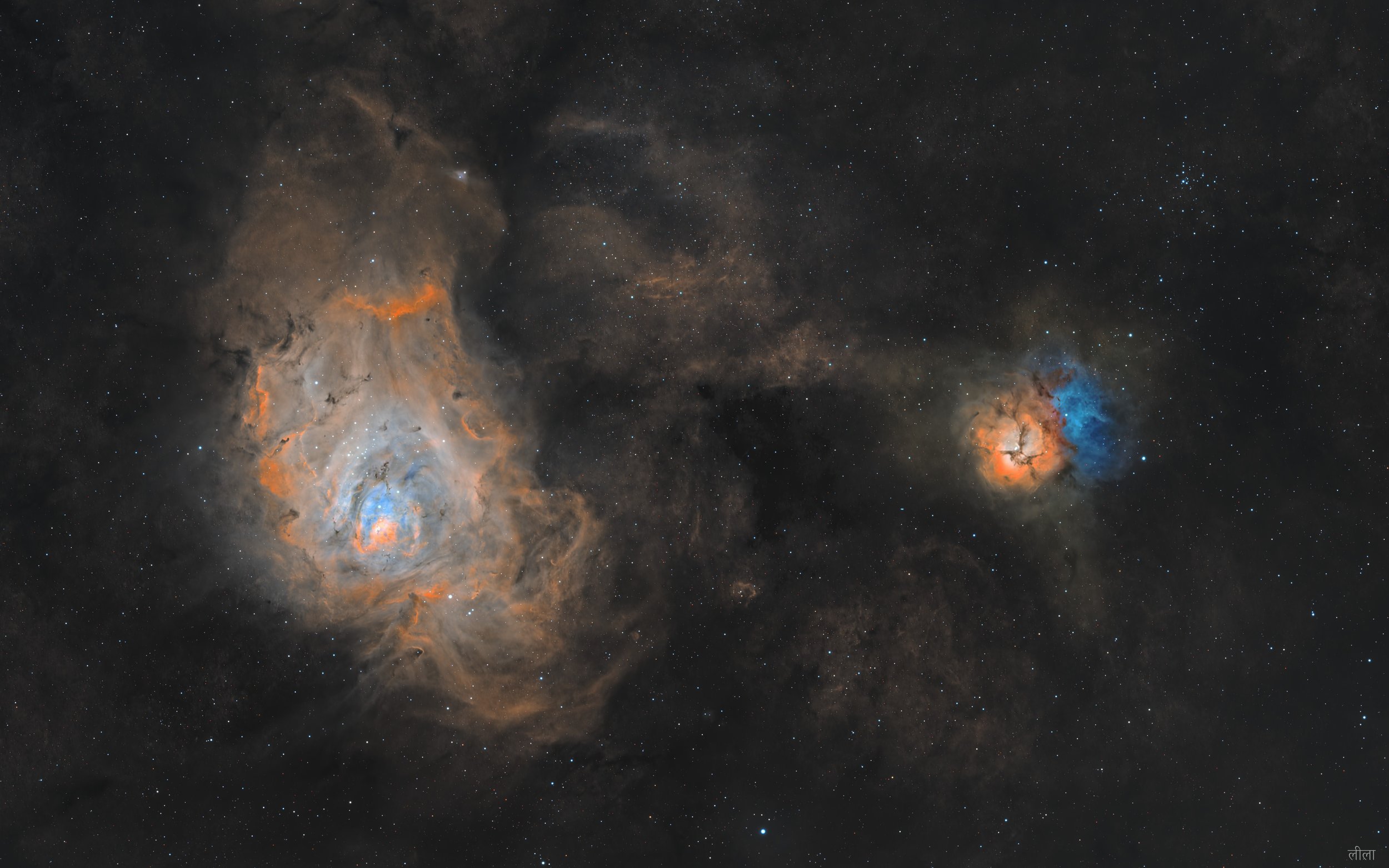
The Oyster and The Fly - M8 and M20 l Constellation Sagittarius | RGBHSO
There was once an oyster who, having spent many ages quietly accumulating layers of light around a single bright irritant at her centre, decided the moment had come to open. She did so slowly, with the unhurried confidence of something that has never doubted its own magnificence. Her shell unfurled in folds of orange and rose, and there at the centre, nested in blue, sat the pearl — luminous, swirling, exactly as splendid as she had always known it would be.
She had, of course, been expecting an audience.
Nearby — though not so near as it appeared, for the two had never in fact been neighbours (only seemingly aligned by the accident of a shared sightline of a random observer) — something else had arrived. It had not been invited. It had not announced itself. It was smaller, busier, divided into three restless lobes by dark seams that gave it the appearance of something with too many thoughts at once, glowing pink where it burned and blue where it merely reflected the burning of others. It had not come to admire the oyster. It had not even noticed her. It was simply passing through, inquisitive, indifferent, already looking at something else.
This should not have mattered. The oyster's pearl was, by any reasonable measure, the more magnificent object. And yet something in the frame had shifted. The eye, given two things to look at, does not rank them immediately. It moves. It lingers, unexpectedly, on the smaller, stranger shape with its three-fold wound of darkness — not because it asked to be admired, but because it never asked at all. It goes back to the larger, more opulent object, Perhaps it even begins to compare.
The oyster, magnificent and patient, continues to hold her pearl toward whatever light reaches her, exactly as she intended. The fly, meanwhile, has already moved on to something else entirely, several hundred light years further off, quite unaware that it shared a stage at all.
Is there a moral to this? Perhaps none. Or perhaps that splendour alone does not guarantee full attention. Perhaps that some of the most vivid presences in a frame aren't even that invested in being there. Perhaps that not everything is about competition, and sometimes it is best to live and let live. Most definitely that what the creator of an image makes may not, in fact, be what the viewer of the image takes away.
22 hours 10 minutes integration | Kagga Kamma Remote Observatory, South Africa | Bortle 1 | Tele Vue 76 running at f5
Available as:— Metal print — the recommended format for this image. — Acrylic print — exceptional depth and colour saturation— Fine art paper — archival giclée, satin or matte finish
Sizes from 12" to 40" on the long edge. Made to order.
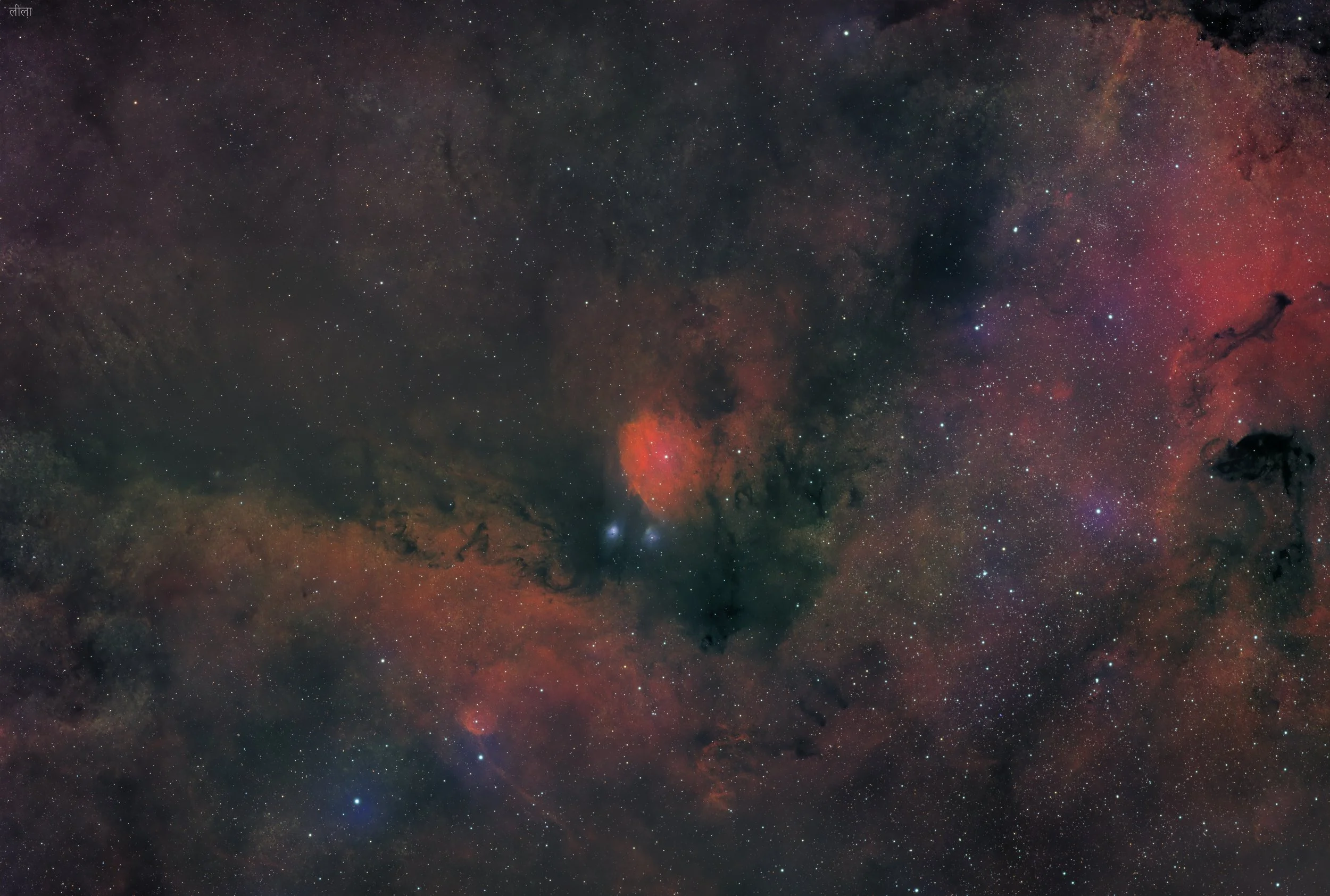
Grazie Boccioni (after States of Mind, 1911) - IC1284 & the NGC6590 Complex | Constellation Sagittarius | RGBHSO
Every large station has a ceiling that belongs to no one. High, dark, vaulted by smoke and time, it receives everything that happens beneath it without comment — the embraces, the arguments, the people standing very still pretending they are not watching someone walk away. The ceiling does not distinguish between arrivals and departures. It simply continues to be the space in which all of it occurs.
This is that ceiling — a great dark lane of dust sweeping diagonally across a field in Sagittarius, opaque enough to silence the stars behind it, indifferent to everything playing out beneath. The station it vaults is one of the busiest in the southern Milky Way, immediately south of M24, the Small Sagittarius Star Cloud — a region so dense with stellar activity that even a wide field reveals multiple simultaneous scenes, each complete in itself, none aware of the others.
At the centre, IC 1284 burns — a red emission nebula, its hydrogen ionised and roiling, caught in the turbulent moment of star formation. This is where the farewells happen, where the steam billows and the figures blur into one another and the noise is too great for any individual voice to carry.
The dark nebulae — LDN 323, LDN 328 — are those who go. Oblique, in motion, cutting across the field at angles that suggest departure rather than arrival, they carry with them whatever they hold — cold gas, compressed matter, the raw material of stars not yet born — moving through the station without looking back.
And those who stay: NGC 6589 and 6590, the two blue reflection nebulae, standing in borrowed light — the scattered glow of stars they do not themselves possess. They are not going anywhere. They have been here before the farewells began and will remain long after the last departure has dissolved into silence. Still. Present. Carrying the weight of everyone who has already left.
Five thousand nine hundred light years away, the station holds all three states simultaneously — as every station does, as every moment of leave-taking does — without hierarchy, without resolution, without end.
27 hours 10 minutes integration | Kagga Kamma Remote Observatory, South Africa | Bortle 1 | Tele Vue 76 running at f5
Available as:— Metal print — the recommended format for this image. — Acrylic print — exceptional depth and colour saturation— Fine art paper — archival giclée, satin or matte finish
Sizes from 12" to 40" on the long edge. Made to order.

The Crescent Nebula |Constellation Cygnus | Dualband HO SO
In the deep ocean, beyond the reach of sunlight, there are creatures that carry their own light. Translucent, ancient in their body plan, they drift through perpetual darkness generating bioluminescence from within — their internal structures visible through their walls, their organs lit by chemistry rather than any external source.
Five thousand light years away in Cygnus, something follows a similar logic. NGC 6888 floats against the deep red field of the surrounding hydrogen cloud — a bubble twenty-five light years across, its shell permeable to the eye, its interior churning and self-illuminated. The teal-blue glow is oxygen, ionised not by starlight from outside but by shock waves generated within the bubble itself — the fast stellar wind of the central Wolf-Rayet star WR 136 slamming into the slower wind it expelled when it was a red giant two hundred and fifty thousand years ago. The collision generates X-rays. The creature is heated by its own past catching up with its present.
WR 136 is one of the most extreme stars in the galaxy — 600,000 times brighter than the Sun, its surface temperature approaching 70,000 Kelvin, already four and a half million years old and nearing the end of a life that will conclude in a supernova explosion visible across the sky. It is not large, as Wolf-Rayet stars go. But it is extraordinary — stripping itself layer by layer, shedding a solar mass of material every ten thousand years, building the nebula around itself from its own discarded substance.
William Herschel first observed this object in 1792 from these same latitudes, and recorded it as a double star. He could not see what it was. The technology of his time could not reveal what lay inside the light. This image was made from inner city skies — the same perpetual artificial glow that Herschel never knew, but that his successors have learned to see through — using narrowband filters that isolate the specific wavelengths of hydrogen and oxygen, rendering the invisible visible, the interior legible, the creature finally seen for what it is.
10 hours 18 minutes integration | London, UK | Bortle 9 | Takahashi FSQ106N
Available as:— Metal print — the recommended format for this image. — Acrylic print — exceptional depth and colour saturation— Fine art paper — archival giclée, satin or matte finish
Sizes from 12" to 40" on the long edge. Made to order.

The Couple - Longmore-Tritton 5 |Constellation Coma Berenices | Dualband HO SO
Not everything announces itself.
This is a quiet object — a pale teal bubble floating in an almost empty field, its surface crumpled and textured, a single small red point near its centre the only hint of warmth. It does not have the scale of a star-forming region or the violence of a Wolf-Rayet bubble. It simply exists, at the edge of the galaxy, asking very little of the eye.
But look more carefully at what is actually here. LoTr 5 is the highest galactic latitude planetary nebula in the entire Milky Way — it sits almost directly above the galactic plane, just one and a half degrees from the north galactic pole, floating in the space between galaxies rather than within one. When Longmore and Tritton discovered it in 1980 on photographic plates, they noted, almost in passing, that two members of a distant galaxy cluster could be seen through the nebula itself. The shell is fifteen light years across and largely transparent — a ghost of a star's former self, drifting above the galaxy that made it.
And then there is the central star. Or rather, the central stars — because what appears to be a single point of warm light is in fact a binary system of profound strangeness. The visible component is a G-type star, a star much like our own Sun, warm and yellow and apparently ordinary. It dominates the optical light so completely that for years it was assumed to be the source of the nebula's ionisation. It is not. Hidden behind it — invisible in ordinary light — is a white dwarf of extraordinary temperature, approaching 150,000 Kelvin, one of the hottest companion stars ever found in any planetary nebula. It is this invisible star that does the real work, pouring ultraviolet radiation into the surrounding gas, maintaining the nebula's glow. The star you can see is not the star that matters. The star that matters cannot be seen.
And the visible star has not escaped the relationship unchanged. Over their long shared history, the white dwarf — when it was still a giant, still alive in the conventional sense — transferred mass to its companion, enriching it with heavy elements forged in its own interior. The G star carries that history in its chemistry now, permanently altered by proximity to something that no longer exists in the form that shaped it.
Fifteen light years of glowing gas. A hidden star doing invisible work. A visible companion transformed by a relationship with something now gone. Discovered in 1980, still not fully understood, floating quietly above the galaxy at the highest possible latitude, looking outward rather than in.
Not everything announces itself. Some things quietly exist far from madding crowds — patient, mutually altered yet inseparable, looking out and over far horizons together.
10 hours 24 minutes integration | London, UK | Bortle 9 | Takahashi FSQ106N
Available as:— Metal print — the recommended format for this image. — Acrylic print — exceptional depth and colour saturation— Fine art paper — archival giclée, satin or matte finish
Sizes from 12" to 40" on the long edge. Made to order.
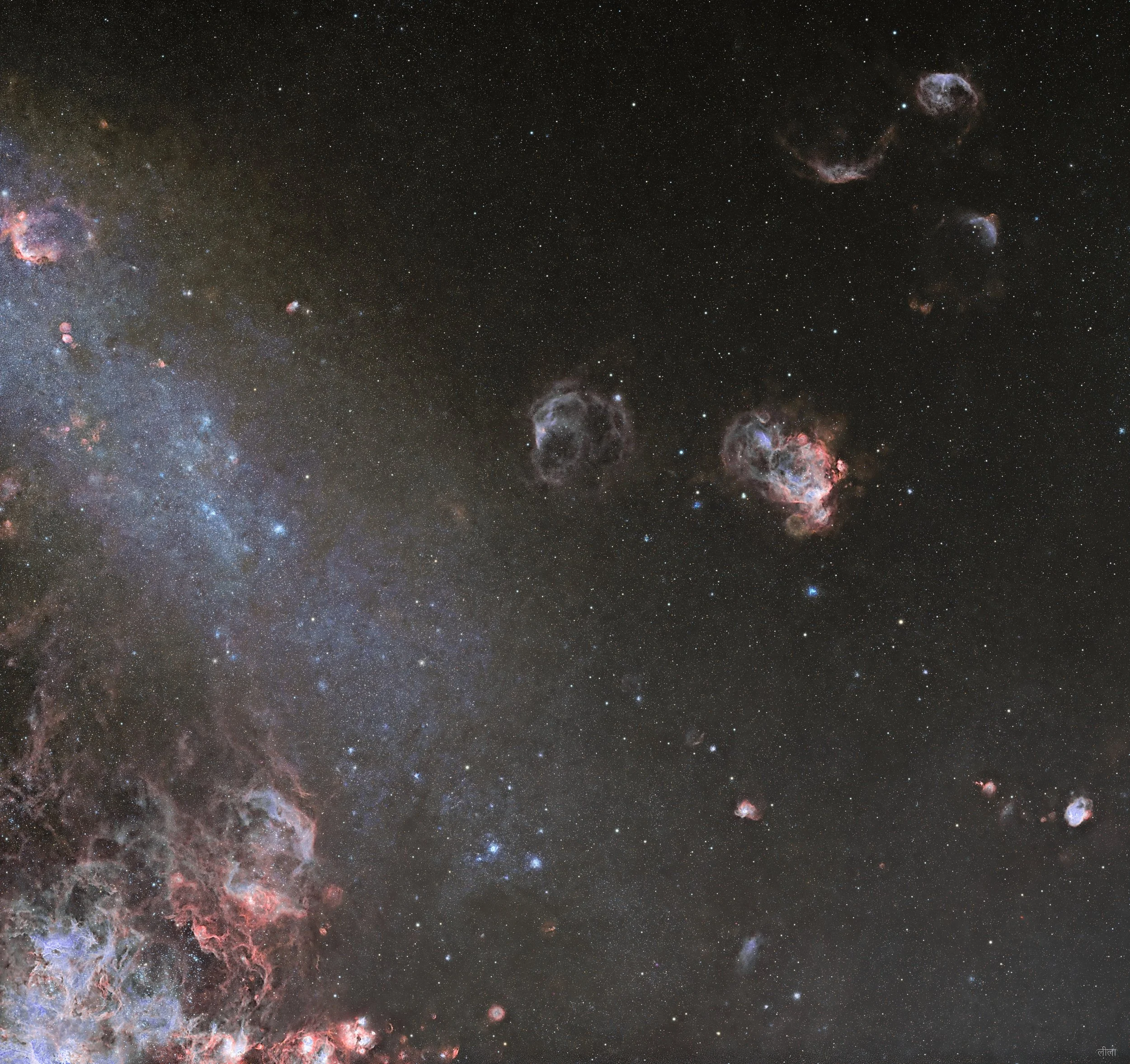
The Other Bank - NGC2018, N206 Complex & the Large Magellanic Cloud | Constellation Dorado | RGBHSO
Every river has two banks. One holds the crowd — the grand structures, the famous views, the hullabaloo of the spectacular and the celebrated. Safety in numbers. The known quantity. The place where the maps are detailed and the paths are worn smooth by everyone who came before.
The other bank is different. Quieter, yes — but not merely quieter. Sparser. More exposed. Requiring something of whoever finds themselves there: a willingness to have left the crowd behind, or an inability to have stayed with it, which from the outside can look like the same thing. Here be monsters, the old cartographers wrote, at the edges of what they knew. Here be ghosts. Here be madmen. They meant: here be the unmapped. Here be what we haven't decided to look at yet.
The Large Magellanic Cloud — our nearest galactic neighbour, 160,000 light years away — is usually encountered at its most dramatic: the Tarantula Nebula, the sites of recent supernovae, the most violent star formation in the Local Group. The lower left of this frame carries the faintest suggestion of that world, the top edge of the Tarantula complex just visible, already receding. The rest of the image belongs to the other bank — the quieter reaches of the LMC where the clusters are smaller, the nebulae less celebrated, and the sky between them darker. To look here requires turning your back to the crowd. Most people don't.
On this bank: nomads and lost children. Castaways. The Hen objects — HII regions catalogued with the quiet anonymity of the truly numerous — glow in pinks and reds, each its own small drama, each easy to overlook in a galaxy that contains so many thousands like them. The clusters NGC 2010, 2031, 2051, 1987 — present, catalogued, largely unstudied, the background population of the far bank going about their long business.
And then NGC 2018, floating free of the main body entirely — a young stellar cluster wrapped in its own glowing shell, luminous and self-contained, oriented outward. It recalls Kubrick's Star Child: something newly formed and already complete, facing a direction that has no name yet. Among the lost and the drifting, it is something else — one of the few who chose the path less travelled, or who were born already facing the right way. The Star Child does not look back at the crowded bank. It has already moved on to whatever question comes next.
And finally, the structure with no name. A wispy circular form, its three-armed symmetry recalling a triskele — one of the oldest symbols in human culture, carved into stone at Newgrange five thousand years before telescopes existed — suggesting cycles, continuity, triple motion. But it could equally be a mask formed in candlesmoke, a face glimpsed in the moment before it dissolves, a kabuki ghost assembled from nothing and returning to nothing between one breath and the next. It has no catalogue designation. It may be the fading echo of a star that died in another galaxy before our ancestors learned to write. The literature is silent on it. It simply exists, on the far bank, unnamed and unaccounted for, as things do when no one has yet decided what to call them.
To go find new things, new places, new insights — one must turn their back to the crowds and wander in the parts unknown. The far bank has always been where that wandering leads. It is not comfortable. It is not safe. But it is where the unnamed things are, waiting with the patience of objects that do not know they are being looked for.
25 hours 50 minutes integration | Kagga Kamma Remote Observatory | Bortle 1 | TeleVue 76 running at f5
Available as:— Metal print — the recommended format for this image. — Acrylic print — exceptional depth and colour saturation— Fine art paper — archival giclée, satin or matte finish
Sizes from 12" to 40" on the long edge. Made to order.

So dawn goes down to day.
Nothing gold can stay.
— R.F.
A Forest in Autumn - NGC292, the Small Magellanic Cloud | Constellation Tucana | RGBHSO
Island forests have a different character from continental ones. Shaped by winds that roll in off open oceans, buffeted by weather that has built up over thousands of miles of uninterrupted water, they grow differently — lower in exposed places, denser in sheltered ones, the trees huddling in thickets where the land offers some protection. They maintain their dignity. The forest is still a forest. But it has been made by forces larger than itself, and carries that making in every bent branch and turned trunk.
Two hundred thousand light years away in the constellation Tucana, the Small Magellanic Cloud is such a forest — a dwarf irregular galaxy, companion to the Milky Way, shaped by gravitational winds from forces far more powerful than itself. The Milky Way, the Large Magellanic Cloud — both have been pulling at it across intergalactic space for billions of years, distorting its form, drawing material away through the Magellanic Bridge, a stream of gas already flowing outward like leaves lifted from a canopy by a wind the forest cannot resist. There is even scientific debate about whether the SMC is truly bound to us at all — its velocity may be too high for permanent orbit, making it not a companion galaxy but a visitor, an island being blown through on currents too forceful to tame.
This image does not chase any single object within it. Instead it tries to show the texture of the whole — the way the forest and its canopy thicken and thin. The clusters and nebulae distributed through it like thickets here and there. The stars glimpsed through canopy of varying density, forming bridges between the thickets. The golden-yellow HII bubbles glowing among deeper reds and burgundies like embers still holding warmth.
And it was here, in this same island, that Henrietta Leavitt in 1908 discovered the relationship between the brightness and period of Cepheid variable stars that gave us the means to measure the universe. The SMC, small and buffeted and possibly just passing through, turned out to contain the key to cosmic distance. The island forest held the ruler that allows us to measure oceans.
36 hours 30 minutes integration | Kagga Kamma Remote Observatory | Bortle 1 | TeleVue 76 running at f5
Available as:— Metal print — the recommended format for this image. — Acrylic print — exceptional depth and colour saturation— Fine art paper — archival giclée, satin or matte finish
Sizes from 12" to 40" on the long edge. Made to order.

A Doppelganger - NGC6744 | Constellation Pavo | RGBH
Some things do not need to announce themselves. They simply are what they are, without apology or performance — and the quality of their presence is felt precisely because they have no need for recognition from you.
The IFN — the interstellar cirrus of our own Milky Way — lays down the setting first. Grey-blue velvet, deep and textured, sweeping across the field in broad lanes and finer filaments, a few hundred light years away at most, closer to us than the nearest star-forming regions. On this cushion, presented without fanfare, sits NGC 6744. A barred spiral galaxy thirty million light years away in the constellation Pavo — the Peacock — its arms open and unhurried, its warm core surrounded by the blue of young star clusters forming along the spiral structure. It is larger than our own Milky Way, spanning 175,000 light years, and it is one of the most Milky Way-like galaxies known — the same flocculent, loosely wound arms, a similar relationship with a companion irregular dwarf galaxy NGC 6744A that echoes our own arrangement with the Magellanic Clouds.
There is something quietly vertiginous about this. To look at NGC 6744 is to see something that resembles home, from the outside, from thirty million light years away. The structure is familiar. The proportions are familiar. What it would feel like to be inside it — to look out from one of its spiral arms at the surrounding universe — would presumably feel very much like what we feel when we look out from ours. We are looking at a version of ourselves we can never visit, never inhabit, can only observe.
Around it, the field is not empty. ESO 104-44, a low surface brightness galaxy, reveals itself here only because of depth and darkness and patience — the kind of object that simply does not exist in a quick image, appearing in this one as a quiet presence that had been there all along, waiting to be seen. LEDA 320569, with its intriguing ring around the core, carries its own unexamined story — the literature is largely silent on it, its ring structure unexplained, another object on the far bank going about its business without having been formally introduced.
The whole field has this quality. Not fanfare. Not cataclysm. Simple beauty that is confident in its own skin, present without needing to perform its presence, glowing softly on its velvet cushion thirty million light years away, indifferent to whether anyone is looking.
27 hours 50 minutes integration | Kagga Kamma Remote Observatory | Bortle 1 | TeleVue 76 running at f5
Available as:— Metal print — the recommended format for this image. — Acrylic print — exceptional depth and colour saturation— Fine art paper — archival giclée, satin or matte finish
Sizes from 12" to 40" on the long edge. Made to order.
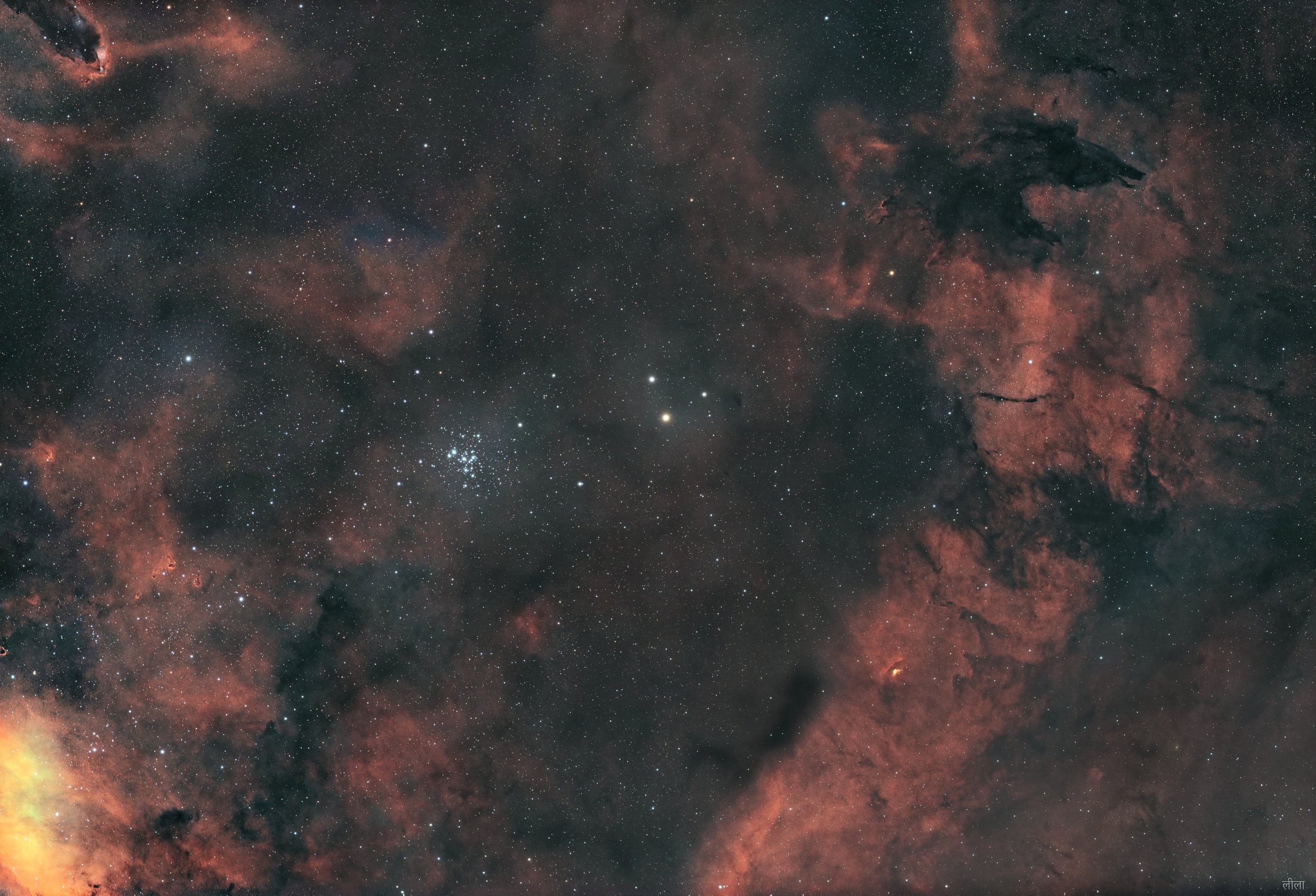
The Firelight and the Wolf — RCW 113, Gum 55 and NGC 6231 | Constellation Scorpius | RGBHSO
Before cities, before walls, before the idea of inside and outside had been fully separated from the raw fact of darkness — there was fire. A clearing. A circle of warmth in the cold, and beyond the warmth, the night. Our ancestors sat in that circle for hundreds of thousands of years, watching the shapes at the edge of the light, and feeling, somewhere between the fire and the darkness, the pull of both. The sky above them contained this same setting, and the same tension.
At the lower left, the fire — the edge of the great Prawn Nebula, its amber and terracotta glow the colour of embers seen through smoke, old and established, its warmth spreading outward into the surrounding dark. Around it, the emission regions of RCW 113 and Gum 55 carry that light further, the amber haze of a fire seen from a distance, reaching across the field.
And in the middle ground, drawn toward it — NGC 6231. A young open cluster of brilliant blue-white stars, only three million years old, newly formed, not yet settled into whatever it will become. Five thousand six hundred light years away in Scorpius, it sits between the fire and the darkness, pulled in both directions simultaneously — toward the warmth and safety of the light behind it, and toward the shapes at the edge ahead. It has been drawing human eyes since at least 1654, when Giovanni Hodierna first recorded it. Even then, something in us recognised the youngsters gathered in the middle ground.
Because at the edge of the firelight, kept back but not gone — Sandqvist 17. The Dark Wolf. Named for Fenrir, the great wolf of Norse mythology, bound at the edge of existence by forces that knew it could not be destroyed, only contained. It circles in the upper reaches of the frame, its dark mass prowling and watching, lit just enough by the fire to be visible — which is almost worse than complete darkness. You cannot see what is beyond it. You can only see that something is there.
Further out, at the margins where the firelight thins to almost nothing, other shapes persist. The Dark Tower to the upper left — another great pillar of cold molecular gas, ancient and indifferent. Things that are not quite in the story but are not quite outside it either. The kinds of shapes that make the youngsters around the fire feel the pull more acutely — not away from the dark, but toward it. The adventure that the safety of the fire makes possible to imagine, and the dark makes terrifying to attempt.
This is what our ancestors felt in the darkness. Not these objects — they could not have known what they were looking at. But this feeling. The fire behind. The shapes ahead. The youngsters in between, not yet knowing which way they will go.
Some went toward the fire. Some walked into the dark. Most, probably, spent a long time in the middle ground, feeling both.
30 hours 50 minutes integration | Kagga Kamma Remote Observatory | Bortle 1 | TeleVue 76 running at f5
Available as:— Metal print — the recommended format for this image. — Acrylic print — exceptional depth and colour saturation— Fine art paper — archival giclée, satin or matte finish
Sizes from 12" to 40" on the long edge. Made to order.
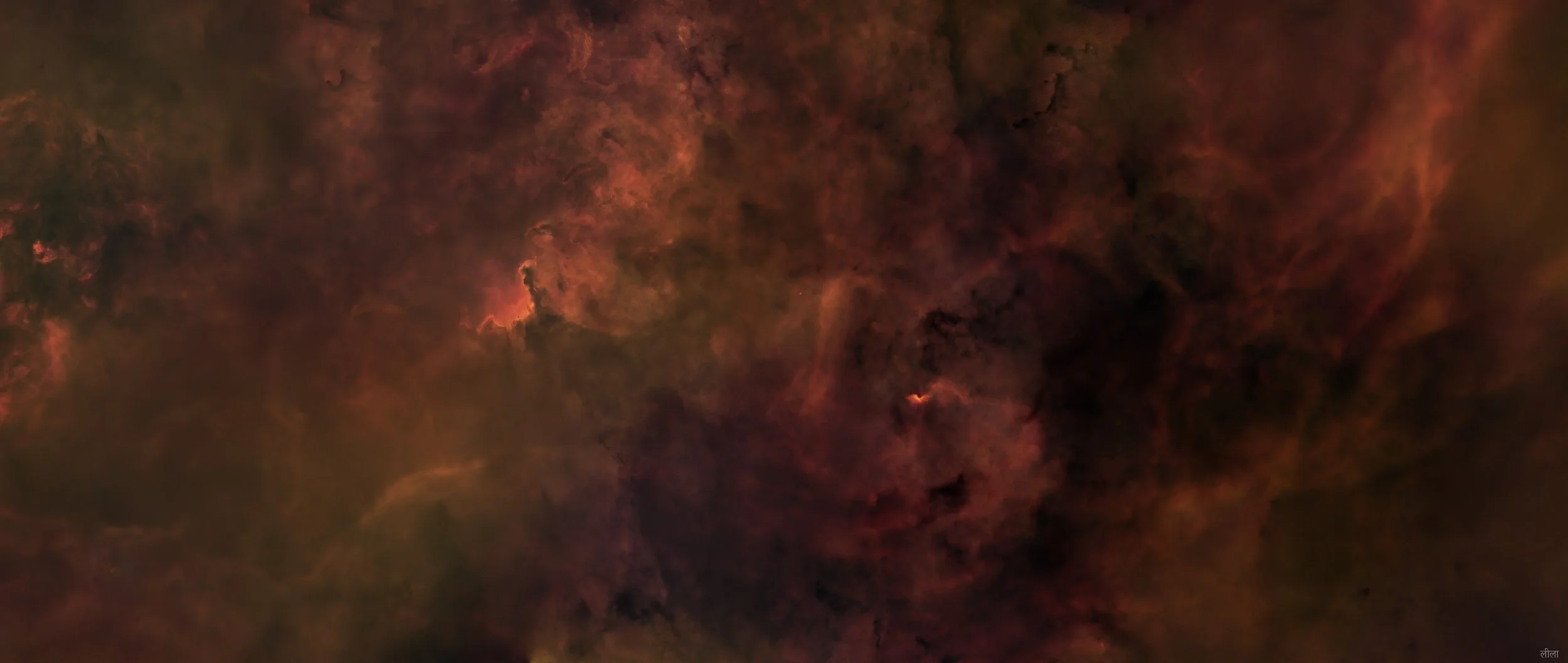
The Forge — RCW 75, Ced 122 and Stock 16 | Constellation Centaurus | RGBHSO
A forge is never still. The heat, the pressure, the material being worked — all of it in constant motion, the shape of the thing emerging slowly from the violence of the process. You cannot rush it. You can only maintain the conditions and wait for what the work produces.
Six thousand five hundred light years away in Centaurus, the forge has been burning for millions of years. RCW 75 is a vast emission nebula — hydrogen and sulphur ionised by the young open cluster Stock 16, its hot massive stars pouring ultraviolet radiation into the surrounding gas, heating it, driving it, sculpting the dark molecular clouds into the forms visible here. Those clouds are not passive. They push back, compress, collapse inward under the pressure — and in collapsing, form new stars, which in turn ionise more gas, which drives more collapse. The forge feeds itself.
The work has already gone through several shifts. A previous generation of massive stars — now dispersed, their individual identities lost in the wider field — hammered the great elephant trunk at the heart of the complex into implosion. That implosion triggered what you see now: the current generation of star formation, the present roar of the forge, the material being worked into the next thing. And along the ionisation-bound edge of the complex, the dense dust clouds where the next generation will form are already accumulating, already feeling the pressure. The blacksmith is always working ahead.
In the midst of all this — two small planetary nebulae, Th 2-A and Wray 17-60, the end products of previous stellar lives cooling in the corner of the workshop. Around them the forge roars on, indifferent to what has already been made, entirely focused on what is being made now.
The starless version of this image — stripped of the individual points of light that locate and orient the eye — shows the forge most purely. What remains is atmosphere, pressure, heat rendered in crimson and burnt umber and deep shadow. The material being worked. The conditions being maintained. The process, continuing without pause, as it has for millions of years and will for millions more.
No one commissioned this work. No one is waiting for the finished piece. The forge burns because the conditions for burning exist, and because burning is what forges do.
41 hours 32 minutes integration | Kagga Kamma Remote Observatory | Bortle 1 | TeleVue 76 running at f5
Available as:— Metal print — the recommended format for this image. — Acrylic print — exceptional depth and colour saturation— Fine art paper — archival giclée, satin or matte finish
Sizes from 12" to 40" on the long edge. Made to order.
prints
Filters
No results found
No results match your search. Try removing a few filters.